Get Full Government Meeting Transcripts, Videos, & Alerts Forever!
Get email alerts on the Elevate Florida Mitigation Program topic
No spam. Unsubscribe anytime.
Elevate Florida program, $400M in mitigation funds, explained at Port Richey City workshop
Summary
Michael Scott of Elevate Florida described eligibility, 75/25 cost share, project types and timeline for a new residential mitigation program funded by FEMA and a "swift current" grant; residents raised questions about costs, insurance and application portal access.
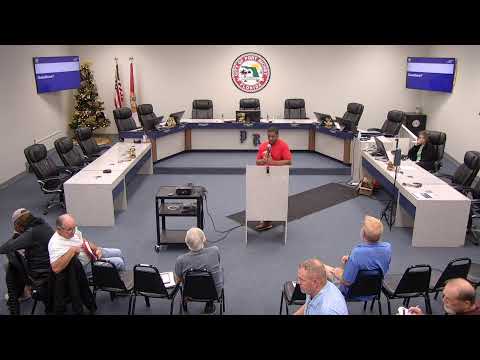
Michael Scott, constituent services manager for Elevate Florida, gave a community presentation in Port Richey City explaining the state's new Elevate Florida residential mitigation program and how homeowners can apply for elevating or rebuilding flood-prone homes. The program, Scott said, is funded by a combination of FEMA hazard mitigation funds and what he described as "swift current grant funding," and currently has $400,000,000 allocated.
The program aims to reduce future hurricane- and flood-related damage by providing a government-managed project-management approach and financial assistance that covers 75 percent of mitigation construction costs, with homeowners responsible for a 25 percent cost share. "We're not looking to dupe anybody," Scott told attendees. "By the time you get to that point in the process, you will be made aware of how much those costs are gonna be, and then you'll decide whether or not this program is gonna work for you."
Scott said eligible property types include single-family homes, multifamily structures, duplexes, townhouses, semi-detached apartments, and mobile and manufactured homes. Properties owned by an LLC or other business entity are not eligible; the property must be owned by an individual. For attached buildings such as condos or townhomes with shared ownership, Scott said all owners must apply and agree to proceed together; a single owner dissenting would block that building from participating.
Program project types Scott described are: structural elevation (raising an existing building to at least one foot above the base flood elevation), mitigation reconstruction (demolish and rebuild when a structure cannot safely be elevated), acquisition-demolition (local government acquires and maintains the lot as open space), and limited roof- and shutter-strengthening measures. Scott said mitigation reconstruction carries a construction cost cap of $220,000 under the program; anything above that cap would be the homeowner's responsibility. For structural elevation the 75/25 split is not capped, he said.
Scott walked through a staged application process. Stage 1 is application submission and document collection. Stage 2 is application review and inspections; applicants must sign a pre-mitigation agreement and pay the initial 25 percent cost share for inspectors and assessments before inspections occur. Scott warned that signing the pre-mitigation agreement and paying that initial share makes an applicant a program participant and that withdrawing after inspections could leave the applicant responsible for inspection costs. Stage 3 is the FEMA determination and award of an estimated construction cost share; Stage 4 covers construction, temporary relocation and closeout. Scott said no construction was underway for any applicants at the time of the presentation.
Scott outlined documents applicants should gather: photos, insurance declaration pages, elevation certificates, geotechnical (soil) reports, flood photos, insurance claim records, and any local substantial-damage declarations. He said missing documents are not disqualifying; Elevate Florida will procure required inspections and assessments as part of the application process.
On insurance, Scott said awardees will be required by FEMA to maintain a National Flood Insurance Program (NFIP) policy for the life of the property after mitigation. He explained reduced or waived homeowner cost shares may be available for properties with documented repetitive-loss or severe repetitive-loss histories under NFIP criteria (for example, two or more paid losses >$1,000 in a 10-year period or four or more payments with cumulative thresholds described by NFIP).
Residents asked about likely construction costs, whether second homes qualify, how the program handles townhomes, portal access and contact with assigned case managers, and whether homeowners can live on-site (for example, in an RV) during construction. Scott said he could not provide definitive cost estimates because contractors had not been procured; he warned that elevation often is a six-figure project but emphasized that the program will run a public competitive procurement and seek competitive prices. He confirmed second homes owned by individuals may be eligible but said a forthcoming scoring system may prioritize primary residences because demand will likely exceed available funding.
Scott acknowledged technical and procedural concerns raised by attendees: user problems with the application portal, difficulty reaching case managers, potential local permitting and zoning conflicts (height restrictions), and risks of incurring municipal penalties or permit expiration if projects extend over local time limits. He said Elevate Florida staff will work with local governments and take community feedback to the state's Bureau of Mitigation, but that specific local waivers or fee relief would depend on city or county decisions.
Scott closed by reminding attendees they will be assigned a case manager, that the program is intended to provide a government-managed project-management service (inspectors, engineers and general contractors procured by DEM), and that contact information appears on handouts and is available by email at info@elevatefl.org and a toll-free number attendees cited (877-353-8835).