Get Full Government Meeting Transcripts, Videos, & Alerts Forever!
Get email alerts on the State Legislative Update topic
No spam. Unsubscribe anytime.
City legislative liaison outlines budget pressure, local priorities and floodplain grant push
Summary
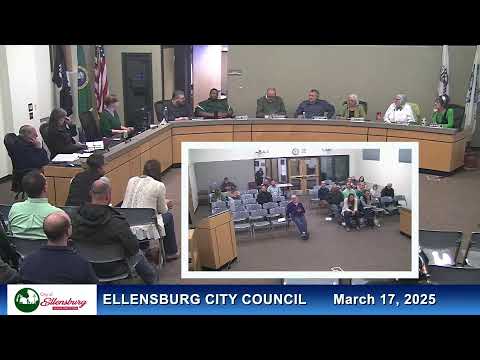
Josh Weiss gave a state legislative update to the Ellensburg City Council, saying the Legislature is shifting from bill hearings to heavy budget decisions and noting that the city is pushing for Floodplains by Design funding and monitoring public safety grants and preemption bills.
Josh Weiss, identified in the agenda as the presenter for a state legislative session update, told the Ellensburg City Council that the Legislature is moving from bill-level hearings to budget negotiations with roughly 41 days left in the 105‑day session.
Weiss said the state’s revenue forecast will guide the biennial operating and transportation budgets and that leaders are already weighing deep reductions and potential revenue measures. “All reductions budget proposal to build the case for additional revenue,” he said, summarizing the political dynamic between the governor’s proposals and Democratic negotiators.
The update focused on topics of direct local interest. Weiss told the council the city’s delegation is working to preserve funding for a Floodplains by Design acquisition west of town and that the Floodplains by Design capital program is one the city hopes the Legislature will protect from deep cuts. He said staff also submitted a jurisdictional proviso for the Mountain View tennis courts and that legislation to permit smaller public facility districts did not advance past cutoff.
Weiss described two areas of active interest statewide: additional grant funding and local options for public safety funding and preemption bills that could affect local regulations. He said there were competing House and Senate approaches to grant $100 million in public safety grants and to enable local options to raise funds for law enforcement. Weiss also said the city had weighed in against bills to preempt local parking requirements for residential projects and against any legislation that would remove local management rights to set rules on the use of artificial intelligence in bargaining with unions.
Council members asked about fiscal notes — agency estimates of a bill’s budget effect — and Weiss described the process, the role of state agency and local government fiscal note offices, and the uncertainty in many fiscal estimates. He noted the city is monitoring flexibility in state pass‑through accounts such as the Public Works Assistance Account and the Municipal Criminal Justice Account, which could be swept during major budget cuts.
Why it matters: the presentation framed how state revenue constraints could reshape projects and capital grants the city is pursuing, and set expectations that the council’s priorities (floodplain acquisition, local recreation projects) rely on outcomes in the coming budget negotiations.