Get Full Government Meeting Transcripts, Videos, & Alerts Forever!
Get email alerts on the Regional Transportation Plan topic
No spam. Unsubscribe anytime.
Thurston Regional Planning Council outlines 25-year transportation plan, flags Yelm projects and resilience gaps
Summary
Lisonbee Osterberg, planning manager at the Thurston Regional Planning Council, told the Yelm Planning Commission that the council’s draft Regional Transportation Plan (RTP), called “What Moves You,” looks out to 2050, projects rapid regional growth and lists major projects and policy targets affecting Yelm including the Yelm Loop; the draft will be released for public review at the end of the month with a public comment period through April–May and a July adoption target.
Lisonbee Osterberg, planning manager at the Thurston Regional Planning Council, told the Yelm Planning Commission that the council’s draft Regional Transportation Plan (RTP), called “What Moves You,” looks out to 2050, projects rapid population and housing growth across the region, and lists major projects and policy goals that local jurisdictions should use when updating their transportation elements.
The RTP matters because projects must be listed in the regional plan to be eligible for many federal and state transportation funds, and the plan must be consistent with local comprehensive plans under state law. Osterberg said the draft will be released for public review at the end of the month, with a public comment period through April and May and an adoption target in July.
Osterberg said the region is growing quickly and that the RTP is a high-level, financially constrained roadmap of projects, modes and targets the region will track. “No surprise to folks in Yelm, our region is growing very, very quickly,” she said. She described a modeling process that shows what the system will look like with currently funded projects and with the full list of projects the region hopes to fund.
Key figures and projects cited in the presentation include projections of large regional population and housing increases (Osterberg said the region will need tens of thousands of additional housing units), roughly 80 regional projects in the RTP, about 18 miles of new roadways, more than 65 miles of pedestrian facilities and 29 miles of new multi-use trails (the Curry Line Trail is included), and several realigned highway interchanges that are planned over the 25-year horizon. For Yelm specifically, Osterberg identified projects the RTP includes in regional modeling and recommendations: the Yelm Loop, Coats Avenue extension, Mossman Avenue and Tahoma Boulevard extension.
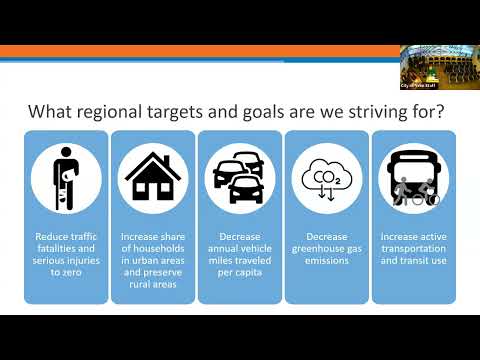
Osterberg said the RTP sets regional goals and targets—safety (a regional aspirational target of zero fatalities and serious injuries), reduced vehicle miles traveled per person, increased share of trips taken by transit/walking/biking, and greenhouse-gas reductions—and that current planned land use and roadway projects alone will not achieve all those targets. She said the RTP is financially constrained and that the next full RTP update in five years will incorporate the comprehensive-plan changes jurisdictions adopt this cycle.
Commissioners asked about how the RTP aligns with the city’s comprehensive-plan update, emergency detour and resilience planning, and coordination with Pierce County across the Nisqually River. Osterberg said the RTP’s timing is slightly out of phase with current local comprehensive-plan updates and that jurisdictions should use the RTP as a near-term snapshot while recognizing the next RTP update will re-incorporate updated local land-use decisions. On resilience, she said the council has identified a transportation-resilience strategy—spurred by the Amtrak derailment and related closures—that would address emergency detour routes and other hazards but that the project is identified as an unfunded need: “We have identified a project, but we don't have funding for it.”
Osterberg also described planned TRPC studies that will inform future projects, including a multimodal level-of-service effort, a freight mobility strategy, a regional safety action plan and bicycle-system studies. She said many RTP-listed projects are eligible for federal funding only if they are included in the RTP (and in the shorter-term Regional Transportation Improvement Program/TIP).
The commission did not take a formal vote on the RTP; Osterberg said TRPC will post the draft for public comment and that staff will circulate public-review notices when the draft is released.
Ending: TRPC asked local officials to review the draft RTP when it is released and to use the document in local comprehensive-plan consistency analyses; OSTerberg and TRPC staff offered to follow up on specific local questions raised by commissioners after the meeting.