Get Full Government Meeting Transcripts, Videos, & Alerts Forever!
Get email alerts on the Land Use Zoning topic
No spam. Unsubscribe anytime.
Pine County adopts broad zoning, septic and shoreland ordinance changes
Summary
Pine County on the record adopted Ordinance 2025-11, updating the county zoning ordinance, the subsurface sewage treatment systems ordinance and the shoreland management ordinance.
Pine County on the record adopted a package of ordinance changes Wednesday that revise the county zoning ordinance, the subsurface sewage treatment systems ordinance and the shoreland management ordinance.
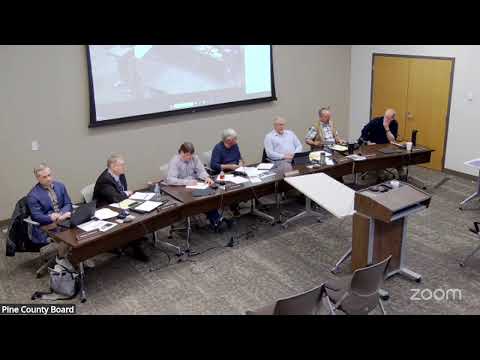
The move approved Ordinance 2025-11 after a public hearing and discussion. Commissioner Ludwig moved adoption; Commissioner Holland seconded the motion, and the board approved the ordinance by voice vote.
County auditor/treasurer Kelly Frauder presented the package, which the county’s planning commission reviewed and recommended in January. Frauder told the board the three ordinances were intended to align language across county rules and with state requirements and to clarify how several common situations will be handled. Key revisions include standardizing the vocabulary and permitting process for short-term rentals so non-shoreland areas are treated the same as shoreland areas; changing the county’s density zoning approach (parcels-per-40 rules) to avoid creating lots that break up tillable farm fields; and removing a long-standing local requirement that holding-tank sewage systems always include a water meter.
Frauder also described several shoreland-specific changes the county added to the shoreland management ordinance to allow townships greater flexibility: the new “water-oriented commercial residential” zoning district (added to the ordinance so townships may adopt similar districts), a new use table for that district, and a change to allow “office building” uses as a conditional use in the high-density residential district where a township requests it (Frauder cited Pekegama/Pakegama Township’s interest in repurposing an old sanatorium building). The shoreland update also revised the county’s agricultural feedlot section to mirror state statute — which, as Frauder said, does not allow new feedlots in shoreland areas — and directs existing feedlot regulation to the state rules.
The ordinance package incorporates language the Department of Natural Resources provided permitting owners of nonconforming shoreland structures to replace an existing dwelling with a new building that is not larger than the old one, so long as the replacement does not expand the nonconformity. Frauder said the change follows DNR guidance and aims to reduce the number of variance hearings required for modest, like-for-like replacements.
Frauder summarized other clarifications included in the three ordinances: short-term rentals will be permitted through an administrative permit with standardized rules (quiet hours, occupancy, pets, boats), townships that require an interim-use permit must have applicants secure the township permit before seeking the county administrative permit, and the shoreland ordinance will cross-reference the county septic rules rather than repeat them in two places.
During the public hearing, Mark Lambert of Sand Lake Resort in Windermere Township urged the board to support the water-oriented commercial residential language, saying it would help local redevelopment and resort operations. Frauder answered commissioners’ questions about how the density provisions treat parcels that straddle two 40-acre units and confirmed the new language clarifies counting in those cases.
After discussion the board voted to adopt Ordinance 2025-11. The ordinance passage was taken by voice vote; no opposing votes were recorded in the proceedings.
Implementation and next steps: Frauder told the board the zoning board had already recommended the changes and that the DNR has approved the shoreland language included in the package. Townships that have opted into the county zoning ordinance will be affected; townships that did not opt in keep their existing local rules.