Get Full Government Meeting Transcripts, Videos, & Alerts Forever!
Get email alerts on the Homestead Exemption topic
No spam. Unsubscribe anytime.
Augusta-Richmond County hears three options for local floating homestead exemption
Summary
Staff presented three cap options — CPI, housing price index and a flat 3.5% cap — for a local floating homestead exemption after Augusta opted out of House Bill 581; commissioners heard public calls to pause and calls to act, and staff said local documentation must be submitted to the General Assembly by March 24.
Administrator Allen opened a public information session on Augusta’s local homestead exemption process and said the county previously exercised its option to opt out of House Bill 581. “As you all know, Augusta decided to opt out of House Bill 581,” Administrator Allen said.
Chief Appraiser Scott Rountree reviewed three local options staff modeled as alternatives to the statewide floating homestead: an index tied to the Consumer Price Index (CPI), an index tied to a Housing Price Index (HPI), and a flat annual cap of 3.5 percent. “The indexes that we looked at for our floating homestead version locally were the consumer price index, a housing price index, and we also looked at some flat annual rates,” Rountree said. He summarized staff’s historical modeling: over about 30 years CPI averaged roughly 2.5 percent, the local HPI averaged about 3.36 percent (4.6 percent nationwide), and a flat 3.5 percent cap produced the least volatile long-term tax-shift in staff’s scenarios.
Rountree told the commission staff estimates show average tax-shift outcomes under the three approaches of about 3.9 percent (HPI), 2.36 percent (CPI) and 1.59 percent (3.5% flat). He also said a 2 percent cap would have produced just over $1,000,000 in exemptions in the county in one hypothetical year.
Staff emphasized that any local option would not change overall county revenue calculations for the rollback tax rate; instead, exempted homestead valuation increases would shift tax burden to non-homestead property owners unless the county adopted an offsetting local option sales tax (a “FLOS” under HB 581). Administrator Allen said all three options the staff presented would meet the state’s “adjusted base year” requirement and therefore would be eligible to seek a FLOS referendum.
Public commenters and commissioners voiced differing views. Sue Parr, representing the Augusta Metro Chamber, urged caution and asked the commission to “put a pause on this and continue to study it,” arguing the business community and nearly half of residents without homesteads could face cost shifts if exemptions expand. By contrast, former commissioner Moses Todd, who represents Isle of Augusta Inc., urged the commission to choose an option now and move forward, saying a floating cap helps prospective homeowners with mortgage affordability.
Commissioner Stacy Pulliam asked staff to clarify the practical effect for individual homeowners, and Rountree replied that the cap limits annual taxable-value growth — for example, a 3.5 percent cap would limit a homestead’s taxable-value increase to 3.5 percent in a year, with any amount above that exempted. Rountree cautioned the net tax savings for a homeowner also depends on future millage-rate changes: “It’s dependent on how much the property value increases,” he said. “If it goes up 4 percent, it’d be a negligible savings. If it goes up 20 percent, it would be a significant savings.”
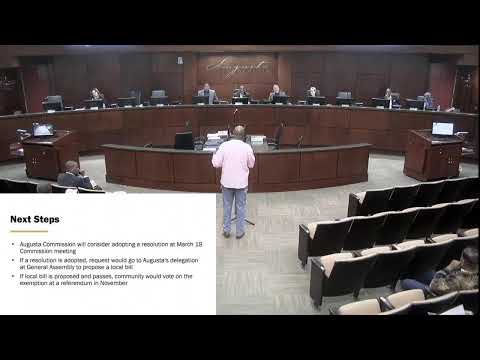
Staff identified next steps and a timeline: if the commission approves a local option to pursue, staff must submit required documentation to the Georgia General Assembly by March 24 and complete a local advertisement process this week. Administrator Allen warned the General Assembly can alter or override local submissions. The commission did not take a formal vote during the public information session; Administrator Allen said the Augusta Commission will consider adopting a resolution at its commission meeting later the same day to advance a local bill and, if a local bill is proposed and passes, Richmond County voters would decide the exemption in a November referendum.
The session closed after additional public comments and staff thank-yous. The commission’s formal action — if any — was scheduled for its commission meeting later that day.