Get Full Government Meeting Transcripts, Videos, & Alerts Forever!
Get email alerts on the Utilities Wastewater topic
No spam. Unsubscribe anytime.
Sioux Falls advances first reading for wastewater system capacity charge; public comment supportive
Summary
Council set an April 1 date for the second reading of an ordinance to replace acreage-based cost-recovery fees with a meter-size-based system capacity charge (SCC); staff said the change would shift some expansion costs to developers over a 10-year transition and eliminate cost recovery fees after 2028.
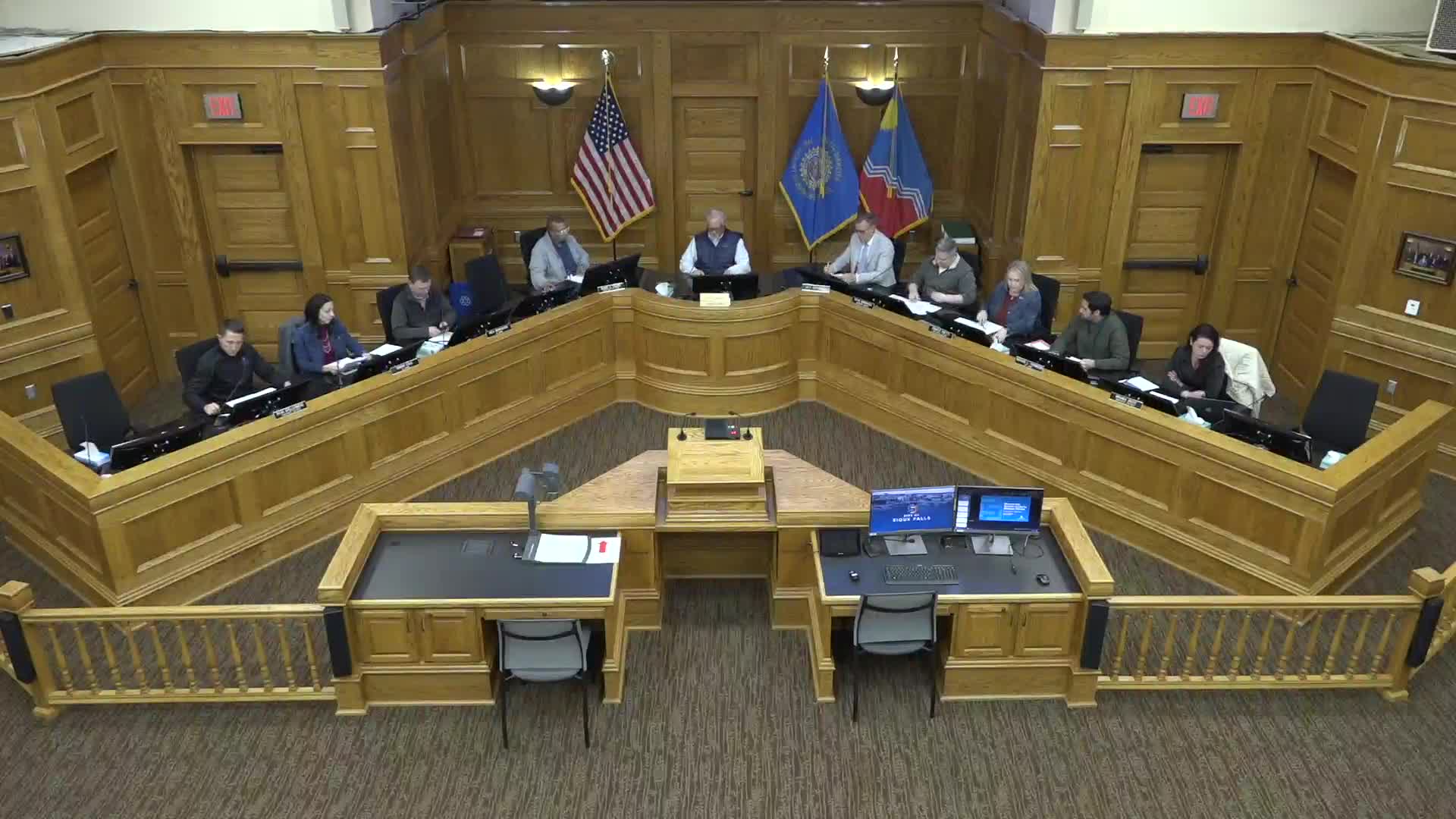
The Sioux Falls City Council on March 11 set a second reading for April 1 on a first-reading ordinance to establish a wastewater system capacity charge (SCC) that would replace the city's acreage-based cost recovery fees.
Public Works Director Mark Cotter and Ryan Johnson, utility administrator, presented the proposal to charge a one-time SCC based on water meter size when a meter is purchased, rather than the current cost recovery fee collected at platting and based on land area. Johnson said the SCC is intended to create a clearer nexus between capacity requested by a development and the fee charged.
"We're proposing to do that by shifting from a cost recovery fee, which is based on area and paid at planning, and shift that to an SCC model, which is collected when the water meter is purchased from the city," Cotter said. Johnson added the proposal would be implemented over a 10-year transition and that all cost recovery fees would be eliminated after 2028 as the SCC takes effect.
Staff described the policy goals as stabilizing utility customer rates, making charges equitable based on capacity, and scaling funding for long-term growth across multiple basins. The presentation estimated that once fully implemented the revenue mix would shift from roughly 95% utility ratepayers and 5% cost recovery fees to about 90% from ratepayers and 10% from SCCs, and cited an illustrative annual shift in funding on the order of millions of dollars (presentation estimate: approximately $3,500,000 annually) to be borne by those expanding system capacity.
Johnson said the SCC would have local and regional components; the regional SCC already exists by ordinance and would now be charged to new customers expanding the system. The proposed SCC schedule covers the most common meter sizes and does not include the cost of the meter or installation, which staff said ranges roughly from $200 for smaller meters up to about $900 for a 2-inch meter.
Staff reported outreach to more than 40 stakeholders across development, home building, housing finance and government sectors, and said both the Infrastructure Review Advisory Board (IRAB) and Affordable Housing Authority (AHA) boards voted to recommend the proposal. Mike Gray of the Sioux Falls Development Foundation spoke in support at the council meeting.
Council members asked about transition fairness for projects already under way. Johnson said staff had worked with a developer who raised four detailed questions and that, after follow up, staff were comfortable proceeding. The Home Builders Association planned to discuss the proposal at its board meeting on March 19 and staff expected a resolution of support to be available for the April 1 second reading.
The council voted 8-0 to set the second reading for Tuesday, April 1.