Get Full Government Meeting Transcripts, Videos, & Alerts Forever!
Get email alerts on the Demolition Tax Affordable Housing topic
No spam. Unsubscribe anytime.
Montgomery County residents, builders clash at public hearing over proposed $20,000 demolition tax
Summary
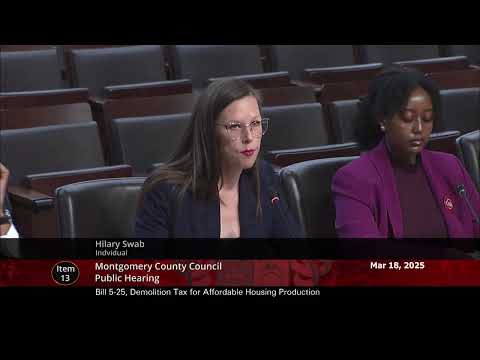
Montgomery County Council held a public hearing on Bill 5-25, a proposed excise tax on certain demolitions and renovations of single-family homes intended to generate revenue for affordable housing programs.
Montgomery County Council held a public hearing on Bill 5-25, a proposed excise tax on certain demolitions and renovations of single-family homes intended to generate revenue for affordable housing programs.
Supporters told the council the tax would fund the County’s Housing Production Fund (HPF) and help produce permanently affordable housing. Rohit Khanna, a member of the Somerset Town Council, said the HPF is “a very efficient model to finance and develop publicly owned, self sustaining, mixed income, good quality and permanently affordable housing,” and urged the council to consider combining demolition-tax revenue with additional appropriations to deliver more units.
The bill matters because demolition of older, smaller homes and replacement with larger, higher-priced homes is one mechanism that can reduce affordable housing supply and increase school enrollments in certain clusters, witnesses said. Advocates argued a dedicated revenue stream would allow the HPF to leverage public funds to produce mixed‑income housing.
Supporters and opponents offered sharply different forecasts about the tax’s effects. Julie Greenberg, a 35‑year Somerset resident, called the HPF “a resounding success” and endorsed Councilmember Mink’s proposal for a $20,000 excise as a fair way to direct funds from demolitions toward affordable housing. Aden (Eden) Aaron, a policy analyst at CASA, said the measure is “critical to prevent new development from driving up costs without creating affordable housing options,” noting concerns about displacement among CASA members.
Opponents representing builders and local home‑building trade groups said the tax could depress demolition permits and concentrate new construction in wealthier areas. Antonio Francis, owner of Francis Development and chair of the Montgomery County chapter’s custom home builders council, said the county already has seen “a significant 50% plus decrease in demo permits issued,” and warned a new $20,000 fee could further reduce rebuilds in parts of the county that cannot absorb that cost. Mimi Brodsky Kress, a longtime local builder, said, “The idea that the cost of a demolition permit would go from several hundred dollars instantly to $20,000 seems ludicrous,” and cautioned the tax could reduce infill building near transit.
Speakers also urged changes to how revenue would be allocated. One commenter referenced a 2019 proposal by Councilmember Glass that would have split similar fees between the Housing Production Fund and Montgomery County Public Schools (MCPS); several witnesses asked the council to consider sharing proceeds with MCPS to help cover enrollment impacts tied to redeveloped properties.
The council accepted in-person testimony from seven speakers and allowed the record to remain open for written submissions. The council’s staff notice stated written materials would be accepted through the close of business on 03/27/2025. The public hearing was later closed with no formal vote on the bill recorded at the meeting.
Key testimony excerpts: Khanna praised the HPF’s ability to leverage funds for permanently affordable housing; Greenberg urged more public emphasis and funding for the HPF; Francis and Kress warned the tax would reduce demolitions and new building; Aaron said the proposal would help protect low‑income and immigrant communities from displacement.
The council did not act on the bill at the hearing; members left the record open until the stated deadline for written submissions and closed the public hearing thereafter.