Get Full Government Meeting Transcripts, Videos, & Alerts Forever!
Get email alerts on the Public Housing topic
No spam. Unsubscribe anytime.
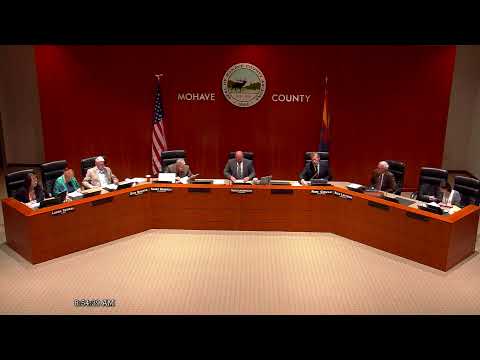
Mohave County Housing Authority adopts PHA plans, formalizes disability preference; director reports long waitlists
Summary
At its March 17 meeting the Mohave County Housing Authority board approved administrative changes and submissions of its annual and five‑year PHA plans, formalized a preference for applicants with disabilities, and heard Director Jeanne Smith report 562 vouchers in use and roughly a two‑year wait for housing rehabilitation grants.
The Mohave County Housing Authority board of directors on March 17, 2025, approved revisions to its administrative plan, adopted its annual and five‑year public housing agency (PHA) plans and certifications, and heard a director’s report that the authority currently manages 562 housing choice vouchers and serves about 688 people.
The administrative revisions included a formalized preference for “mainstream” applicants with disabilities in the agency’s points system, and the board approved updated owner‑occupied housing rehabilitation guidelines. The board also adopted Resolution 2025‑009 authorizing submission of the PHA plan documents and related certifications required for federal funding.
Why it matters: PHA plans and administrative policies determine how federal and state housing dollars are distributed locally. Formalizing a preference for applicants with disabilities changes the documented priority ranking used when allocating limited program slots and may affect who moves sooner from waiting lists into repairs or rental assistance.
Director Jeanne Smith summarized the authority’s programs and program size in a report to the board. “Currently, we have 562 vouchers, and approximately, we serve approximately 688 individuals and their families on these different programs,” Smith said, noting the authority does not own any housing stock and recently developed the Canyon Veteran Villas, which she said serves 47 veterans.
Smith said about 70% of people served by the housing authority are certified disabled. She described workforce and self‑sufficiency work, noting the family self‑sufficiency program includes 40 participants and that she believes 18 have graduated from that program; she said she would confirm and provide exact figures to the board by email.
On funding, Smith said most program dollars are federal funds administered through the Department of Housing and Urban Development and passed through to the authority. She said the county general fund contribution to community services is about $440,000 annually and that the department estimates large leveraged returns; she cited university study figures used in prior analyses but did not supply the underlying report at the meeting.
Jamie Brenier, housing revitalization manager, described the owner‑occupied rehabilitation intake and eligibility process for HOME and Community Development Block Grant (CDBG) funds. “We submit, we have an open waiting list, and applicants that are interested can submit an application to our grants coordinator, Becky Kessler, and she prequalifies the application based on 4 preferences,” Brenier said. She described the prequalification checks — age, income, deeded homeownership, Mohave County residency and FEMA map constraints — and said the authority currently operates an open waiting list with about a two‑year wait.
Brenier confirmed that veteran status is not a qualification factor for the HOME owner‑occupied rehab grants the authority described. She also said the authority shares inspection services with Bullhead City and Lake Havasu City when those cities lack an in‑house inspector.
Smith and Brenier discussed housing development tools the authority uses to attract partners. Smith corrected the meeting transcript’s informal name for a financing tool and identified the widely used program as the Low‑Income Housing Tax Credit (LIHTC) program, which pairs private developers, syndicators and state credit allocations to finance rental developments. Smith said Bullhead City recently saw two LIHTC projects with waiting lists open, and she said a separate state capital improvement financing opportunity is under application for a project that could bring hundreds of homes if awarded.
Smith also mentioned YouthBuild as an upcoming program the authority hopes to pursue; she said YouthBuild award amounts range from roughly $700,000 to $1.5 million and that the program trains youth in homebuilding trades.
The board opened a public hearing on County Housing Authority matters and received no public comment. Items approving revisions to Chapter 4 of the administrative plan, the annual and five‑year PHA plans, and the owner‑occupied rehabilitation guidelines were moved, seconded and approved by voice vote. The board then adopted Resolution 2025‑009 by voice vote to authorize submission of the PHA plans and certifications.
The meeting also included procedural business: the board appointed Borelli, Lettman and Martin to the housing authority board of directors and approved meeting minutes for April 1, June 3, and Sept. 3, 2024. Director Smith presented the financial report for April 2024 through March 2025; the report was received with no further action requested.
Director Smith said staff will provide the board with requested detailed breakdowns — including exact state funding amounts and program graduation counts — after the meeting. With no members of the public speaking during the call to the public, the board adjourned.