Get Full Government Meeting Transcripts, Videos, & Alerts Forever!
Get email alerts on the Zoning Light Business Amendments topic
No spam. Unsubscribe anytime.
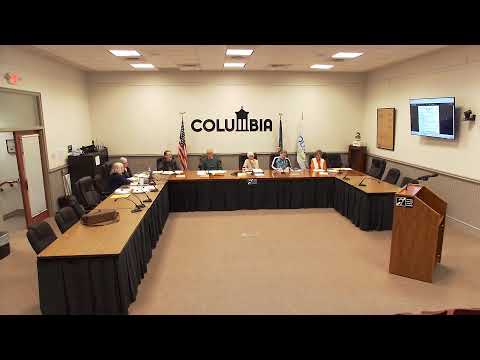
Columbia planning commission reviews light-business zoning edits, recommends removing airport language
Summary
At its March 18 workshop the Columbia Borough Planning Commission reviewed proposed amendments to the light-business zoning district that would remove language allowing continuation or expansion of an airport and would revise the table of permitted uses, setbacks and accessory-use rules.
Columbia Borough Planning Commission members on March 18 reviewed draft amendments to the borough’s light-business zoning district and its table of permitted uses and recommended removing a provision that currently allows continuation or expansion of an airport on properties in that district.
“Light business district. The description of that is to provide for a range of light commercial, institutional, and industrial uses in a manner that is compatible with adjacent homes, to also provide for continuation of the airport if desired by the property owner,” Mary (Planning Commission member) said, reading the current wording and urging that the airport clause be deleted.
The commission’s discussion centered on several recurring problems staff and commenters identified in the draft: inconsistent cross-references to Section 22030 (additional requirements for principal uses) and Section 22031 (accessory uses); uses listed in the table that lack implementing standards in the ordinance (warehousing, trucking terminals, hospitals); and a series of use-classification questions — for example, whether child day care should remain an accessory use or be allowed as a principal use in the light-business district.
Why it matters: Commissioners said the existing airport language and certain permitted uses could create conflicts with adjacent residential neighborhoods and might oblige the borough to defend uses that are no longer intended. They also flagged potential implementation gaps: the table of uses references standards in Section 22030 that, in several cases, are either absent or split between indoor and outdoor provisions.
Key recommendations and discussion points
- Remove airport reference: Multiple commissioners supported deleting the sentence that allows the “continuation of the airport” from the light-business district description and removing airports from the permitted-uses table. The commission agreed to make that a formal recommendation to council.
- Accessory uses and day care: Commissioners said child day care should remain permitted at minimum as an accessory use to benefit employees and nearby workers; one commissioner noted council had earlier directed changes in the opposite direction. The commission recorded a request to explicitly permit college/university support buildings, community centers/libraries and cultural centers as permitted uses rather than accessories where appropriate.
- Solar facilities and manufacturing definitions: Large solar-energy production facilities were flagged as currently referenced in multiple sections; commissioners said the drafting should clarify whether on-site solar for the property, accessory rooftop panels, and off-site energy-production (utility-scale) installations are treated differently. “Large solar energy production needs to go back to the memo,” a commissioner said, noting the current text treats solar in more than one place.
- Target ranges: The table lists “target range” but commissioners pointed out Section 22030 separately addresses outdoor and indoor ranges (outdoor standards for barriers and noise; indoor requirements for ventilation and enclosure). The commission recommended explicitly listing indoor target ranges as permitted (with safety and ventilation standards) and disallowing outdoor ranges in the district.
- Undefined or missing standards: Several permitted uses identified in the table — “transportation equipment,” warehousing, trucking terminals and hospitals — lack cross-referenced standards in Section 22030. Commissioners asked staff to either add definitions and standards or remove the uses from the table until standards are drafted.
- Setbacks, buffering and landscaping: Commissioners noted the ordinance already includes a 25-foot internal setback for industrial areas and a 40-foot setback where a building abuts residential property, but they recommended clearer buffering and tree/shrub landscape requirements along industrial-residential property lines. One member cited a West Hempfield ordinance change (published in legal notices) that replaces a 200-foot no-build restriction with a required landscape buffer adjacent to residential zoning as a possible model for stronger protection.
- Parking and impervious surface: A presenter at the meeting recommended revisiting the borough’s parking requirements so they reflect actual use rather than square footage alone; the speaker suggested options such as geotextile overflow parking (pervious) to reduce unnecessary impervious cover for businesses with low employee counts.
- Fencing and security: Commissioners raised concerns about tall security fences directly adjacent to residences and asked that the draft address maximum fence heights, screening and buffering for security fencing when proposed next to residential zones.
- Short-term rentals and ordinance organization: Commissioners clarified that short-term-rental rules remain in Chapter 220 (zoning) and are not being moved to Chapter 166; by contrast, the borough’s broader rental-property code is being consolidated from Chapter 112 into Chapter 166. The commission asked staff to correct status notes that inaccurately state items have gone to LCPC (Lancaster County Planning Commission), because several items have not been submitted there.
- Guinness tract and overall approach to zoning: A visitor who addressed the commission urged caution in over-prescribing permitted uses before soliciting buyers for a large tract (the “Guinness site”), recommending the borough identify absolute prohibitions and use special exceptions for uncertain uses so the district can remain flexible for future developers.
Votes at a glance
- Approval of Feb. 18 work-session minutes — voice approval; “aye” recorded; mover/second not specified in the record; outcome: approved.
- Motion to adjourn — motion by Ted (Planning Commission member), second by Deb (Planning Commission member); outcome: approved.
Next steps and context
Commissioners asked staff to draft specific language removing airport references from the light-business description and from the table of permitted uses, to add or correct cross-references to Section 22030 and 22031, and to draft clearer buffering, fence-height and parking guidance for the district. The commission also scheduled the topic for the public special meeting on Thursday, and staff said the meeting package is posted online under council agendas. A staff member said they will circulate a brief memo summarizing the March 18 discussion.
The planning commission’s review is procedural: no ordinance amendment was adopted at this workshop. Further changes will appear as formal recommendations or ordinance language for consideration at a future public meeting.