Get Full Government Meeting Transcripts, Videos, & Alerts Forever!
Get email alerts on the State Policy topic
No spam. Unsubscribe anytime.
Wisconsin Counties Association outlines priorities: court funding, mental health, transportation; flags Act 253 redaction issues
Summary
Mark O'Connell of the Wisconsin Counties Association told the Barron County Board the association is pressing the state for shared court funding, additional mental health support, and a long-term transportation revenue strategy; he also urged legislative clarification of Wisconsin Act 253 on video redaction and fees.
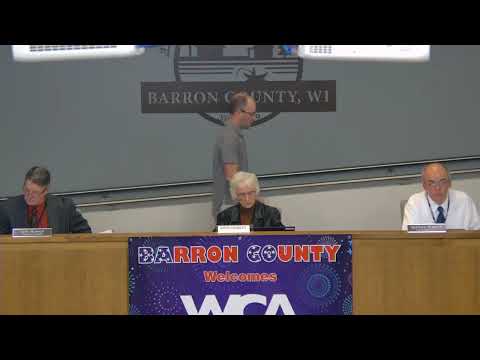
Mark O'Connell, president and CEO of the Wisconsin Counties Association, briefed the Barron County Board March 17 on the association's legislative agenda and on implementation issues from a law passed last year known as Act 253.
O'Connell told supervisors the association is seeking a closer funding partnership with the state for circuit courts and asked the legislature and governor to consider approximately $70 million to better share costs for the state court system. "We are looking for more of a shared relationship," O'Connell said, arguing that more state support should be provided through flexible circuit court support grants so counties can apply money where most needed.
On mental health, O'Connell said the association is requesting roughly $35 million from the state to help counties respond to rising needs across populations and geographies. He described the issue as multi-faceted and likely exacerbated by pandemic-related isolation and technological changes.
O'Connell also discussed transportation funding and the long-term unsustainability of the gas tax as vehicle fleets electrify. He urged counties and the state to begin exploring diversified revenue streams such as vehicle-miles-traveled approaches or tolling to ensure future infrastructure investment.
The association representative highlighted Wisconsin Act 253, which addresses public-records requests for law-enforcement video and allows redaction with certain exceptions. O'Connell cited two implementation problems: an unclear definition of "financial gain" for requesters and ambiguity about what counties may charge — whether for reproduction only or for staff time spent reviewing and redacting video. He warned that burdensome requests for video redaction can divert law-enforcement resources from public-safety duties and said the WCA seeks legislative clarification.
Board members asked about specific issues they had heard from constituents, including the placement of high‑risk 980 placements (post-release placements supervised by the state). O'Connell said he would check whether the association has active state-level measures addressing those placements.
O'Connell concluded by encouraging board members to contact the WCA for technical assistance and to engage local partners on state budget priorities; he said the association would continue to press the state for court funding, mental-health support and transportation revenue planning.
Key points - WCA request for shared court funding: roughly $70 million targeted to circuit court support grants that give counties local flexibility. - Mental-health ask: approximately $35 million to bolster county mental‑health services and supports. - Transportation: need to plan for alternatives to gas-tax revenues as vehicle fleets change. - Act 253 implementation: calls for clearer legislative guidance on "financial gain" and chargeable redaction work to avoid diverting law enforcement resources.