Get Full Government Meeting Transcripts, Videos, & Alerts Forever!
Get email alerts on the Daylight Saving Time topic
No spam. Unsubscribe anytime.
Alaska senators hear competing plans to end daylight saving time
Summary
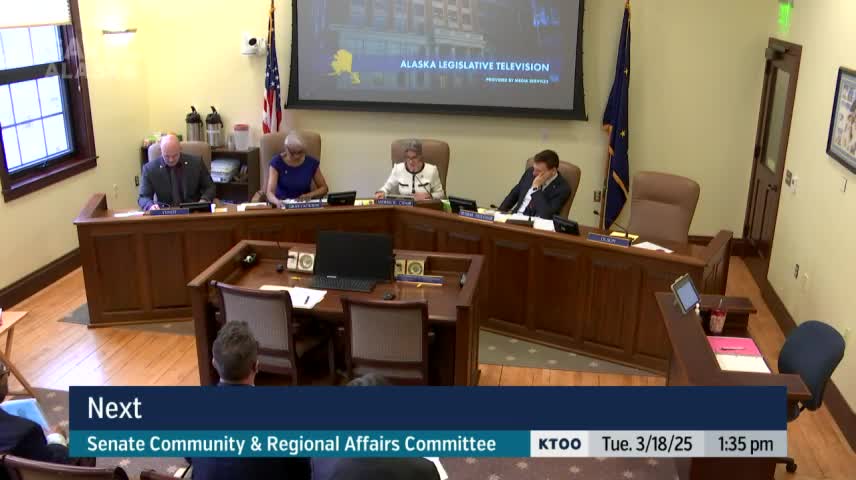
The Senate Community and Regional Affairs Committee on March 18, 2025, held first hearings on two competing bills that would end Alaska’s twice‑yearly clock change.
The Senate Community and Regional Affairs Committee on March 18, 2025, held first hearings on two competing bills that would end Alaska’s twice‑yearly clock change.
Senator Merrick, chair of the Senate Community and Regional Affairs Committee, opened the session and introduced Senate Bill 26, sponsored from his office. Carrie Crocker, staff to Senator Merrick, summarized the measure: “SB 26 aims to fix that … the bill would permanently ditch daylight savings time, meaning no more spring forward, no more falling back.”
The bill is structured in sections. Section 1 would exempt Alaska from daylight saving time by amending AS 44.12. Section 2 would direct the state legislature to formally petition the U.S. Department of Transportation under the Uniform Time Act of 1966 to move the entire state to Pacific Time. Section 3 makes the exemption from daylight saving time effective only if the Department of Transportation places the entire state in the Pacific time zone before Jan. 1, 2035; Section 4 makes the petition to DOT effective immediately on passage; and Section 5 ties the exemption’s effective date to the DOT action that places Alaska in Pacific Standard Time.
Separately, the committee heard Senate Bill 102 from Senator Scott Kawasaki, chair of the Senate State Affairs Committee. Joe Hayes, staff to Senator Kawasaki, told the committee his office circulated a constituent survey showing 75.6% preferred permanent standard time over permanent daylight time, 95.5% opposed changing clocks twice a year, and 97.7% supported eliminating daylight saving time.
An invited witness, JP (spelled J‑A‑Y P‑E‑A), president of the nonprofit Save Standard Time, urged the committee to reject SB26 and approve SB102. “Daylight saving time is simply a mandate to wake early and to sleep less,” JP said, arguing that permanent daylight time would push winter sunrises in Anchorage past 9 a.m. for months and, in parts of western Alaska, make mornings significantly darker. JP cited national medical and safety organizations in support of permanent standard time and said adopting SB102 would allow the state to end the clock change immediately without waiting for a federal time‑zone approval.
Committee members asked no substantive questions during the session. No motions or votes were taken. Senator Merrick closed the hearing by scheduling both bills for further consideration at the committee’s next meeting on March 25, 2025, and asking members and stakeholders to submit amendments to his office by close of business before that date.
Why it matters: SB26 conditions the end of daylight saving time on a federal time‑zone change to Pacific Time, which would require action by the U.S. Department of Transportation under the Uniform Time Act of 1966. That federal dependency is central to the bills’ difference: SB102 would move Alaska to permanent standard time without a state request to alter time‑zone boundaries. The proposals affect daily schedules, school start times, commerce and travel coordination with the Lower 48, and sunrise timing in population centers from Anchorage to Western Alaska.
Next steps: Both bills remain under consideration; the committee will revisit them at its March 25 meeting. No vote was recorded on March 18.