Get Full Government Meeting Transcripts, Videos, & Alerts Forever!
Get email alerts on the State Legislation topic
No spam. Unsubscribe anytime.
Senate Rules advances referral of House bills, sends SR 323 to standing committee
Summary
At its March 18, 2025 meeting, the Georgia Senate Rules Committee unanimously referred a package of House bills to committee and sent SR 323 to a standing committee; members also heard brief presentations on a range of bills including an accelerated income tax cut, changes to student completion grants and NextGen 911 updates.
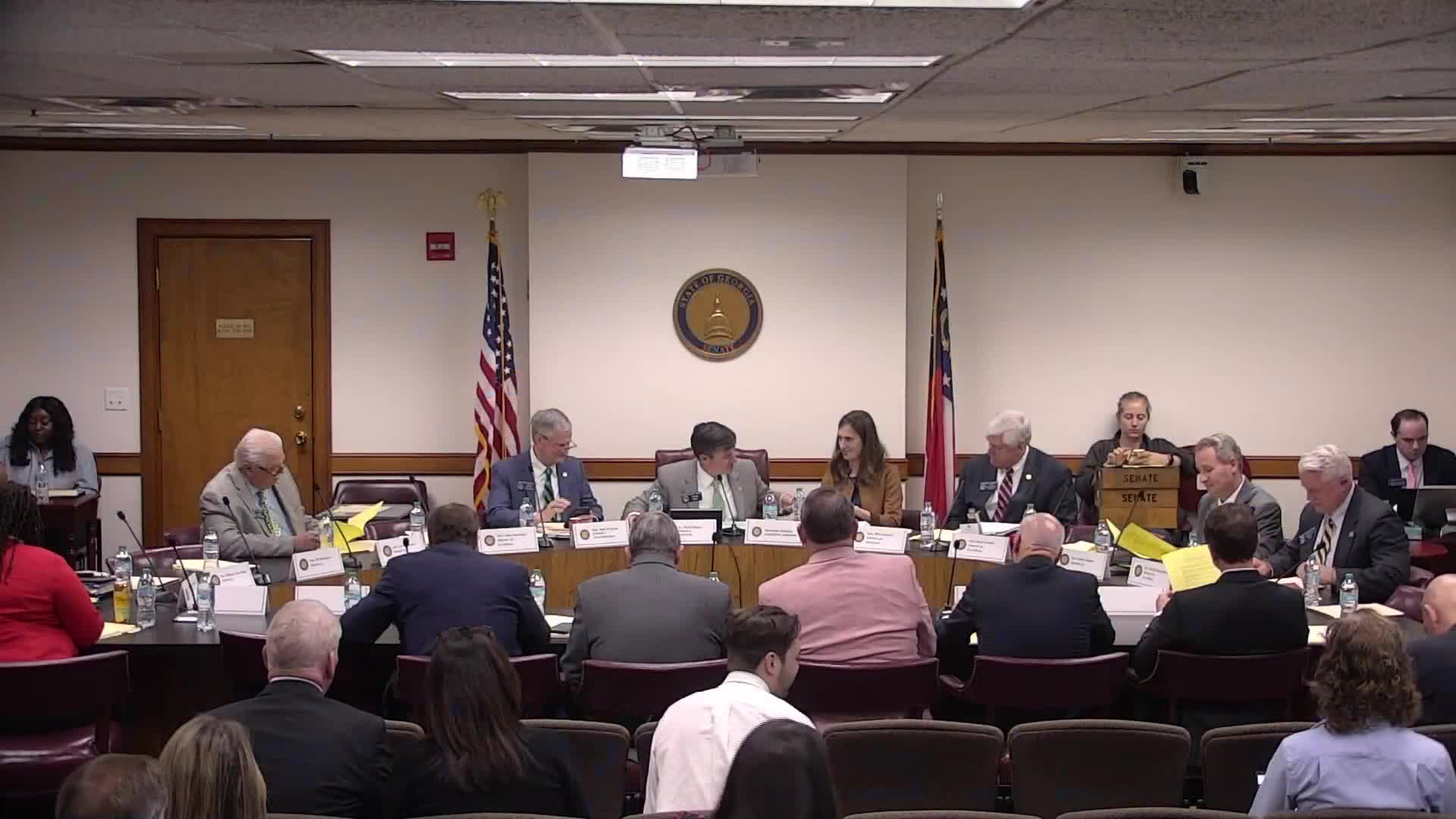
ATLANTA — The Georgia Senate Rules Committee met March 18 and unanimously approved procedural referrals that will send a set of House bills to committee and move Senate Resolution 323 to a standing committee.
Committee Chair Senator Walker called the meeting to order and asked that SR 323 be referred to a standing committee; the chair said the referral included a small amendment changing the number of days attached to the resolution. "All in favor, say aye," the chair said; committee members responded, and the chair announced, "Motion carries unanimously." The committee scheduled the SR 323 standing-committee hearing for Thursday.
The committee then heard concise presentations from House members and state executive-branch representatives on a broad slate of measures. Speakers described policy changes, budgetary figures and program adjustments but most bills were presented for committee placement rather than for debate or final action. Representative Hall, speaking for the governor, described House Bill 111 as a measure to accelerate a planned income-tax rate cut "from 5.39 to 5.19 percent." Representative McBride summarized changes to a college completion grant (HB38), saying the program provides up to $2,500 per student, that the bill adjusts completion thresholds (70% for four-year programs and 45% for two-year programs) and that the legislature budgeted $10,000,000 for the program over the prior three years.
Other measures presented included proposals to: - Allow use of historic building tax credits in Atlanta tied to World Cup-related development (HB360). - Amend enterprise zone provisions for Centennial Yards (HB416). - Permit GIFA loans when municipal natural gas systems require them (HB51). - Reformat earned-wage-access products as structured loans with a capped fee (HB241). - Extend a temporary exemption on intangible recording taxes on security deeds to 62 months (HB586), which the presenter said had neutral positions from ACCG and GMA. - Move regulation of certain licensed facilities from the Department of Community Health to the Department of Behavioral Health and Developmental Disabilities (HB584), with present-day budget authority already available. - Increase statutory caps on alternative investments for certain public pension funds and raise the mortgage-bond aggregate cap for the Georgia Dream homeownership program from $3,000,000,000 to $6,000,000,000 (HB159). - Place the Georgia Lottery Corporation under the Administrative Procedures Act for rulemaking transparency (HB74). - Update NextGen 911 adoption options for counties and cities (HB423). - Increase the indemnification limit for public-school teachers under the public-service officer level from $75,000 to $150,000 (HB105). - Add specified crimes to the Georgia Bureau of Investigation's administrative-subpoena authority with oversight from the attorney general (HB161). - Make technical housekeeping changes at the Department of Insurance, including moving license renewals from annual to biennial (HB410).
Several presenters emphasized that measures were departmental or agency bills intended to streamline operations rather than expand substantive new authorities; speakers repeatedly said the bills did not increase caps or create new programs where none previously existed. For example, Representatives McDonald and others described HB112 as a one-time tax credit for taxpayers who paid 2023 and 2024 liability, and presenters for HB475 (Department of Economic Development) described only clarifying changes to existing film tax-credit language.
Late in the meeting the committee approved a motion to refer a package of bills to committee consideration. The listed bills in the motion were HB55, HB111, HB112, HB161, HB406, HB423, HB584, HB614 and House Resolution 42; the chair called for the vote, received a second, and announced the motion "carries unanimous." The transcript does not record individual roll-call votes or a named mover and seconder for the final referral motion beyond the chair's announcement and the second referenced in the record.
The committee did not take final votes on the substantive provisions of the bills presented; most items will proceed to committee hearings where members can request staff analysis, fiscal notes and testimony. The chair repeatedly reminded members that the day’s action was procedural and that many bills were being placed "in the book" for later consideration.
Votes at a glance - SR 323: Motion to refer SR 323 to standing committee with an amendment changing the number of days — motion carried unanimously; mover/second not specified in the transcript. (Scheduled for standing-committee consideration on Thursday.) - Referral motion: Committee voted to refer HB55, HB111, HB112, HB161, HB406, HB423, HB584, HB614 and HR42 to committee — motion carried unanimously; mover/second not specified in the transcript.
The committee meeting record shows many additional House bills were presented for placement or informational purposes; legislators who presented bills or described them asked staff and members to "be on the lookout" for departmental and governor's bills that the Rules committee typically moves quickly through the process.
The committee recessed following the unanimous referrals; members were told to "get to your committees," and the chair closed the session.