Get Full Government Meeting Transcripts, Videos, & Alerts Forever!
Get email alerts on the Counter Drone Law topic
No spam. Unsubscribe anytime.
Panel gives do‑pass recommendation to bill shielding officers who disable drones near border
Summary
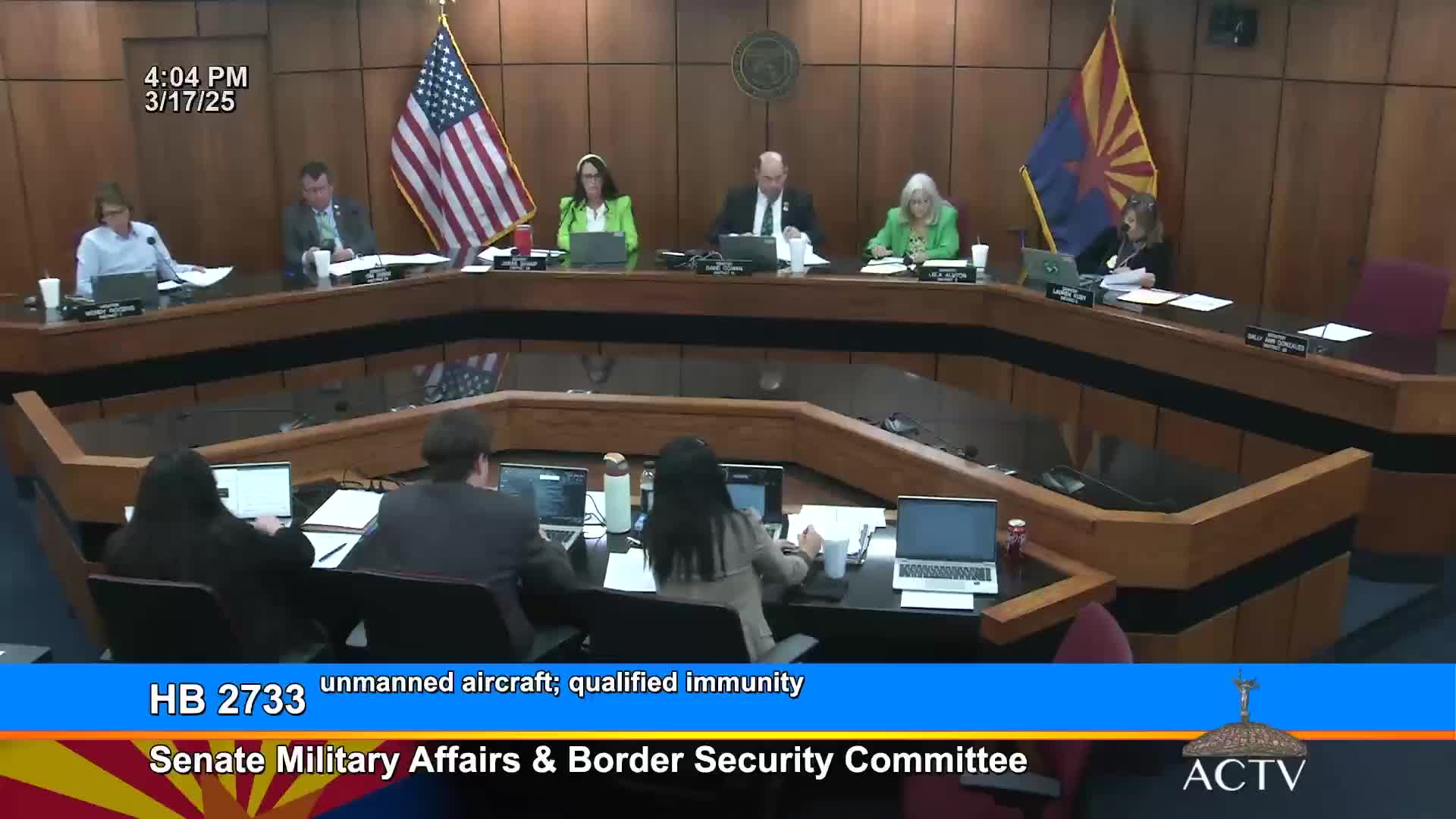
The Senate Military Affairs and Border Security Committee recommended passage of House Bill 2733, which would shield public entities and employees from civil liability when a peace officer disables or destroys an unmanned aircraft within 15 miles of the border if the officer has reasonable suspicion the aircraft is being used for organized crime, drug offenses, terrorism or similar acts.
The Senate Military Affairs and Border Security Committee voted to give House Bill 2733 a do‑pass recommendation after testimony that highlighted both law‑enforcement needs to counter cartel drone use and civil‑liberties concerns about journalist and researcher drones.
The bill’s text presented to the committee would immunize a public entity or employee from liability to an unmanned aircraft operator for damage to personal property caused by a peace officer intercepting, disabling, destroying or otherwise rendering inoperative an unmanned aircraft within 15 miles of the border if the officer has reasonable suspicion the aircraft is being used to commit organized crime, fraud, terrorism, a drug offense, or an imitation drug offense.
Why it matters: Supporters said the measure addresses a growing threat from criminal actors using unmanned aircraft systems to surveil or drop contraband across the border. Opponents, including the ACLU of Arizona, warned the statute could conflict with federal law and FAA authority, and could endanger legitimate drone uses including journalism, research and agriculture.
Barry Arons, speaking for the Trowler Association, said his group had withdrawn opposition after negotiating language with the attorney general’s office and that the bill “protects personal property in these cases” while preserving rights. The attorney general’s office testifiers, including Nick Deebus, said local and federal law enforcement have reported increased drone use by drug cartels and that state law should allow local officers to react.
Jean Woodbury of the ACLU of Arizona urged a no vote, citing FAA preemption and concerns about how “reasonable suspicion” would be applied. “It is a federal crime to shoot down an aircraft, and that includes unmanned aerial vehicles,” Woodbury told the committee, and she said the bill may create conflicting state and federal authority.
Robert Watkins, operations commander for the Cochise County Sheriff’s Office, told the committee the threat has evolved and urged lawmakers to consider national‑security implications. Watkins said local experience demonstrates both narcotics drops and potential violent uses of weaponized drones abroad, and he favored giving officers the discretion to act given the totality of the circumstances.
The committee recorded a do‑pass recommendation: 5 ayes, 1 nay, 1 not voting. Several committee members said they remained concerned about potential preemption by federal aviation law and asked for further refinement before floor action.
Implementation notes: Committee testimony did not specify operational protocols, training requirements, or reporting requirements for use of force against unmanned aircraft; the attorney general’s office and sheriff representatives said coordination with federal partners is typical in Border Patrol sectors.
Action: House Bill 2733 — Committee action: do-pass recommendation; committee tally 5 ayes, 1 nay, 1 not voting.