Get Full Government Meeting Transcripts, Videos, & Alerts Forever!
Get email alerts on the Health Insurance Claims Ai topic
No spam. Unsubscribe anytime.
Committee approves bill requiring human medical review for some insurer denials; debate centers on claims vs. prior authorization
Summary
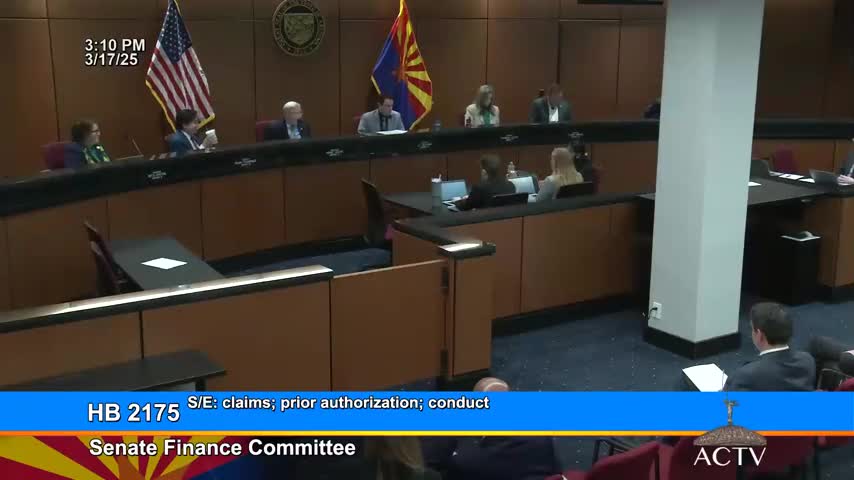
A Senate committee on March 13 voted 5–2 to pass House Bill 2175, as amended, after adopting a strike‑everything amendment that would require a medical director or licensed health care provider to personally review insurer denials and prior authorizations that involve medical necessity, experimental status, or other matters requiring medical judgment.
A Senate committee on March 13 voted 5–2 to pass House Bill 2175, as amended, after adopting a strike‑everything amendment that would require a medical director or licensed health care provider to personally review insurer denials and prior authorizations that involve medical necessity, experimental status, or other matters requiring medical judgment.
Representative Willoughby, the bill sponsor, told the committee she wants “a human… to be the one that makes the final decision” on denials that implicate clinical judgment and expressed willingness to continue stakeholder talks (strike amendment dated 03/13/2025, effective 07/01/2026). She said the measure does not ban use of AI for administrative tasks but would prevent AI from “supplanting human judgment” in final adverse decisions.
Nut graf: Supporters — including the Arizona Medical Association, Arizona Hospital and Healthcare Association and patient advocates — framed the bill as a targeted fix to growing automated denials. Opponents from health insurers and PBMs argued the claims side of the bill would create an unprecedented work stream, delay clean‑claim payments, and impose significant operational costs. The committee adopted the amendment and voted to return the bill with a due‑pass recommendation.
What the amendment does and why supporters want it
The adopted “strike everything” amendment (03/13/2025) clarifies that before a claim or prior authorization may be denied on grounds that involve medical necessity, experimental status, or other issues requiring medical judgment, a medical director or health care provider must individually review the decision, exercise independent medical judgment, and not rely solely on recommendations from other sources. The sponsor and physician groups said the change is intended to preserve patient safety where clinical judgment is at issue while still allowing AI for administrative screening.
Supporters’ testimony
Amanda Sheinson of the Arizona Medical Association testified in “strong support” and said the bill is needed because denials and prior authorization burdens have “grown exponentially,” and that AI should not be allowed to “supplant the judgment of a physician.” Christina Corriere (Arizona Medical Association) said federal reports show a share of denials are categorized as medical‑necessity related and that denials rose sharply as AI became widely available; she told the committee there was a 20% increase in denials between February 2022 and February 2023 in national reporting cited by proponents.
Damien Johnson, representing the Arizona Hospital and Healthcare Association, described provider and hospital financial impacts — citing industry survey numbers included in his testimony — and urged committee passage while acknowledging continuing stakeholder discussions.
Opposition and operational concerns
Chad Heinrich, representing Arizonans for Affordable Health Coverage (insurer interests), said prior authorization denials already require medical‑director signoff under current Arizona law and argued the claims provision is the problematic portion. Heinrich told the committee that claims are processed on the back end, can include administrative and contractual questions (for example unpaid premiums or fraud checks), and that requiring a medical director review of claims would create a separate Arizona work stream. He warned that moving claims into a manual review stream would risk delaying payment beyond the state’s 30‑day clean‑claim requirement and could cost insurers millions to reconfigure national claims systems to accommodate an Arizona‑only process.
Committee discussion and compromise signals
Senators on both sides said they wanted more technical work on the claims language. Several members noted there was more consensus on the prior‑authorization (pre‑service) portion than on the claims (post‑service) portion. Sponsor Willoughby and opponents both said they were open to further drafting work; the sponsor added the bill includes a delayed effective date (07/01/2026) to allow additional stakeholder negotiation.
Votes and next steps
The committee adopted the strike‑everything amendment and returned HB 2175 with a due‑pass recommendation. The roll and tally recorded in the hearing transcript show the bill passed the committee as amended by a 5–2 vote.
Ending: The sponsor and opponents both said they planned additional meetings; the bill proceeds with the amendment in place and a delayed effective date intended to allow further drafting before statewide implementation.