Get Full Government Meeting Transcripts, Videos, & Alerts Forever!
Get email alerts on the Property Tax Reform topic
No spam. Unsubscribe anytime.
Legislative hearing on House Bill 231 sparks sharp debate over property‑tax shifts, short‑term rentals and charter cities
Summary
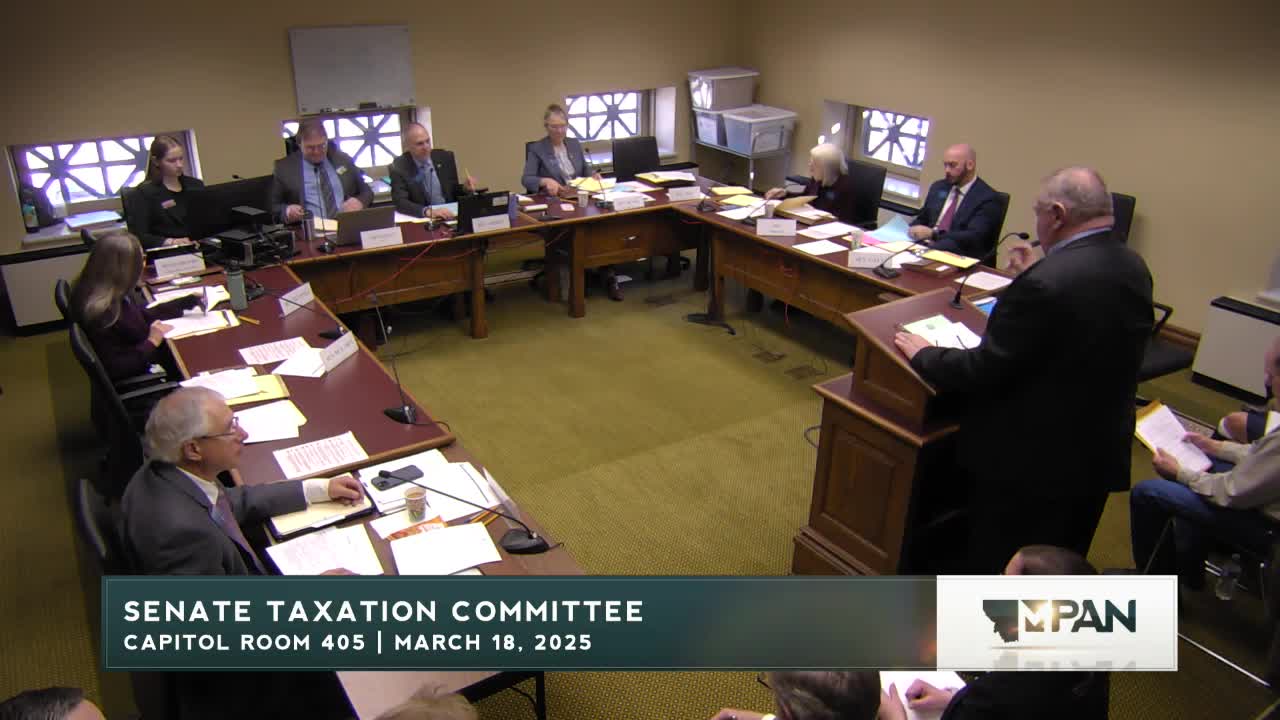
HELENA — Representative Lou Jones, R., House District 18, introduced House Bill 231 to the Senate Taxation Committee, proposing a multi‑tiered restructuring of Montana’s property tax rates intended to reduce bills for many owner‑occupied homes while shifting more tax burden to nonresident owners and certain commercial properties.
HELENA — Representative Lou Jones, R., House District 18, introduced House Bill 231 to the Senate Taxation Committee, proposing a multi‑tiered restructuring of Montana’s property tax rates intended to reduce bills for many owner‑occupied homes while shifting more tax burden to nonresident owners and certain commercial properties.
The bill’s sponsor said the measure targets owner‑occupied residences, long‑term rentals and small businesses with a dynamic, median‑based rate structure. Supporters, including the Montana Quality Education Coalition and the governor’s budget office, told the committee the bill balances property‑tax relief with continued revenue for K‑12 schools. Opponents — led by the city of Billings, the Billings Chamber and several municipal leaders — warned the bill would sharply reduce local tax bases in some charter or mill‑capped cities and would force steep cuts to public safety funding.
Jones told the committee HB 231 arose from the governor’s property‑tax task force and state modeling that show a growing share of residential taxable value is held by out‑of‑state addresses. He said 22.7 percent of all residential taxable value in Montana is mailed to an out‑of‑state address and that tourist pressure and short‑term rentals have driven sharp increases in residential market value in parts of the state. “Property tax is an incredibly complicated subject,” Jones said, adding that the bill attempts to be dynamic by tying thresholds to county medians.
What the bill would do
Under the version Jones described, residential property would be taxed under a tiered schedule tied to multiples of the county median value: an owner‑occupied or qualifying long‑term rental would receive lower rates for lower tiers (for example, roughly 0.9 percent up to 2 times the median and 1.1 percent up to 4 times the median), with the top residential rate remaining about 1.89 percent above the highest tier. Commercial property would be bifurcated: a lower rate on the first portion of value (Jones described roughly 1.5 percent up to about $2.1 million, six times the median) and the current top commercial rate (about 1.89 percent) thereafter. Jones said the design is intended to deliver tax cuts to roughly 230,000 owner‑occupants, 30,000 long‑term rentals and about 35,000 small businesses statewide.
Sponsor’s fiscal framing and claimed outcomes
Jones and administration witnesses told the committee the bill would produce significant statewide reductions in property taxes for residential owners — Jones cited a statewide average reduction of about 20.48 percent for homes and about 23.08 percent for long‑term rentals in the bill’s present form — while moderating the shift to other classes by preserving the top commercial rate. The Department of Revenue staff and the governor’s budget office offered models and technical analysis the committee could use to examine county‑by‑county results.
Short‑term rentals and owner occupancy
The treatment of short‑term rentals was a focal point at the hearing. Jones said owner‑occupied homes could still be rented some portion of the year and keep the owner‑dwelling preference: “If you’re an owner dwelling in Montana, you can short‑term rent out your place either long or short term as long as it’s 7 months of an owner dwelling,” he said. He added the bill distinguishes frequent, commercial short‑term rentals — which he said should pay nearer the higher rate — from occasional rentals by homeowners. Multiple short‑term rental owners testified that many hosts are Montana residents who rely on rental income; they asked the committee to exempt or soften treatment of some short‑term rentals.
Local governments and charter cities push back
Municipal officials warned of concentrated local impacts. Billings Mayor Bill Cole testified the city “opposes this bill because it would reduce the value of our mill and shrink our tax base by about 12 percent, which translates to approximately $6,500,000 per year,” and said that would equate to roughly 67 full‑time positions. Billings finance director Andy Zoeller told the committee the city’s charter caps mills and prevents the city from simply raising levies to restore revenue: “HB 231 currently as written would not do this though. Because of our mill letter mill levy cap, any tax bill that would reduce the value of a mill would result in a loss of revenue to Billings,” he said.
Several other smaller charter communities raised similar concerns; Sunburst Mayor Holly Hovland asked that the bill’s amendment clarify protections beyond a single fiscal year so charter towns would not face long‑term uncertainty. Senators and staff discussed drafting an amendment intended to prevent an inadvertent revenue loss to charter or mill‑capped local governments.
Administrative, implementation and equity concerns
Witnesses raised administrative concerns about eligibility and timing. Margie McDonald of Big Sky 55 Plus noted the fiscal note anticipates 23 new Department of Revenue FTEs to implement the program and 13 ongoing FTEs thereafter, and she flagged the bill’s March 1 application deadline for owner‑dwelling designation as a barrier for some people. Several witnesses warned that long‑term rental owners might not see tax reductions in the first year because of timing and assessment certification deadlines. Others asked about trusts and whether family legacy homes held in trust would qualify.
Opponents and competing proposals
Business groups and taxpayer associations opposed the bill on policy grounds. The Montana Chamber of Commerce and the Montana Taxpayers Association argued the bifurcated commercial rate introduces long‑term uncertainty and could produce repeated upward adjustments for certain commercial taxpayers over time. Some witnesses asked the committee to consider alternative bills — for example, Senate Bill 90, which relied more on lodging and rental‑car taxes to fund relief — instead of the property‑tax rate approach.
Quotes from the hearing
• Representative Lou Jones (sponsor): “This isn’t a perfect bill. There is no way to draft a perfect property tax bill with all the classes in Montana.”
• Mayor Bill Cole, Billings: “Billings opposes this bill because it would reduce the value of our mill and shrink our tax base by about 12 percent, which translates to approximately $6,500,000 per year.”
• Margie McDonald, Big Sky 55 Plus: the fiscal note “indicates there will be a need for 23 FTEs at the DOR to stand up this system, and then I think it’s 13 FTEs moving forward.”
What the hearing decided and next steps
The committee did not take a vote on HB 231. Jones acknowledged the bill will likely be amended and said he asked staff to draft clarifying language to protect charter cities and to refine technical language. Department of Revenue analysts said they will continue county‑level modeling to show exact effects under different parameter choices. No formal committee action was recorded at the hearing.
Why it matters locally
Property taxes fund public schools and many local services; proponents argued the proposal would protect school revenue while targeting relief to owner‑occupied residences. Opponents warned that local mill‑capped or charter governments could face difficult tradeoffs — including cuts to public safety — if the state reduces taxable value without a mechanism clarifying how those jurisdictions can maintain needed revenue.
Ending
The committee heard extensive testimony from homeowners, municipal leaders, advocacy groups, business associations and Department of Revenue staff. Sponsors said they will work with stakeholders on amendments; the committee left the bill open for further technical work and potential changes before any floor action.