Get Full Government Meeting Transcripts, Videos, & Alerts Forever!
Get email alerts on the Property Tax Relief topic
No spam. Unsubscribe anytime.
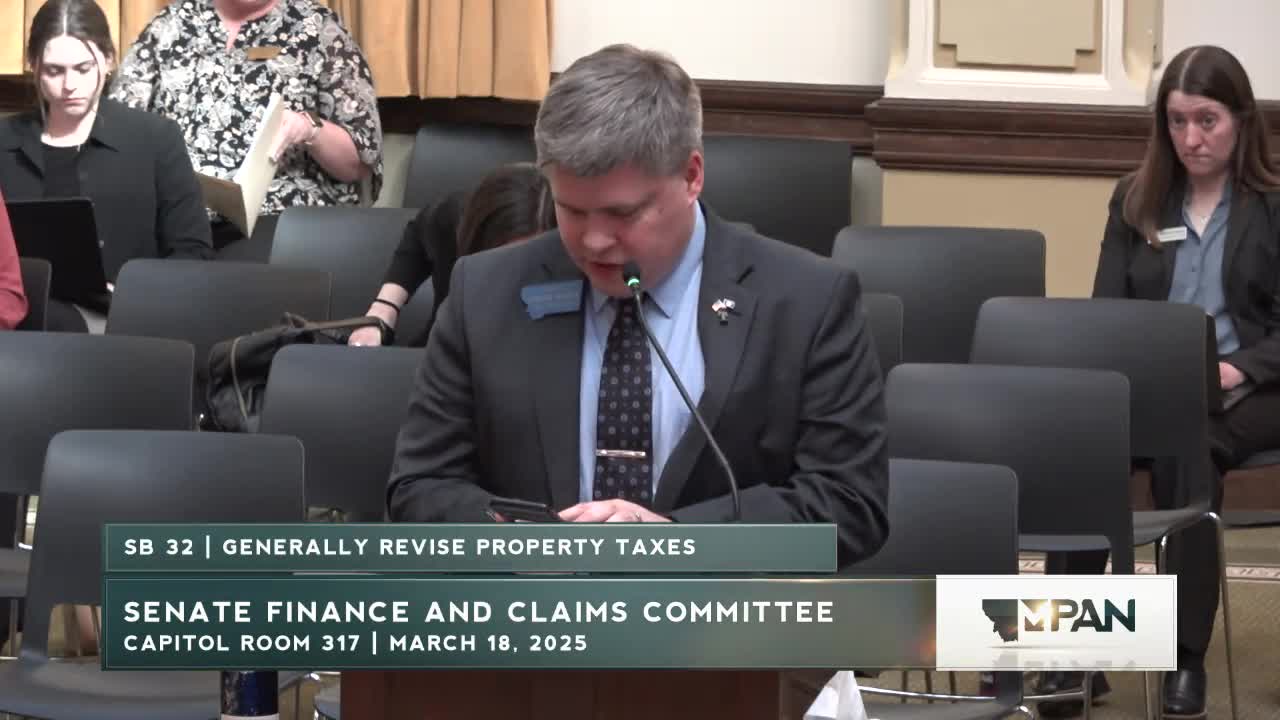
Senators hear competing property‑tax relief proposals; sponsor says bill aims to target relief and reduce utility tax burden
Summary
Senate Bill 32 would restructure property-tax rates to lower the base rate for owner-occupied homes and change rates for other classes, with department fiscal staff, municipalities and policy groups testifying about potential local government revenue uncertainty and targeting of relief.
Senate Finance and Claims received extended testimony on Senate Bill 32, a property-tax relief bill that proposes changing class rates for taxable value and seeks to shift tax burdens among owner‑occupied homes, rentals, businesses and centrally assessed utilities.
Sponsor Senator Jeremy Trebis (Senate District 10) summarized his bill as a relatively simple change to rate structure intended to reduce owners’ tax burdens while reducing taxable value for utilities. He told the committee the bill “mostly just adjust[s] the rates,” and said it would set a lower rate for owner-occupied class 4 property (he cited 1.25% for owner‑occupied in his floor summary) while applying a 1.65% rate for many other property tax classes. The sponsor emphasized that most school funding formulas would remain outside the bill and that utility-related taxable‑value reductions should translate to lower utility bills for ratepayers.
Trebis walked members through elements of the fiscal note, including an initial staffing need tied to separating owner‑occupied versus other-residential classifications. He said the fiscal note shows an initial staffing increase (the sponsor referenced about 13 additional FTEs during initial years, with lower ongoing staffing) to administer the new classification, and projected multi‑year revenue decreases to state and local funds under the bill’s rate changes.
Opponents included the Montana Budget and Policy Center, which argued the bill’s flat rate reductions are less targeted than an alternative structure in House Bill 231 and would provide disproportionately larger cuts to high‑value properties. Municipal representatives, including the City of Missoula, told senators the bill could create revenue uncertainty for growing cities and restrict local governments’ ability to respond to growth because the bill’s inflation cap and rate changes reduce flexibility to float mills.
Department of Revenue staff and Legislative Fiscal Division witnesses were available for technical questions about the fiscal note, taxable‑value analysis and school funding interactions. Department economists and property-assessment staff noted that the bill’s long‑run effect could allow mills to rise with inflation so jurisdictions might recover revenue over time, but they warned of short‑run reductions that could affect local services.
Senators asked detailed questions about who benefits under different proposals and how the bill compares to other relief measures such as House Bill 154 and House Bill 231; proponents and opponents said those bills are complementary or competing approaches. The sponsor urged committee members to compare fiscal notes when weighing policy choices; no committee action or vote took place during the hearing.