Get Full Government Meeting Transcripts, Videos, & Alerts Forever!
Get email alerts on the Domestic Violence Child Witnesses topic
No spam. Unsubscribe anytime.
Committee backs expanding child‑endangerment penalties to recognize child witnesses as victims
Summary
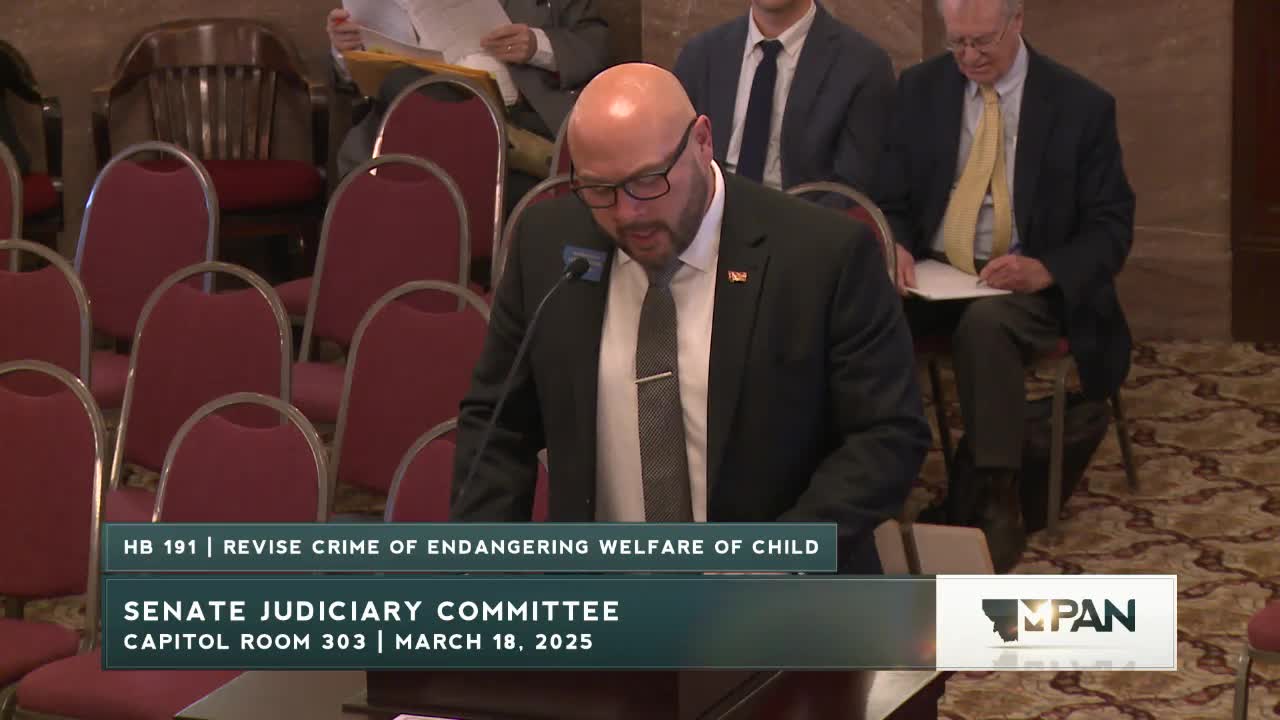
The Senate Judiciary Committee heard testimony supporting House Bill 191, which would add a standalone subsection to Montana’s endangering‑the‑welfare statutes to recognize children who witness domestic violence as victims and to open access to services. The committee moved the bill forward in executive action.
Representative Curtis Schomer, sponsor of House Bill 191, opened the hearing saying the measure “protects children” by increasing penalties and creating a distinct subsection to recognize children who witness violence.
Nut graf: Proponents — including prosecutors, the Department of Justice, statewide law‑enforcement representatives and victim‑service groups — said recognizing child witnesses as victims would change law‑enforcement documentation and increase access to counseling and crime‑victim compensation for affected children. The committee moved HB 191 out on a do‑concur voice vote.
Supporters’ testimony: Jennifer (domestic violence prosecutor in Billings) told the committee that children who witness domestic violence face increased risks of suicide, substance abuse and long‑term health problems; she said the bill would “prevent” cycles of violence and help identify children as victims eligible for services. Alex Sturhan for the Montana Department of Justice urged a due‑pass and said the bill helps hold accountable parents who commit violence in front of children. Shelby Demars of the Montana Police Protective Association and Beth Brenneman of the Montana Coalition Against Domestic and Sexual Violence urged passage and praised use of "predominant aggressor" language, which they said helps officers identify the primary assailant in complex scenes.
Questions and scope: Committee members asked how recognition as victims would interact with existing partner/family member assault (PFMA) processes and child‑protective actions. Witnesses said recognizing child witnesses as victims typically expands eligibility for counseling and victim compensation; prosecutors said that if law enforcement cannot identify a predominant aggressor, the new subsection would not apply because its underlying assault element would not be met.
Executive action: The committee took executive action and passed a do‑concur motion on HB 191 by voice vote; Senator Ricky moved the motion and the record shows Senator Smith and Senator Olson as aye by proxy. The committee chair announced the motion passed unanimously.
Ending: Sponsors and witnesses framed HB 191 as a preventive, child‑centered change intended to expand services and improve documentation of domestic‑violence incidents involving children.