Get Full Government Meeting Transcripts, Videos, & Alerts Forever!
Get email alerts on the Fertility And Assisted Reproduction topic
No spam. Unsubscribe anytime.
Committee debates IVF/ART licensing, storage and genetic‑testing limits; amended bill fails in committee
Summary
After amendments to add physician and laboratory certification, bonding for embryo storage and limits on embryo genetic testing, House Bill 945 failed in committee 4–6. Legal staff summarized compliance timelines and Department of Health said additional inspectors would be needed.
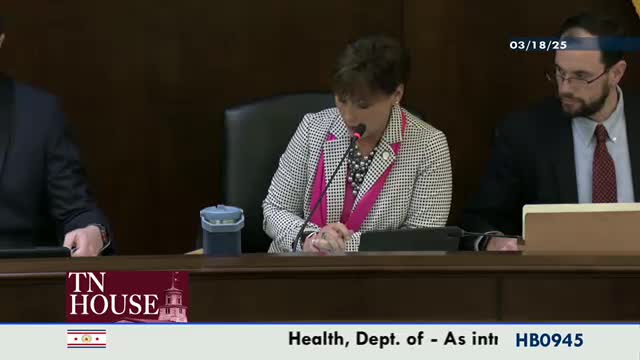
House Bill 9 45, with two committee amendments, was the subject of extended testimony and legal review on March 18, 2025. The sponsor, Chairman Williams, presented amendments to require assisted reproductive technology (ART) certification for physicians, licensing and bonding for laboratories that store embryos, and an affidavit requirement that clinics use Society for Assisted Reproductive Technology (SART) consent templates. The committee adopted two amendments during the hearing and later voted on the amended bill; the final committee vote was 4 ayes and 6 nos, and the bill failed.
Chairman Williams said the measure was intended to protect patients and embryos after recent clinic closures and alleged unlicensed practice in the state. He described three primary elements of the amended bill: a certificate for physicians who practice ART, licensure and a performance bond for laboratories that store embryos, and using standard clinic consent forms so families receive consistent informed consent. Williams said the untimely amendment removed a proposed limit on the number of embryos that could be cryogenically stored and preserved language allowing genetic testing limited to chromosomal anomaly testing and fetal anomaly testing.
Heather Hasbaugh of Legal Services summarized the amended bill for the committee, saying it "prohibits a person to practice in assisted reproductive technology unless that person has obtained an assisted reproductive technology certificate" from the appropriate medical board, allows delegation within training and scope, and requires a 60‑day compliance window after promulgated rules. Hasbaugh said the amended language would require an affidavit that SART template consent forms are used and that genetic testing would be prohibited except when used for "chromosomal anomaly testing or fatal [fetal] anomaly testing." She described requirements for fertility clinic certification, annual inspections by the Department of Health, reporting obligations to CDC, and Department authorities to deny, suspend, revoke, or refuse renewal of certification.
Physicians and patient advocates testified about practical effects. Dr. Christopher Motteville, medical director of Tennessee Fertility Institute, said broad statutory language could limit clinical judgment and patient access to testing that helps identify embryos with better potential for pregnancy; he explained that pre‑implantation genetic testing (PGT) is used to screen chromosomal aneuploidy and that testing use increases with maternal age. Patient advocates including Kara Edwards (Starfish Infertility Foundation) and Molly Walker (Tennessee Fertility Advocates) described personal experiences with clinic closures and urged more time for the legislature to consider the implications for the roughly one in six people affected by infertility; Edwards said she was among patients harmed by a local clinic closure.
Department of Health staff said implementing the inspection and certification requirements would require additional inspectors and resources; the department said it is contracting with the Health Facilities Commission for lab inspections but is hiring med‑lab inspectors to assume those duties when contracts expire.
Committee members debated redundancy with federal reporting and third‑party lab accreditation, the scope of genetic testing restrictions, whether the Department of Health has the expertise to inspect embryology labs, and whether the certificate and bonding provisions would prevent abrupt closures that leave patients' embryos at risk. After committee debate the chair called the question on the amendment package; that procedural question passed on a 10–0 vote. On final roll call the amended House Bill 9 45 failed 4–6 in the Population Health Subcommittee.