Get Full Government Meeting Transcripts, Videos, & Alerts Forever!
Get email alerts on the Transportation Policy topic
No spam. Unsubscribe anytime.
TDOT tells finance committee it remains committed to legacy road projects while balancing inflation, funding and evolving needs
Summary
Tennessee Department of Transportation officials told the Senate Finance Ways and Means Committee they remain committed to projects from the 1986 tax-restructuring program and the IMPROVE Act but emphasized a need to prioritize projects because of flat user-fee revenue, inflation and changing local needs.
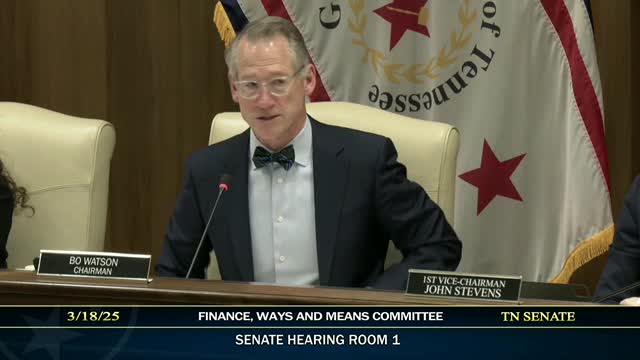
Tennessee Department of Transportation leaders on March 18 briefed the Senate Finance Ways and Means Committee about the status of legacy roadway projects, the department’s 10-year plan and the practical constraints that affect project delivery.
Committee members asked whether projects listed in the Comprehensive Tax Restructure Act of 1986 and in later statutes such as the IMPROVE Act remain priorities and how TDOT balances older statutory commitments with changing congestion and community needs. TDOT officials said they are "totally committed to every single project" listed in those acts but noted that funding, inflation and evolving local priorities have required the agency to break long corridors into deliverable segments and re-prioritize work.
Deputy Commissioner Preston Elliott and the department’s chief engineer outlined a multi-factor prioritization process that considers project performance, safety, time to deliver, community input and metropolitan planning organization (MPO) priorities. They said TDOT has advanced many projects from the 1986 program and IMPROVE Act and is delivering 72 of 93 non-bridge IMPROVE Act projects in the 10-year planning process; a small number of corridor segments remain to be completed.
Lawmakers repeatedly raised examples of projects that remain incomplete decades after authorization. Senator Hensley described a corridor intended to provide four-lane access from Columbia to Lexington with roughly 6.5 miles still outstanding and said the project was originally scheduled for completion by 1999. TDOT officials said some sections have been constructed while remaining portions face environmental or right-of-way challenges that lengthen delivery timelines.
Committee members pressed TDOT on financing mechanics. Michael Winston, DGS fiscal officer, and TDOT staff explained that capital project fund dollars are held until projects draw on them, that some capital appropriations are not bonded and that bond issuance timing is handled by Finance & Administration. TDOT officials explained they include inflation escalation to the midpoint of construction in cost estimates and that when bids are received 2–3 years after budget submission, projects increasingly have sufficient funds to award contracts because bidder participation has increased since 2023.
Senators also raised questions about non-state roads in the budget. The committee discussed a proposed allocation for Peyton Road, a project that is not a state highway but which appeared in the administration’s capital plan and has federal earmarks; TDOT said federal earmark funding was programmed and that local ownership and operations would remain local after construction.
On performance and maintenance, TDOT officials said the resurfacing program for 2025 is roughly $425–$591 million depending on the scope referenced, and they emphasized steps taken to increase the state of good repair after several years of underinvestment. TDOT leaders told the committee recurring revenue from fuel taxes and registration fees has been largely flat, increasing pressure on the department to prioritize work and seek alternative revenue strategies.
The department outlined a governor-proposed transportation revenue package that would dedicate additional recurring transportation-related revenue and cited an $8,080,000,000 recommendation in broader fiscal plans to address long-term needs (discussion framed as administration recommendations rather than committee action at the hearing). TDOT leaders described the tradeoffs of bonding and noted Tennessee is among a small number of states with no state debt for transportation.
Committee members asked about county-seat connector statutes and about project delivery metrics; TDOT officials said 68 county seats have been connected under the policy, with others in various stages. Officials also emphasized they track project phases and delivery timelines and will provide additional detail on older projects that remain on planning lists.
TDOT’s presentation closed with committee praise for the department’s operational performance, followed by requests for additional detail on completion rates and the timeline for older projects.