Get Full Government Meeting Transcripts, Videos, & Alerts Forever!
Get email alerts on the Capital Budget topic
No spam. Unsubscribe anytime.
General Services outlines $719M capital request including historic library renovation and youth facility funding
Summary
The Department of General Services presented a $719 million FY26 capital package that includes the renovation of the Old Library and Archives Building, roof and window work at the state capitol and funding to finish three youth development centers.
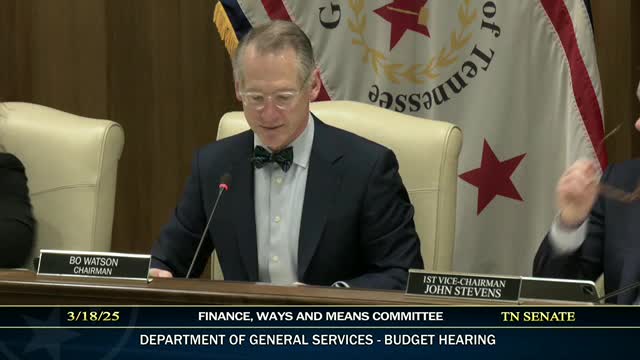
The Department of General Services (DGS) on March 18 presented the administration’s FY26 capital-outlay plan to the Senate Finance Ways and Means Committee and outlined a set of projects totaling approximately $719 million.
Matt Van Epps, commissioner of DGS, and John Hall, deputy commissioner and director of the Real Estate Asset Management division (STREAM), told the committee the request includes 16 capital-improvement projects totaling about $572 million and 31 capital-maintenance projects totaling about $147 million.
The most prominent projects described were a $139.5 million request to renovate the Old Library and Archives Building (a structure on the National Register of Historic Places), additional funding to complete a state capitol roof, window and door project, and an $81.1 million allocation to finish construction of three youth development centers for the Department of Children’s Services (DCS).
Van Epps showed a rendering and said the Old Library and Archives renovation would preserve historical features, remove storage stacks on the west side and build new office space to accommodate the Administrative Office of the Courts with a secure connection to the Supreme Court Building. The committee confirmed the $139.5 million appropriation includes about $134 million proposed as bonded funding.
The request also includes $3.5 million in additional capital maintenance for state building roof, window and door work, bringing that project to roughly $28 million total; work is expected to begin spring 2025 and run into fall 2026, the agency said. DGS said the scope includes replacing 209 windows and 15 wooden exterior doors with designs matching the original state capitol and replacing the copper roof with a new pre-patina copper roof.
The DCS allocation completes previously requested funds to construct three youth development centers (including Woodland Hills in Nashville and two facilities at John Wilder in Somerville). DGS said the Woodland Hills facility will be a 72-bed staff-secure center; the John Wilder site will include a 72-bed hardware-secure facility and a separate 48-bed staff-secure facility. Commissioners confirmed those centers are intended to serve post-adjudicated youth under DCS custody.
DGS also outlined a $275.4 million request to build a new Tennessee Emergency Management Agency (TEMA) operations center and administration building on the Joint Forces Headquarters campus in Nashville. The agency described the proposed new facility as 175,000 square feet with a state-of-the-art emergency operations center, training and planning space, an auditorium and expanded parking; DGS said the current operations center is undersized, located in a basement and has infrastructure problems.
On parks and outdoor recreation, DGS described capital support for the Department of Environment and Conservation’s plan to create three stand-alone state parks and to complete the Devil’s Backbone State Park project; DGS said capital improvements would include visitor centers, utilities, roads and parking.
Committee members asked for more details about project lists and schedules. Michael Winston, fiscal officer for DGS, said capital project financing and the timing of bond sales are handled by the Finance and Administration department; he added that some state projects that are not bonded remain in the capital project fund until construction draws on them. Committee members also sought lists of completed projects tied to large multi-year park investments and asked DGS to provide completion tallies by fiscal year.
Van Epps and Hall discussed inflation and market volatility, and said STREAM escalates cost estimates to the midpoint of expected construction and monitors bidder rates to set contingencies. DGS described a typical four-year project lifecycle from program verification to construction closeout.
Committee members requested additional detail about older projects that remain on planning lists and asked whether previously authorized projects are still likely to be delivered. DGS said it has delivered many legacy projects over time but acknowledged longer-duration projects and changing priorities can delay individual corridors or elements and that the state continues to prioritize projects based on available funds and changing needs.
No formal vote was taken on the DGS capital presentation. DGS leaders agreed to provide the committee with requested follow-up details on project completions, financing and schedules.