Get Full Government Meeting Transcripts, Videos, & Alerts Forever!
Get email alerts on the Arts Funding topic
No spam. Unsubscribe anytime.
Senate finance committee gives Tennessee Arts Commission budget positive recommendation amid questions on reserves and federal grants
Summary
The Senate Finance Ways and Means Committee gave the Tennessee Arts Commission’s FY26 budget a positive recommendation after a presentation and questioning about specialty license plate revenue, reserve use and a paused CMS-funded program.
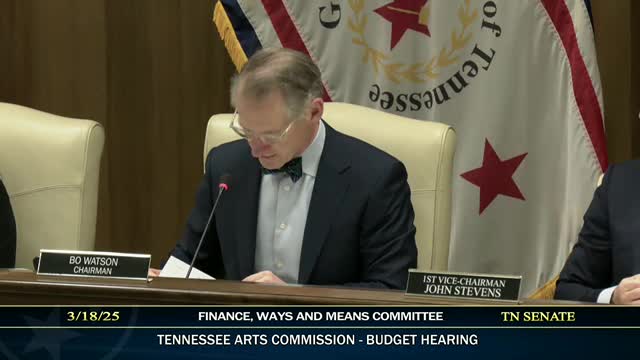
The Senate Finance Ways and Means Committee on March 18 voted to give the Tennessee Arts Commission’s proposed FY26 budget a positive recommendation after agency leaders outlined grant activity, revenue sources and reserve use.
The commission requested about $17.6 million in the governor’s recommended budget, including roughly $13.6 million in state funds, $1 million in federal funds and $3 million from other sources and reserves, Executive Director Anne Pope told the committee. Committee members pressed the commission on whether planned use of reserves and the reliance on specialty license plate revenue posed risks if federal funding changed or license-plate sales slowed.
The budget matters because the Arts Commission distributes grants statewide and the agency asked lawmakers to authorize one-time reserve use and a projected increase in specialty-plate revenue to meet demand for grants, particularly in rural communities.
Pope said the commission’s mission is “to cultivate the arts for the benefit of all Tennesseans in their communities.” She told lawmakers the governor’s recommendation included a technical request to raise the estimate for specialty license plate dedicated appropriations and a one-time use of reserves to address increased grant demand. Pope said the commission has obligated roughly $9.7 million of an arts-and-culture recovery fund and reported no findings in recent ARPA audits by the comptroller’s office.
Senators pressed for specifics. Senator Hensley asked what would happen if the commission lost the roughly $1 million in federal funds the budget anticipates; Pope replied, “We'd have to reduce grants.” She and staff said the agency is watching specialty plate sales closely and expects growth based on current trends and about eight months of additional sales data before the board finalizes a May budget vote.
Committee members also asked about a person-centered music program funded by a one-time CMS grant. Pope said the original $1 million award came through a nursing-home penalty fund, the program ran roughly three-and-a-half years with extensions during the COVID period, and training materials and equipment remain in nursing homes but the CMS continuation is “on hold” and the Arts Commission has no current funds to maintain the program.
On specialty plate revenue, committee members asked how proceeds are distributed. Pope said newly approved plates split net proceeds roughly 50% to the sponsoring nonprofit, 40% to the Arts Commission (used for grants) and 10% to the highway fund; she said the Department of Revenue handles remittances and the arts commission receives accounting on a quarterly basis. Later a staff member told the committee that, for fiscal 2023, the Department of Revenue remitted $951,161 to the state highway fund from new specialty plate proceeds.
After discussion the committee’s chair called for a motion and members voted in favor of a positive recommendation. The clerk recorded 10 ayes.
The committee did not take up standalone legislation for the Arts Commission; the action was a budget recommendation that moves to subsequent budget processes.
The Arts Commission provided committee members with a county-by-county list of 2024 grants and reported regular grant applications were up more than 12% for FY26, totaling nearly $26 million in requests.
Looking ahead, the commission said it is monitoring federal grant decisions and will report back if the federal funding picture changes. Committee members asked the commission to provide further detail about reserve balances and how projected specialty-plate revenues would cover the commission’s planned one-time reserve draw.
10 ayes were recorded and the Arts Commission’s budget received a positive recommendation from the Senate Finance Ways and Means Committee.