Get Full Government Meeting Transcripts, Videos, & Alerts Forever!
Get email alerts on the Katie Beckett topic
No spam. Unsubscribe anytime.
Subcommittee advances measure to ease access to Katie Beckett home-and-community funds for families
Summary
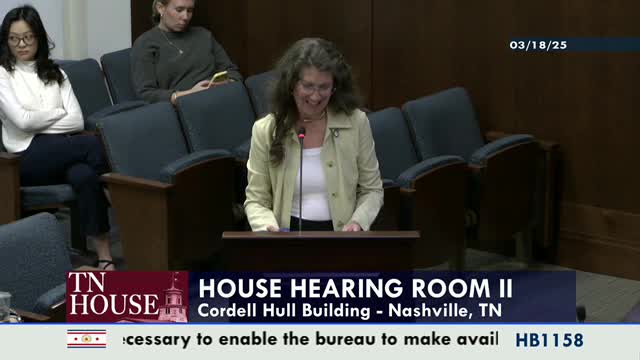
House Bill 1158, sponsored by Representative Lynn, moved to full Insurance after testimony from the Tennessee Disability Coalition and committee members about administrative barriers preventing families in the Katie Beckett Part A program from using allotted home- and community-based funds.
House Bill 11 58, sponsored by Representative Lynn, moved out of the TennCare Subcommittee to full Insurance on a 6-0 vote after members discussed changes meant to make Katie Beckett Part A funds easier for families to use.
Representative Lynn said the bill was brought by the Tennessee Disability Coalition on behalf of families. She described the Katie Beckett program as a state implementation of a federal option designed to let medically fragile children obtain Medicaid-like supports without regard to parental income. “Part A has about 300 slots a year for children in Tennessee...Currently, 239 children are on Part A,” Representative Lynn said. She told members that the statute sets aside about $15,000 in home and community–based services funds for Part A recipients but that families typically are able to access only a portion of that benefit.
Jeff Strand, director of public policy for the Tennessee Disability Coalition, testified in support and described administrative hurdles. “In part A, they have to go through their MCO. And that has proven to be so difficult...only be able to use about 18% of the benefit, about $2,800 out of that $15,000,” Strand said. He said the bill would create an easier mechanism (similar to the Part B health-reimbursement-account process) so families could use allocated funds for formulas, durable medical equipment and other medically necessary supports without protracted prior-authorization processes.
Members asked questions about equity between Part A and Part B and whether families sometimes shift eligibility to access funds more easily. Strand said moving between parts is sometimes driven by process burdens rather than need. Representative Lynn and committee members expressed support for lowering administrative barriers so families can spend more of the funds on direct care rather than on paperwork.
The subcommittee voted 6-0 to send House Bill 11 58 to full Insurance.