Get Full Government Meeting Transcripts, Videos, & Alerts Forever!
Get email alerts on the Physician Payments topic
No spam. Unsubscribe anytime.
Committee advances bill proposing $600 million to raise TennCare doctor payments to shore up rural access
Summary
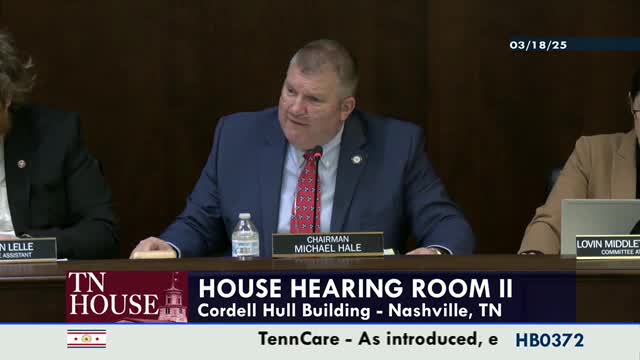
The TennCare Subcommittee advanced House Bill 372 to full Insurance after testimony that low Medicaid/TennCare reimbursements are driving independent physicians away from serving TennCare patients. Sponsor and witnesses said the bill would require a major payment increase in year one and a fee schedule change to stabilize rural provider networks.
House Bill 372, titled the Tennessee Modernization and Access Act of 2025, advanced out of the TennCare Subcommittee to the full Insurance Committee after members voted in favor of moving the measure.
The bill, sponsored in subcommittee by Representative Hulsey, proposes a series of reimbursement changes for physicians who treat TennCare enrollees. Representative Hulsey told members the measure is intended to stop a “loss of doctors” serving Medicaid patients and said the bill carries a large first-year fiscal note: “Dollars 600,000,000,” he said. The sponsor described a funding formula that limits managed-care organizations’ administrative take and directs most dollars to providers.
The measure drew extended testimony from a rural pediatrician, Dr. Veil Higginbotham, who described how lower payments have reduced access in parts of Northeast Tennessee. “My practice cares for over 3,200 pediatric patients, which over 56 percent or 1,900, are insured through TennCare,” Dr. Higginbotham said. She told the committee that specialty care and dental services have become harder for families to find locally: “It used to be about an hour drive for my patients to get an evaluation. Now it's about 3 hours, with [specialty care] in Chattanooga,” she said. She also cited the state Department of Health county reports in saying pediatric care in Carter County declined fivefold from 2023 to 2024 and that Johnson County has no pediatric providers.
Members questioned the fiscal assumptions and how the proposal would interact with managed-care organizations (MCOs). Representative Hulsey said the bill would create a fee schedule and limit MCO administrative take to a small percentage of the new pool of funds; he said about 80 percent of the funds would go directly to providers and about 20 percent to targeted program payments for quality or exceptional care. He said TennCare “is turning back in $660,000,000 this year,” arguing the state could find resources to fund the change.
Committee members asked whether the change would be budget-neutral in later years; Hulsey said he had been told the plan “will pay for itself” after year one but acknowledged the committee and budget drafters would need to study the second-year impacts. Members also pressed that real-world implementation would require work with TennCare and the MCOs on rate schedules and averaging negotiated rates.
The subcommittee recorded a 5-0 vote to move House Bill 372 to the full Insurance Committee.
The measure now goes to full Insurance, where its fiscal assumptions and budget placement will be reviewed.
Ending: The committee’s action sends the bill to the next stage of consideration; members and the sponsor signaled that the measure will require negotiation with TennCare, the state budget office and managed-care plans before any final funding or implementation is resolved.