Get Full Government Meeting Transcripts, Videos, & Alerts Forever!
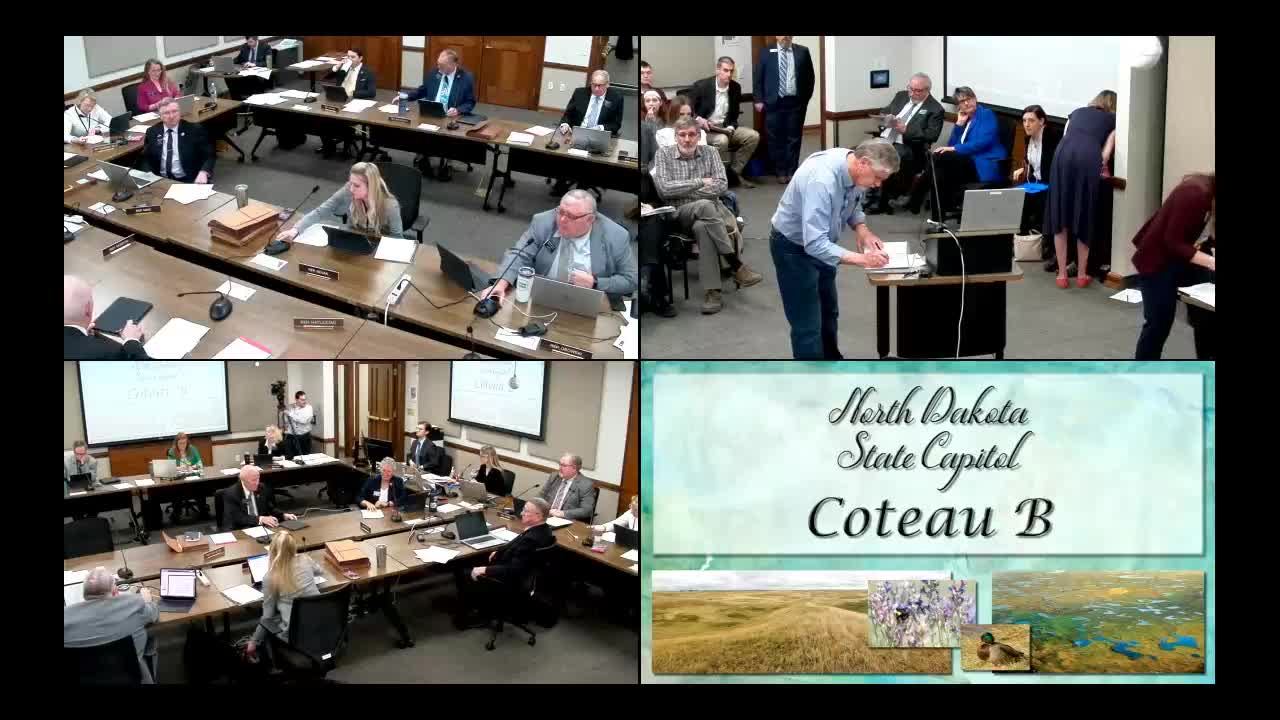
House Education Committee hears wide-ranging testimony on Senate Bill 2400, proposed education savings account program
Summary
At a House Education Committee hearing in Bismarck, lawmakers and dozens of witnesses debated Senate Bill 2400, a proposal from Senator Michelle Axman to create an education savings account (ESA) program administered by the Department of Public Instruction (DPI) that would allow families to use state-directed funds for approved education services across public schools, nonpublic schools and homeschool settings.
At a House Education Committee hearing in Bismarck, lawmakers and dozens of witnesses debated Senate Bill 2400, a proposal from Senator Michelle Axman to create an education savings account (ESA) program administered by the Department of Public Instruction (DPI) that would allow families to use state-directed funds for approved education services across public schools, nonpublic schools and homeschool settings.
The bill sponsor, Senator Michelle Axman, told the committee she crafted the measure after studying other states’ programs and said Senate Bill 2400 would “actually make North Dakota the very first state ever to have an ESA program that would support all students, including public school students.” Axman described a tiered structure: a public-school tier (listed in the bill at $500 per public-school student, with the sponsor saying she will seek $1,000 in appropriations), means-tested amounts for nonpublic-school students (up to $3,500 for families at or below 300% of the federal poverty level, $2,000 for families between 300% and 500%, and $500 for families above 500%), and a $500 allotment for home-educated students. Axman said the program would run through a “high-quality online digital wallet or marketplace” that would only list preapproved, services-based providers and that DPI would contract with a third-party vendor to operate the marketplace and auditing functions.
Why it matters: supporters said the plan would expand access to tutoring, dyslexia or speech services, dual-credit courses and — for the first time in a state ESA bill, the sponsor said — mental-health services as an approved expense. Governor Armstrong’s office, represented by Maria Nesit, described the bill as an “opt-in” tool to supplement existing funding, and Nesit told the committee, “I I wanna reiterate that the current form of Senate Bill 2,400 is not a voucher bill.” Proponents said the marketplace model reduces fraud risk compared with a simple receipt-reimbursement system and may help rural families access virtual courses or specialists not locally available.
Details of the proposal and…
Already have an account? Log in
Subscribe to keep reading
Unlock the rest of this article — and every article on Citizen Portal.
- Unlimited articles
- AI-powered breakdowns of topics, speakers, decisions, and budgets
- Instant alerts when your location has a new meeting
- Follow topics and more locations
- 1,000 AI Insights / month, plus AI Chat