Get Full Government Meeting Transcripts, Videos, & Alerts Forever!
Get email alerts on the Graduation Requirements topic
No spam. Unsubscribe anytime.
Committee backs due-pass recommendation for bill allowing local waiver of graduation course in emergent circumstances
Summary
House Bill 1200 would let local school boards substitute alternate coursework for a required graduation course when a student faces emergent circumstances, supporters said at a Senate Education Committee hearing.
House Bill 1200 would authorize local school boards to allow an alternate course or coursework in place of a required graduation course when a student faces emergent circumstances that prevent completion of the required class. Representative Scott Lausser introduced the bill and described it as a narrowly targeted flexibility measure for rare, severe events.
Dr. Bryants, dean of academics at Bishop Ryan Catholic School in Minot, described the case that prompted the proposal. A senior, Tyanna (last name withheld in testimony), was critically injured in a January 31, 2024 traffic crash and suffered multiple traumatic injuries including a traumatic brain injury; she spent months in a neurorehabilitation hospital. Dr. Bryants said hospital educators worked with the school’s teachers to have the student complete required work through alternative means (nonverbal responses, assistive methods) so she could graduate on time. He said current Century Code (cited during testimony as North Dakota Century Code 15.1‑21‑02.2) requires coursework be completed as written and provides no mechanism to waive a specified required course in an emergency; House Bill 1200 would give local boards authority to approve an alternate course in emergent circumstances so students in comparable situations would not be denied graduation.
Macy Blinsky (state representative, District 40) and local school board association representatives supported the bill and praised the sponsoring legislators and school staff who helped the student. Jim Uppgren, legislative liaison at the Department of Public Instruction, provided neutral information: under current law the state has no mechanism to waive minimum coursework requirements, local districts approve transcripts and diplomas, and an existing optional curriculum (for students who have failed courses or are in the lower quarter of their class) does not apply to most emergent high‑performing students. Uppgren said the bill’s emergent‑situation provision should remain narrow and that local decisions are the appropriate mechanism.
Senators discussed how many credits to permit (one vs. two) and whether any notation about the emergent substitution should accompany the diploma or transcript. Witnesses warned against automatic transcript markings that could expose medical information; they suggested a private verification letter that the student could use if a postsecondary institution or employer queried the diploma.
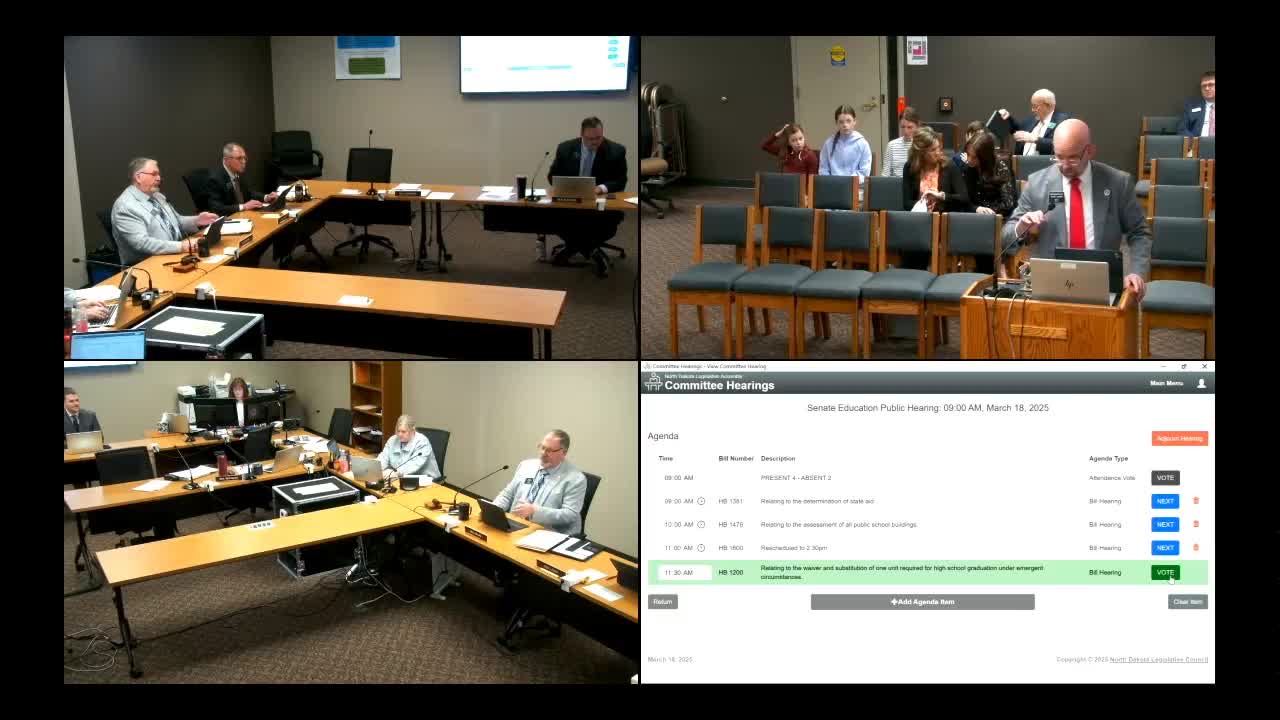
The committee adopted a motion for a due‑pass recommendation on House Bill 1200 (motion made by Senator Lam, seconded by Senator Bosche); the roll call recorded 4 yeas, 0 nays and 2 not voting.
Ending
The committee voted to give the bill a due‑pass recommendation; proponents said the bill would provide narrowly targeted flexibility for rare emergent cases while leaving diploma authority with local schools.