Get Full Government Meeting Transcripts, Videos, & Alerts Forever!
Get email alerts on the School Facilities topic
No spam. Unsubscribe anytime.
Bill would fund statewide assessment of public school buildings; stakeholders urge $4 million appropriation
Summary
House Bill 1476 would direct the state to inventory and assess public school facilities and create standards; supporters—including a school construction coalition, districts and labor union representatives—urged a $4 million appropriation to contract a vendor and build a data tool so assessments are comparable.
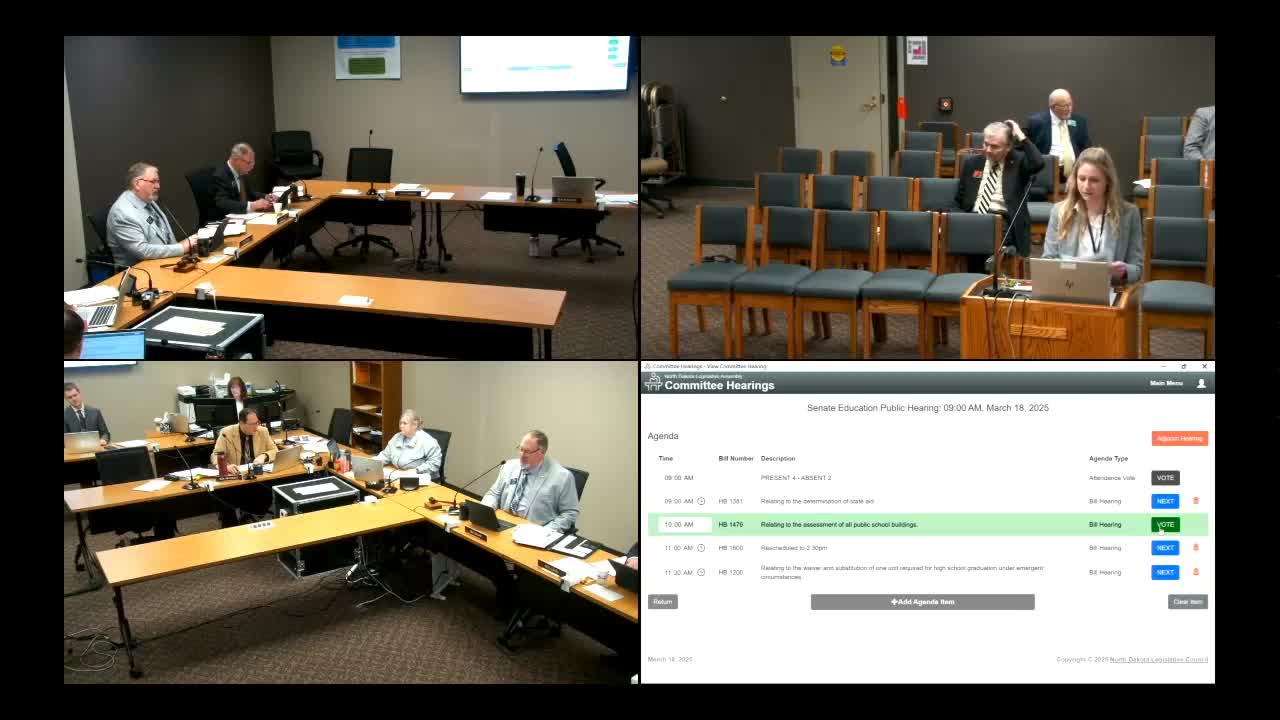
Representative Anna Novak presented House Bill 1476 to the Senate Education Committee, explaining the bill would direct the state to assess public K‑12 school buildings and to study criteria and standards for school facilities. The amended bill before the committee includes a one‑time appropriation of $4 million to begin assessments and to create a standardized assessment tool.
Novak said the interim School Funding Task Force and a School Construction Coalition found many districts lack current facility assessments. She described routine deferred maintenance and structural problems in smaller districts that do not have the tax base to finance repairs or replacement, and she said a consistent assessment is the necessary first step to understanding the scope of need.
Jeff Simon, executive director of the Western Dakota Energy Association and participant in the ad-hoc school construction coalition, summarized results of a survey that found fewer than half of responding districts had current facility assessments. He urged a vendor‑led, standardized statewide assessment so officials could compare conditions across districts and prioritize funding. Simon told the committee the $4 million appropriation could fund vendor costs and a data system; he also said stakeholders had identified a consulting firm experienced in K‑12 facility assessments.
Bob Marthaler, representing North Dakota United, supported the appropriation and cited past litigation and the concept of ‘‘adverse educational consequences’’ in earlier school‑funding litigation, including deteriorating and dangerous buildings. Brandt **** (North Dakota small organized schools) and other superintendents testified similarly, telling senators that some districts have century‑old buildings with deferred plumbing, boiler and accessibility needs and that districts lack consistent local capacity to pay for assessments.
Adam Tesher, school finance officer at DPI, said the department supports statewide assessments and emphasized that to be useful the state should adopt a standard assessment method rather than collect heterogeneous reports that would be difficult to compare. He and other witnesses agreed $4 million would be an appropriate one‑time appropriation to contract for assessments and to build a comparative data tool; DPI noted it may not be possible to complete every building’s assessment within a single biennium.
Committee members asked about local control, whether minimum building standards would follow from assessments, and how assessments would affect Bank of North Dakota revolving loan prioritization. Witnesses said assessments would not automatically impose state mandates on districts but could inform future policy and prioritization; they also said minimum standards would raise funding and legal questions if districts lacked resources to meet them.
Ending
Supporters urged the legislature to add the appropriation back into the bill so the Department of Public Instruction, working with the Office of Management and Budget, can contract for a standardized statewide assessment and create a centralized database to inform future policy and funding decisions.