Get Full Government Meeting Transcripts, Videos, & Alerts Forever!
Get email alerts on the Education Funding topic
No spam. Unsubscribe anytime.
Senate Education hears bill to reduce central-assessed "in lieu" factor from 75% to 65%
Summary
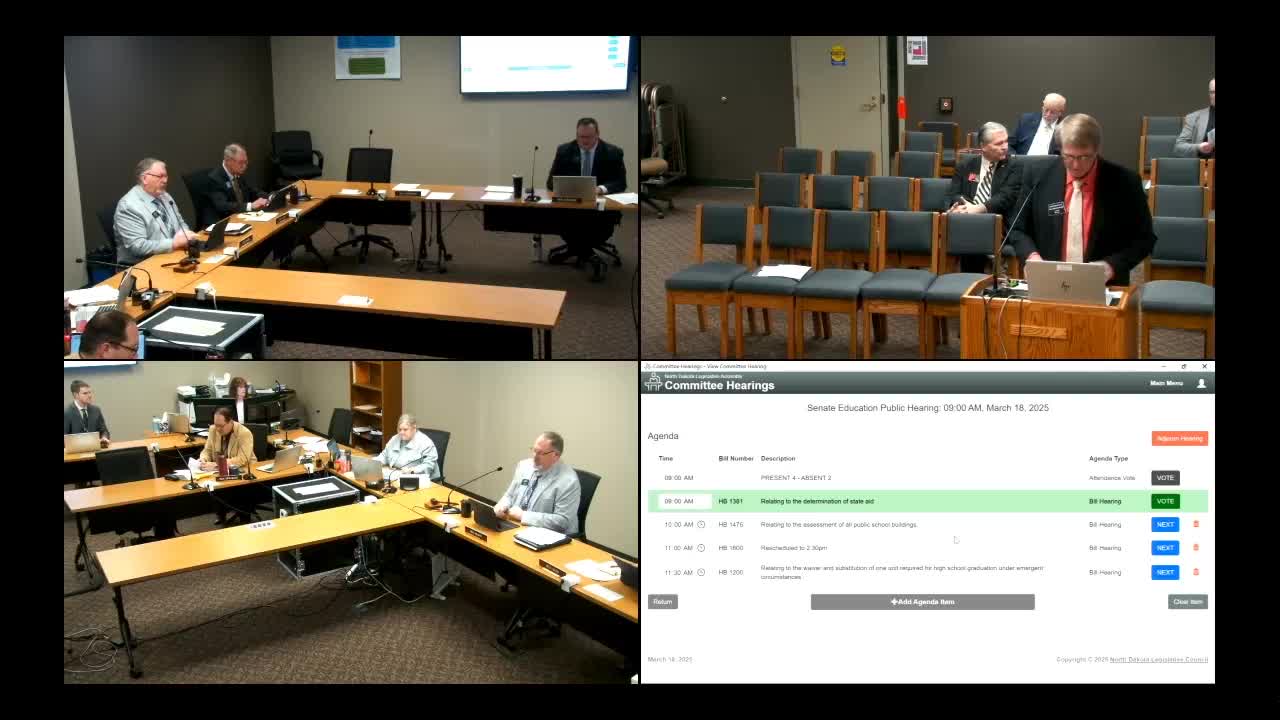
House Bill 1381, carried in testimony by Representative Mike Brandenburg, would change how central-assessed revenues are treated in the school funding formula by reducing the ‘‘in lieu’’ factor from 75% to 65%, allowing many districts to keep about 10% more locally.
House Bill 1381, carried in testimony by Representative Mike Brandenburg, would change how central-assessed revenues (for example, oil and gas production, electric generation and transmission, federal impact aid, and certain mobile-home and telecommunications receipts) are treated in the state school funding formula by reducing the ‘‘in lieu’’ factor from 75% to 65%.
Representative Mike Brandenburg (District 28) told the Senate Education Committee that the bill would allow school districts to retain an additional 10% of those revenues locally instead of having the state treat 75% as imputed into the formula. He said the change would reduce the amount deducted from a district’s foundation aid payment and estimated the biennial fiscal impact presented during House consideration was in the low‑teens of millions of dollars (he cited roughly $12.5 million as a fiscal note during committee discussion).
Supporters and district officials said the bill would most benefit districts that receive significant central-assessed revenues from generation facilities, wind turbines, or other central-assessed property. Brandt (representing Glen Ullin School District in testimony) showed committee members how the change would affect a specific district’s worksheet: a town that now sees a subtraction of about $492,000 in the formula would instead see a subtraction of about $426,000, allowing roughly $65,000 to remain available locally for schools. Superintendent Steve Holland, from Mackenzie County School District No. 1, and Alexander Superintendent Leslie Bieber also testified in favor, saying districts use retained in-lieu revenue for debt service, teacher housing, construction and other locally determined needs.
Adam Tesher, school finance officer at the Department of Public Instruction, said the fiscal note attached to the bill totaled about $13,000,500 from the general fund for the biennium and that the appropriation, if adopted, would be built into the ongoing cost-to-continue. Tesher also summarized prior formula changes: telecommunications and mobile-home categories were treated at 100% deduction from 2013 until 2019, when those two were moved to 75% like other categories, and some line-item adjustments (for example, federal impact aid and tuition imputations) have changed over past sessions.
Committee members asked how retained funds might be used and whether the change would automatically reduce property taxes. Brandenburg and witnesses emphasized that the change would not automatically lower a district’s tax rate; rather, it would provide additional revenue districts could use as they choose (debt service, property-tax relief, salary, etc.), and the state appropriation would backfill the difference so districts are effectively held neutral in total funding. Testimony also noted variation across districts: some will see larger absolute dollar effects than others.
No committee vote on House Bill 1381 was recorded during the hearing.
Ending
Committee members closed the public testimony after asking a series of clarifying budget and formula questions. Several superintendents and district representatives urged passage to return more locally controlled revenue. The bill remained at the hearing stage with fiscal and appropriation questions still under discussion.