Get Full Government Meeting Transcripts, Videos, & Alerts Forever!
Get email alerts on the Healthcare Price Transparency topic
No spam. Unsubscribe anytime.
Lawmakers weigh bill to enforce federal hospital price-transparency rule at state level
Summary
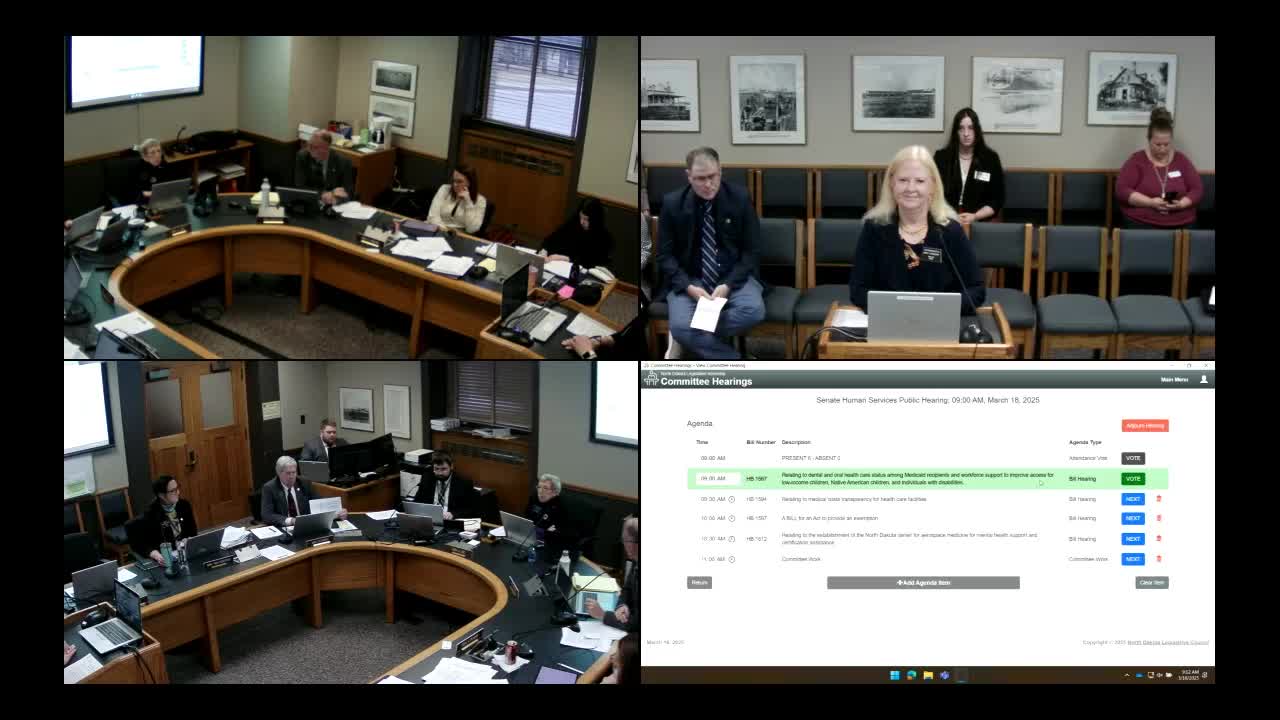
Representative Jared Hendricks and the Insurance Department told the Senate Human Services Committee that HB 1594 would codify federal hospital price-disclosure requirements into state law and add enforcement tools; hospitals and a national transparency researcher testified for and against elements of the proposal.
Representative Jared Hendricks (R-District 10) told the Senate Human Services Committee that House Bill 1594 would strengthen medical price transparency by codifying federal disclosure requirements into state law and giving the North Dakota Insurance Commissioner new enforcement authority.
“HB 15 94 strengthens medical price transparency by codifying compliance into state law and giving the North Dakota Insurance Commissioner tools to enforce,” Hendricks said during his opening remarks.
Why it matters: Committee members and witnesses framed the proposal as an attempt to make hospital and facility prices easier to find and compare, with the goal of empowering consumers and reducing health-insurance premium growth. Supporters said federal rules exist but often go unenforced; opponents warned that inconsistent reporting and complex bundled charges could mislead consumers and that state enforcement duplicates federal rules.
What proponents said - John Arnold, deputy insurance commissioner, said the department’s interim “secret-shopper” study found wide price variation and that federal compliance and enforcement have been inconsistent. “The ability to actually get this information from the hospitals was very difficult,” Arnold said. The testimony cited examples where charges for the same procedure varied widely between hospitals.
- Adam Meyer, senior fellow at the Cicero Institute, said price opacity persists across settings and urged state-level enforcement to fill federal enforcement gaps; he noted other states have adopted similar measures.
What opponents said - Tim Blaso, president of the North Dakota Hospital Association, said hospitals support price transparency but urged caution. He said many hospitals are already posting required data and disputed testimony claiming 0% compliance in North Dakota. “To say that there's 0% of hospitals in the state that are in compliance is totally false,” Blaso told the committee.
- Hospital witnesses also warned that posted data often reflect charges, negotiated rates, and assorted billing components that are not uniformly comparable across facilities; they encouraged working with hospitals and the department to ensure apples-to-apples comparisons rather than imposing new state policing and costs.
Policy details discussed - The bill would adopt federal machine-readable reporting requirements and add a state-level attestation tied to insurer-provider contracts; insurers would be required to obtain attestations from providers as part of network agreements.
- Representative Hendricks described a proposed amendment to exempt the state hospital and noted a sliding penalty scheme that reduces fines for critical-access hospitals and non-hospital providers such as ambulatory surgery centers.
- Committee members questioned whether public price data will actually change consumer behavior for urgent or specialized care and raised concerns about burdening providers with additional administrative work.
Next steps - The committee heard multiple supporters, opponents and neutral testimony including officials from the Insurance Department and the Department of Health and Human Services. No formal committee action was recorded at the close of the hearing. Lawmakers asked for follow-up information on data consistency, charity care, and how uncompensated care would affect price comparisons.