Get Full Government Meeting Transcripts, Videos, & Alerts Forever!
Get email alerts on the Library Materials Obscenity topic
No spam. Unsubscribe anytime.
House Judiciary Committee Hears Bill to Require Libraries, Schools Relocate Explicit Material; ODIN Says $1.1M Upgrade Needed
Summary
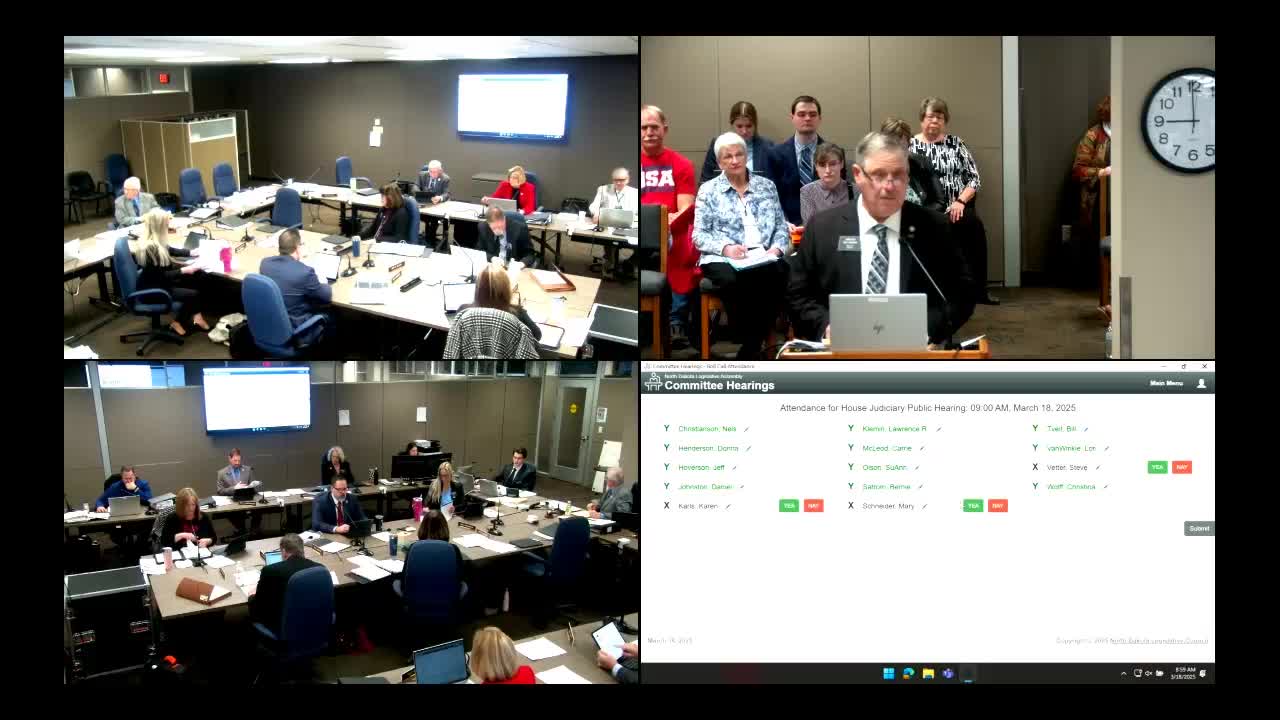
The House Judiciary Committee on Oct. 12 heard testimony on Senate Bill 2307, which would create a process for patrons to challenge sexually explicit or obscene materials in public and K–12 school libraries and require that material later deemed obscene by a state's attorney be relocated "not easily accessible to minors."
BISMARCK, N.D. — The House Judiciary Committee on Oct. 12 heard testimony on Senate Bill 2307, a measure that would create a process for patrons to challenge sexually explicit or obscene materials in public libraries and K–12 school libraries and require those materials to be moved to areas “not easily accessible to minors” if a state's attorney later deems them obscene.
The bill’s sponsor, Senator Behm, told the committee the measure is “a necessary and measured step in protecting minors from exposure to obscene and explicitly sexual materials in schools and libraries,” and repeatedly said, “This bill does not ban books. It simply ensures that explicit content is not easily accessible to minors.”
Why it matters: Supporters said the bill fills a perceived enforcement gap after local review processes failed in some districts; opponents said the measure would impose heavy operational, legal and fiscal burdens on small libraries and risk chilling access to legitimate materials. Neutral technical witnesses warned the bill would require major changes to electronic resource systems used across the state.
Most important provisions and timelines
- Complaint and local review: Under the bill a patron can request that a school district, public library or state agency review material alleged to contain obscene or explicit content. Local committees, boards or administrators would perform an initial review and could escalate the matter to a state's attorney.
- State's-attorney review and remedy windows: If a state's attorney issues an opinion finding the material obscene, the library or school would have a 10-day window to take corrective action (usually relocation to an area not easily accessible to minors). The state's-attorney review period is 60 days from receipt of the request; supporters and bill language referenced a total possible timeframe “up to 70 days” that can elapse from complaint to required corrective action.
- Penalties and funding consequences: If an institution fails to comply after a state's-attorney opinion, the bill as drafted authorizes withholding of state funds; the state library testified it wants to receive the report when that step is reached so it can coordinate any withholding with the treasurer and the Department of Public Instruction for school libraries.
Supporters’ testimony and local examples
Senator Behm and several proponents said the bill is narrowly targeted and preserves access for adults while protecting minors. "If this content is inappropriate for adults in a public hearing, how can we justify making it readily available to children?" Behm said, recounting a library display he said had distressed a 12-year-old.
Representative Mike Brandenburg and parents from the Foreman area told the committee about a small school where a series of graphic novels — identified in testimony as Heartstopper — was placed on a front display and remained accessible to younger pupils despite parent objections. Sarah Plantine, who said her children attended the Foreman school, testified she filed a formal request for reconsideration and that the school's review process was, in her view, handled in a way that disadvantaged complainants. “I filed that on October 11,” Plantine told the committee about her formal request.
Vicki Steiner described visiting a Dickinson library meeting where a board member said a librarian had recommended a cartoon-format title that a board member later said included a sexualized cover. Steiner said library staff had placed the title low on the shelf next to the children's cartoons and that “a 12-year-old was very distressed.”
Clinical testimony also supported the proposal. Dr. Jill Manning, a licensed marriage and family therapist, testified about research she said links early exposure to explicit material with adverse neurological and behavioral outcomes and urged a "due pass" recommendation for the bill.
Opponents’ concerns: burden, scope and First Amendment risk
Opponents — including representatives of the North Dakota Library Association (NDLA), independent booksellers, parents’ groups and local library volunteers — urged the committee to reject or substantially amend the bill.
Dylan Gonser, speaking for the NDLA on behalf of Andrea Placher, said, “North Dakota Library Association is firmly against SB 2307, mainly because we just feel that it's very unnecessary and is very burdensome amongst libraries of all types.” He told lawmakers the state’s libraries already use reconsideration processes, and that the bill’s expanded enforcement path (including potential referral to a state's attorney and withholding of funds) could overwhelm small staffs.
Lindsay Birch, manager of a small bookstore in Minot, and others argued the bill's language is vague and could force libraries to choose between expensive physical alterations, locking or removing resources, or running afoul of the statute. Several witnesses warned that smaller libraries and bookmobiles lack space for a physically separate adult-only section and that vendors for statewide digital resources do not provide the granular content filters the bill would require.
Technical and fiscal testimony: ODIN and state library
Corey Quirk, deputy CIO for technology services at the North Dakota University System, and Jason Bedsall, director of ODIN (the Online Dakota Information Network), testified neutrally but flagged a substantial fiscal and technical impact if the bill’s digital-access provisions are enacted.
Quirk said ODIN would need to move from IP/location-based access to per-user authentication so that digital resources could be restricted by user age or status. He told the committee ODIN was asking the Legislature for a one-time appropriation of about $1.1 million to upgrade systems and cited ongoing costs in the next biennium of roughly $880,000 to operate and maintain the upgraded authentication and filtering functions.
The state librarian echoed concerns about complexity and explained how many statewide database contracts are jointly negotiated through Minitex and administered by ODIN; she asked the committee to route any statutory reporting that could trigger withholding of funds through the state library so payments can be coordinated with the treasurer and the Department of Public Instruction.
Process questions raised at the hearing
Committee members pressed the sponsor and witnesses on several operational points: whether the state's attorney must be consulted (the sponsor said the state's attorney is explicitly placed in the loop because the bill removes school and library exemptions from the state's obscenity code), what constitutes an adequate “not easily accessible to minors” location (the bill mentions examples such as a sign-posted area or cabinet but leaves specifics to local implementation), and how online vendor systems such as OverDrive/Libby and shared academic databases would be managed.
Several library witnesses noted that OverDrive/Libby and other e-book vendors do not currently offer age-by-user controls usable at the statewide level and that removing or restricting a single title in a vendor collection could remove it for all patrons. Witnesses cautioned that mass or automated complaint lists circulated by outside organizations could overwhelm local review processes.
Committee procedure and next steps
Chairman Clamine opened the hearing by noting public comment would be limited by committee schedule; proponents were given up to an hour, followed by an hour for opponents and a neutral panel. No committee vote was taken during the hearing. Quirk and Bedsall said they would provide the committee and Appropriations Committee the vendor quote and underlying spreadsheet that produced ODIN’s cost estimate.
What the bill would not do (based on testimony)
- Supporters and multiple witnesses said the bill does not create criminal liability for staff or librarians absent the state's-attorney finding and final noncompliance after the specified process.
- The sponsor repeatedly stated the bill is not a blanket book ban; rather, it provides a formal path for review and, where a state's attorney concurs, removal from general youth access.
What remains unclear from the hearing
Committee members and witnesses identified several open items that would likely require drafting fixes or committee amendment, including:
- Precise definitions and minimum standards for “not easily accessible to minors” (signage, rope, cabinet, locked room, separate building) and whether a rope or signage alone is adequate. - Who may file a complaint (the bill language allows individuals; opponents warned that out-of-state or mass-submitted lists could be used to force reviews). - The interaction between the bill and existing federal rules (witnesses referenced the Children’s Internet Protection Act) and other state bills on age verification and digital access. - The fiscal impact and implementation pathway for ODIN and shared digital vendors.
Ending note
Committee members did not vote on SB 2307 at the hearing. Staff and witnesses agreed to provide additional documentation — including ODIN's vendor quote and written testimony referenced during the hearing — if the panel requests further information before working the bill.
Speakers quoted in this article appear in the meeting record and were identified for the committee.