Get Full Government Meeting Transcripts, Videos, & Alerts Forever!
Get email alerts on the Dental Access topic
No spam. Unsubscribe anytime.
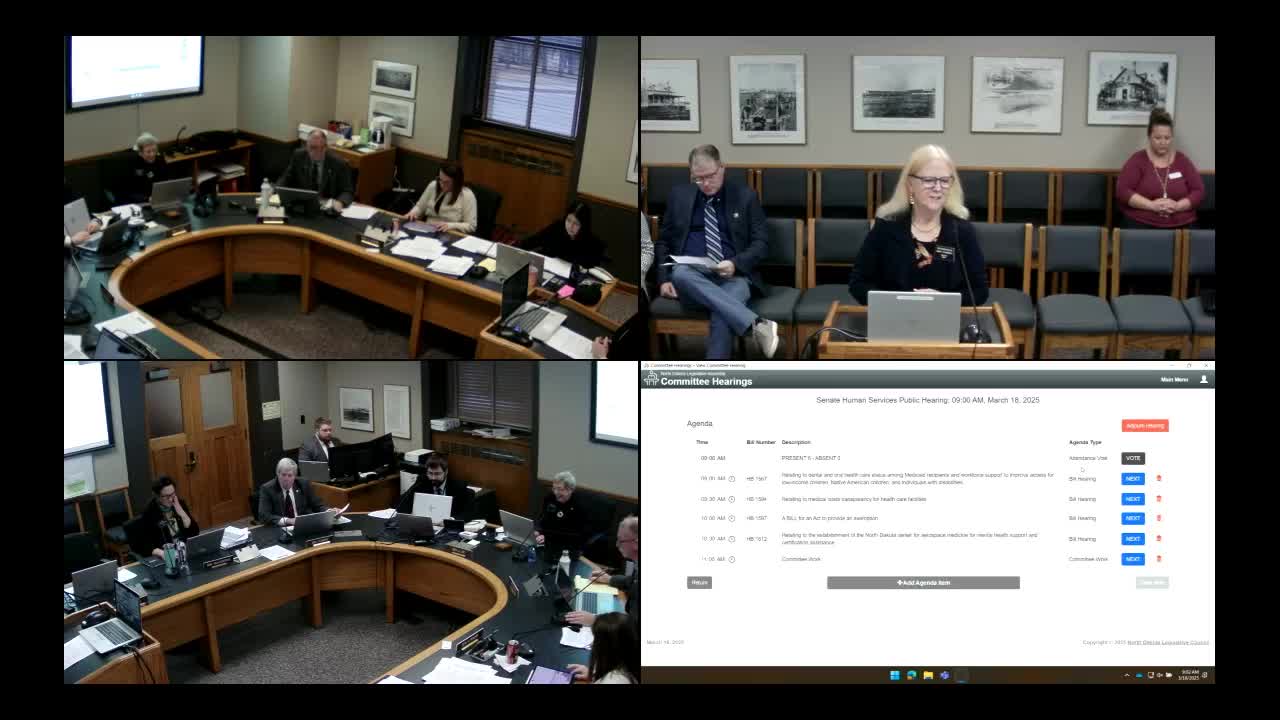
Senate Human Services Committee hears testimony calling for study of dental access for Medicaid recipients, Native American children and people with disability
Summary
Lawmakers and providers urged a legislative study of dental care access in North Dakota, citing provider shortages, low Medicaid uptake, high emergency visits for tooth pain and worse outcomes for Native American and disabled populations.
Representative Mary Schneider (R-District 21) asked the Senate Human Services Committee on Wednesday to approve an interim study of unmet dental and oral health needs for low-income children, Native American children and people with disabilities in North Dakota.
Schneider said the study would examine the scope and causes of poor access and produce plans, goals, costs and timetables to remediate the problem. “It's both shocking and shameful that after the attention from past studies and the admissions of unmet needs, we haven't addressed the problem of dental access in a permanent and meaningful way that solves a problem for Medicaid recipients,” Schneider said.
Why it matters: Providers, community health centers and advocates told the committee that shortages of dentists and administrative barriers to Medicaid enrollment are leaving many patients without routine or emergency dental care. Testimony documented rising emergency visits for tooth pain, widespread untreated decay among children and large disparities for Native American residents and people with disabilities.
Providers and advocates said the study should cover Medicaid reimbursement, administrative barriers to dentist enrollment, workforce recruitment and retention, use of dental students and volunteers, access to facilities needed for complex cases that require anesthesia, and relationships between state and tribal health systems.
What the committee heard - Kim Coleman, policy and partnership manager for Community Healthcare Association of the Dakotas (CHaD), said community health centers provide integrated primary and dental care to underserved communities and support a legislative study. CHaD data cited in testimony show health centers served 11,912 dental patients with more than 25,000 dental visits in 2023 and that about 40% of health center patients are Medicaid beneficiaries.
- Coleman told the committee that emergency and urgent-care visits for tooth pain in North Dakota rose from 2,625 in 2020 to 4,715 in 2024.
- William Sherwin, executive director of the North Dakota Dental Association, said the profession supports the study and noted new educational programs and loan-repayment tools that might help recruitment.
- Testimony from local public-health and human-service leaders described frequent referrals they cannot fill. Barbara Friedland, director and registered nurse at Rolla (Rolla/Rollabr?) County Public Health, said roughly 48% of children screened in her Health Tracks program need immediate dental care and staff often have no local referral options.
Details and data cited to the committee - Committee testimony said only 44% of the statewide need for dental providers is being met and that 19 of the state’s 53 counties have no dentists. - Representative Schneider said there are 69 designated dental health professional shortage areas covering roughly 53,291 people (as reported in testimony) and that many more data points need updating. - CHaD said roughly 1 in 2 kindergartners have experienced tooth decay; more than half of indigenous adults reported no dental visits in five years; and nearly 1 in 4 long-term-care residents in the state have untreated tooth decay.
Proposed study components and options discussed - The bill (House Bill 1567) asks for an interim legislative study to review oral-health status for specified populations, consequences of unmet need, Medicaid enrollment and reimbursement rules, preauthorization and claims-denial rates, use of dental students and apprenticeships, charitable and volunteer programs, and access to surgical/anesthesia facilities for complex dental procedures. - Witnesses recommended examining expanded loan forgiveness, recruitment tied to out-of-state tuition repayment, expanded use of dental hygienists and dental therapists, and grant or appropriation support for dental-student rotations.
What lawmakers said - Senators and committee members asked about training pipelines, the role of federally qualified health centers, and whether recent changes in state programs and board membership might improve access. Several members noted ongoing state loan-repayment programs and new training programs in Minot and Bismarck.
Where this goes next - The hearing generated broad, largely unanimous support for moving the bill forward to a committee recommendation for a study. No formal committee vote was recorded at the hearing. Testimony and data were left on the record for the committee’s review ahead of its deliberations.
Ending note: Advocates framed the study as a first step toward measurable changes — not an immediate expansion of services — and urged the committee to ensure the study produces actionable plans and timetables if gaps are confirmed.