Get Full Government Meeting Transcripts, Videos, & Alerts Forever!
Get email alerts on the Deepfake Sexual Images topic
No spam. Unsubscribe anytime.
Committee considers bill to criminalize explicit deepfake images; prosecutors urge using revenge‑porn statute and limit registration requirement
Summary
The Judiciary Committee heard testimony on House Bill 13‑51, a proposal to criminalize explicit deepfake images and videos, with prosecutors and child‑advocacy groups urging the committee to amend the draft to avoid unintended effects on prosecutions and registries.
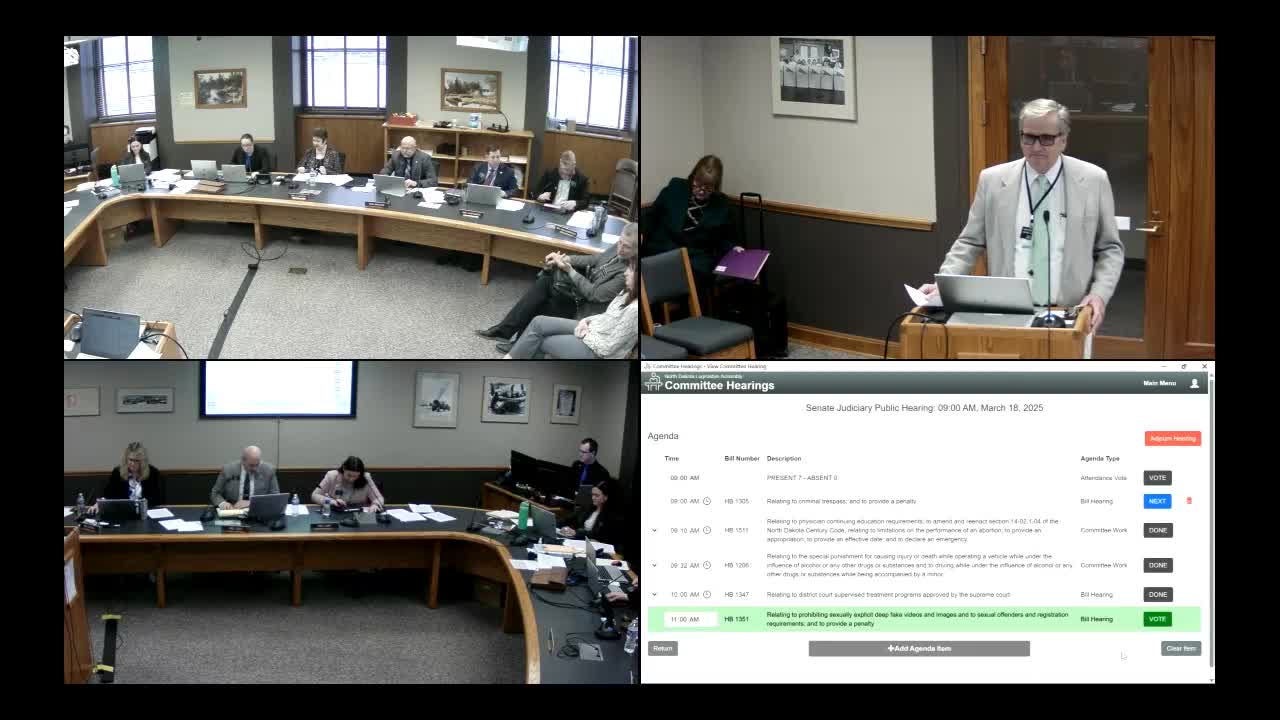
The Judiciary Committee held extensive testimony on House Bill 13‑51, a proposal to criminalize explicitly sexual deepfake videos and images.
Representative Bernie Satram, sponsor, said the bill is intended to address “deepfake videos” that place a person’s likeness into explicit material without consent. He told the committee AI “can be used for great good or great harm,” and said the bill had several friendly amendments to align it with other statutes and to protect internet service providers from civil exposure.
McLean County State’s Attorney Lad Erickson testified that while he supports addressing deepfake harms, he recommended the committee not create a new lesser included offense that would interfere with prosecutions of existing felony sex crimes. Erickson proposed deleting the bill’s new misdemeanor lines (page 1, lines 17–19 in the draft he discussed) and instead amending North Dakota’s existing “revenge pornography” misdemeanor to cover “real or altered” explicit images. He told the committee that the existing approach includes careful defenses and exceptions — for example, parenting or permissive sharing of images — and that courts and prosecutors had already addressed many related situations in prior work on the revenge‑porn statute. Erickson cautioned further that adding a lesser included offense could force victims into trial testimony in cases that otherwise would proceed differently and could create unintended effects on mandatory‑minimum sentencing schemes.
Erickson also urged deleting language that would add the new misdemeanor to the sex‑offender/child‑offender registration scheme; he argued the registration system has been overbroad in the past and that adding a new misdemeanor to mandatory registration would have adverse consequences in borderline cases. The transcript records his request to “delete that” registration addition on page 3 (bottom) of the bill draft.
TechND (technology industry representative Terry Evertz) supported the bill but asked the committee to add explicit immunity language protecting interactive computer-service providers and internet service providers from liability for user‑provided content; TechND offered draft language citing 47 U.S.C. §230 principles. The State Court Administrator’s Office provided a technical amendment to allow courts to order identifying information redacted from pleadings that include identifying information, to keep victim identifying details out of public filings.
Children’s‑advocacy organizations expressed support for curbing deepfake exploitation but said they backed Erickson’s proposed amendment to use the existing revenge‑porn statutory framework and to be cautious about registration language. The committee agreed to collect the proposed amendments and asked Legislative Council to produce a consolidated “Christmas tree” version incorporating the various edits before the committee takes final action.
No committee vote on final passage of HB 13‑51 was recorded on the transcript; senators discussed incorporating the submitted amendments and planned to resume consideration once Legislative Council drafts the consolidated version.