Get Full Government Meeting Transcripts, Videos, & Alerts Forever!
Get email alerts on the Ethics Commission Budget topic
No spam. Unsubscribe anytime.
Ethics Commission tells appropriations panel complaints backlog, staffing and IT gaps hinder timely reviews
Summary
At a hearing on Senate Bill 2004, the North Dakota Ethics Commission urged funding for an education FTE, a case-management system and rule-implementation costs, and described statutory bottlenecks that have left some complaints pending for years.
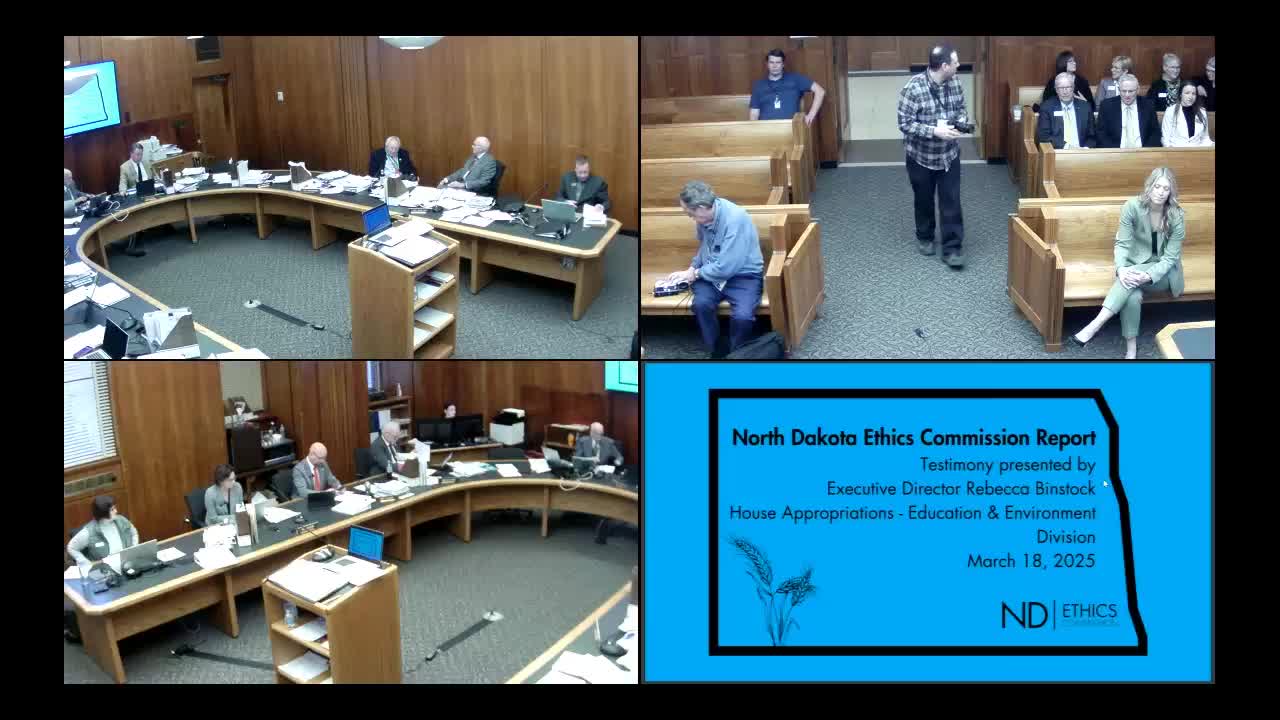
Bismarck — The North Dakota Ethics Commission told the Appropriations — Education and Environment Division on Tuesday that a surge in filings, statutory requirements that prioritize informal resolution and a shortage of staff and IT tools have slowed its ability to resolve complaints, and asked lawmakers to fund additional staff and systems.
The commission’s executive director, Rebecca Binstock, told the committee during a hearing on Senate Bill 2004 — a line-item appropriation for the commission — that filings rose sharply and that many cases are delayed by procedures set in Article 14 of the state constitution and existing statute. “The commission is the individual or the entity that dismisses the complaint, not me as executive director,” Binstock said, describing a multi-stage process that must move from initial review to informal resolution before any investigation.
That process, the commission said, creates bottlenecks. The panel heard that the agency received 59 complaints in roughly the first two-and-a-half months of 2025 and that prior to October 2022 nearly every complaint had been summarily dismissed; since late 2022 the office has seen more sustained filings, including serial filers. General Counsel Logan Carpenter said the commission had focused recent months on House Bill 1360, which sought broad statute changes to speed the process but failed in the House; “we're in process of doing that given the House's actions to kill the bill a few weeks ago,” he said.
Why it matters: Lawmakers and commission staff characterized the current cadence as unfair to both complainants and respondents. Multiple representatives said complaints that hang unresolved for a year or more cause real harm, while commission leaders said confidentiality rules and the statutory steps limit what staff can disclose publicly and slow case movement.
What the commission requested
- An additional education and communications FTE to develop training and outreach for the regulated community and the public; the commission estimated the biennial cost (salary, benefits, IT and travel) in its packet. Binstock said the general counsel and executive director currently devote roughly one-third of their time each to education and that a dedicated position would let legal staff focus on investigations.
- A case-management system: the commission asked the committee to fund a one‑time build (the Senate recommended $50,000) and an ongoing maintenance appropriation; staff cited other states where a case-management system shortened unresolved case duration.
- Funds for rules implementation and professional fees: staff asked for a reserve to implement rules adopted by the commission (they proposed $50,000 as an initial figure) and additional professional-fee funding to support expected litigation and outside counsel needs.
Budget context and activity levels
Binstock provided the committee with the commission’s recent numbers: the 2023–25 appropriation was roughly $1.14 million; the OMB-adjusted base for 2025–27 was shown around $1.12 million; the commission requested several add‑packages including the new FTE and IT/system funding. She said staff conducted 28 educational presentations in 2024 that reached an estimated 1,000 North Dakotans and launched a “Dakota Dilemmas” webinar series (the first webinar had 71 attendees). The agency has three full‑time staff today and noted two FTEs were added in the last session.
Statutory and operational constraints
Binstock and Carpenter described three complaint stages: (1) initial jurisdictional review, (2) a statutorily-required informal resolution stage that staff said often becomes a time sink, and (3) a formal investigation. The commission said the statute gives complainants control over whether an informal-resolution effort proceeds, and that complainants can remain confidential, complicating negotiation with respondents. That statutory architecture, the commission said, invites what staff and lawmakers described as exploitation or “weaponization” of the complaint process.
Commissioner Murray Sogswain, a newly appointed commissioner, told the committee he sees the statutory process as “way too cumbersome” and urged administrative and rule-based solutions if statutory fixes remain elusive.
Questions from lawmakers
Committee members pressed staff on how the commission would shorten case timelines without further statute changes. Representative Martinson repeatedly urged clearer deadlines and quicker dismissals when complainants will not cooperate; Binstock and Carpenter said some relief could come from administrative rule changes and improved internal triage but acknowledged that certain statutory requirements would still limit options.
Several representatives suggested fee or filing limits for serial filers (a “three-strikes” approach was discussed) to deter frivolous submissions; staff reported they were exploring similar measures used elsewhere.
No final action recorded
The hearing reviewed Senate Bill 2004 and the commission’s budget request; the committee did not vote on SB 2004 during the hearing, and no formal legislative action on the bill was recorded at the session’s end.
Ending note
Binstock said the commission will try to identify administrative work-arounds in the near term, shift staff time from legislative work back to clearing complaints now that HB 1360 did not pass, and work with legislators on potential statutory fixes for 2027. The commission asked legislators to consider funding for staffing, a case-management system and rule‑implementation costs to reduce delays and improve public transparency.