Get Full Government Meeting Transcripts, Videos, & Alerts Forever!
Get email alerts on the Fire Services topic
No spam. Unsubscribe anytime.
Bonner County fire chief urges clearer development review, more local water storage and stronger community defensible-space outreach
Summary
Chief Armstrong described staffing gaps and response-time risks across multiple local fire districts, urged earlier fire input on development reviews, recommended community water storage and tracking of cisterns, and offered to work with county planning staff to improve coordination.
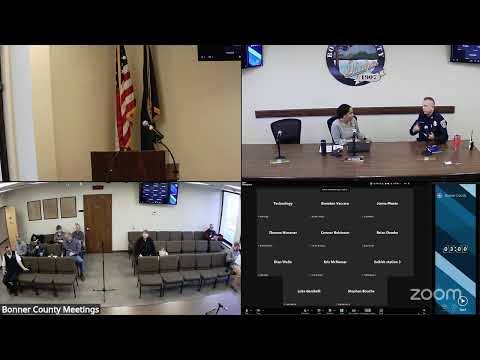
Chief Armstrong, fire chief for Selkirk Fire District and the contract chief serving Northside and the successor joint powers agreement (JPA) for Westside and Sago Fire Districts, outlined staffing shortages, response-time gaps and water-supply limits during a Bonner County “commissioner chat” on Oct. 12, 2025.
Armstrong said the JPA model has given participating districts administrative and operational flexibility but that local staffing and volunteer shortfalls remain a pressing problem. “Defensible space makes a difference,” he said, urging homeowners to remove brush and limb trees rather than clear-cut, and offering free property assessments from trained staff while warning there could be delays if demand spikes. “It’s not an enforcement thing. We’re not gonna write it up,” Armstrong said.
The chief described specific coverage concerns: the Carywood station’s potential loss of staff could push response times to roughly 16 minutes for parts of the Sago Fire District, and some homes on peninsulas or distant corridors could see 17–18 minute responses. He said the Sago district typically has two or three water tenders and three to four firefighters on duty — resources he said would not stop a major wildfire: “We don’t have the resources to stop a major fire.”
Armstrong recommended greater county-level coordination of development review. He said the county’s current email notification for review requests is often too generic and can produce incomplete comments from fire staff; instead he proposed earlier, more specific engagement so fire officials can evaluate likely build-out, water needs, road access, turnarounds and other infrastructure before incremental approvals create unanticipated cumulative impacts. Armstrong offered to meet with planning staff to design clearer questions and to participate in a development-review committee.
On water supply, Armstrong said many properties have cisterns but the county does not track who owns or maintains them, creating reliability problems during incidents. He recommended more community storage — larger tanks or deployable “snap” tanks — and better mapping and maintenance of private cisterns so crews can find dependable fill points. “All these people had cisterns. Nobody’s tracking who has them and who doesn’t,” he said.
Several residents pressed specific concerns during public comment. Mike Rosedale, Bonner County clerk, asked what micro-level features firefighters want to see at a home; Armstrong reiterated defensible space as the most valuable factor and suggested portable pumps or a well-connected cistern with a float valve for those near water sources. A resident identified as Theresa raised the issue of accessory dwelling units and RVs increasing density and pressure on emergency services; Diane Wally said many cisterns are now poorly maintained and would benefit from clearer guidance.
County participants and attendees also discussed levies and the need for face-to-face outreach to explain service needs; one resident warned against creating large centralized bureaucracies, and Armstrong responded that his proposals emphasize lean administration and frontline firefighters rather than growing top-heavy structures.
Armstrong described community engagement plans — open houses, “coffee with the fire chief,” and social media posts — and said he will post events on SelkirkFire.us and coordinate with county staff. He offered to meet with planning staff and commissioners to improve interagency communication and to provide more useful, specific comments on development proposals.
No formal motions or votes were recorded during the chat.
Armstrong closed by urging residents to use the resources offered and to participate in future meetings so planning and emergency services can anticipate growth and its impacts before approvals are final.