Get Full Government Meeting Transcripts, Videos, & Alerts Forever!
Get email alerts on the Emergency Dispatch topic
No spam. Unsubscribe anytime.
Dispatch director details 2024 call volume, wildfire response and technology priorities
Summary
Dispatch reported 89,000 calls in 2024, described challenges during October wildfires, and outlined plans for Everbridge access, tactical dispatch teams, 988 implementation, CAD integrations and staffing/training improvements.
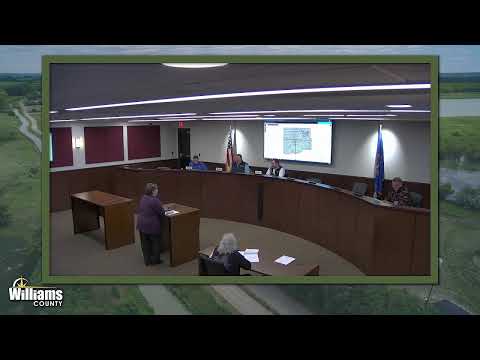
Williams County's dispatch director gave a detailed department update Jan. 21 that included 2024 call volumes, operational lessons from October wildfires and planned technology and staffing investments.
"Overall, we process 89,000 phone calls for the year altogether," said Michelle Grama, director of dispatch, summarizing the department's workload for 2024. Grama told commissioners the center created 17,000 calls-for-service records, received more than 13,000 911 calls (about 36 per day), processed roughly 51,000 nonemergency administrative calls and made about 24,000 outbound calls. The numbers translate to an average of about 244 calls per day handled by the center, she said.
Grama reviewed the dispatch center's response during the October wildfires, when the office received 636 calls over 48 hours, including 82 911 calls and several hundred administrative calls. The volume required holding over shifts and calling in on-call staff, she said. Grama told the board that having an on-call program and the ability to call individuals directly helped staffing responses.
She described communication challenges with more than 30 assisting agencies that used different radio systems and VHF channels. "We were not able to communicate with them effectively," she said, and county dispatch had to coordinate through state radio, which added complexity.
Grama outlined planned changes and technology priorities: obtaining direct access to Everbridge for mass alerts and reverse 911 capability rather than routing through the emergency manager; creating a tactical-dispatcher program so trained dispatchers would be dedicated to large incidents; acquiring a mobile dispatch console for field command; completing implementation of the Total Response platform (targeted for March) and integrating live video-chat features and 988 transfers where eligible. She also discussed CAD integrations, radio-programming capability in-house and a pending move to a cloud-based server in spring.
Staffing and training were recurring themes. Grama said the center now has 14 fully trained dispatchers, four administrative staff who are also cross-trained, and four trainees in a 16-week program; the department reallocated a position to serve as training coordinator and switched to a daily observation reporting platform to track trainee progress. On mental-health support for dispatchers, Grama said supervisors received peer-support and mental-health-crisis training and dispatch staff have access to county first-responder counseling through ConnectUs.
Commissioners praised the response to the fires and complimented Grama on the departmental improvements. No formal action was taken; the presentation was an informational departmental update. Several initiatives described by Grama will require further staff work, procurement decisions and potential interagency agreements before implementation.
A full list of software, hardware and training steps was discussed, but exact procurement timelines and budgetary amounts were not provided in the meeting record.