Get Full Government Meeting Transcripts, Videos, & Alerts Forever!
Get email alerts on the Courthouse Conditions topic
No spam. Unsubscribe anytime.
Judge requests mechanical and environmental study of Miami County Courthouse; commissioners ask administrator to pursue analysis
Summary
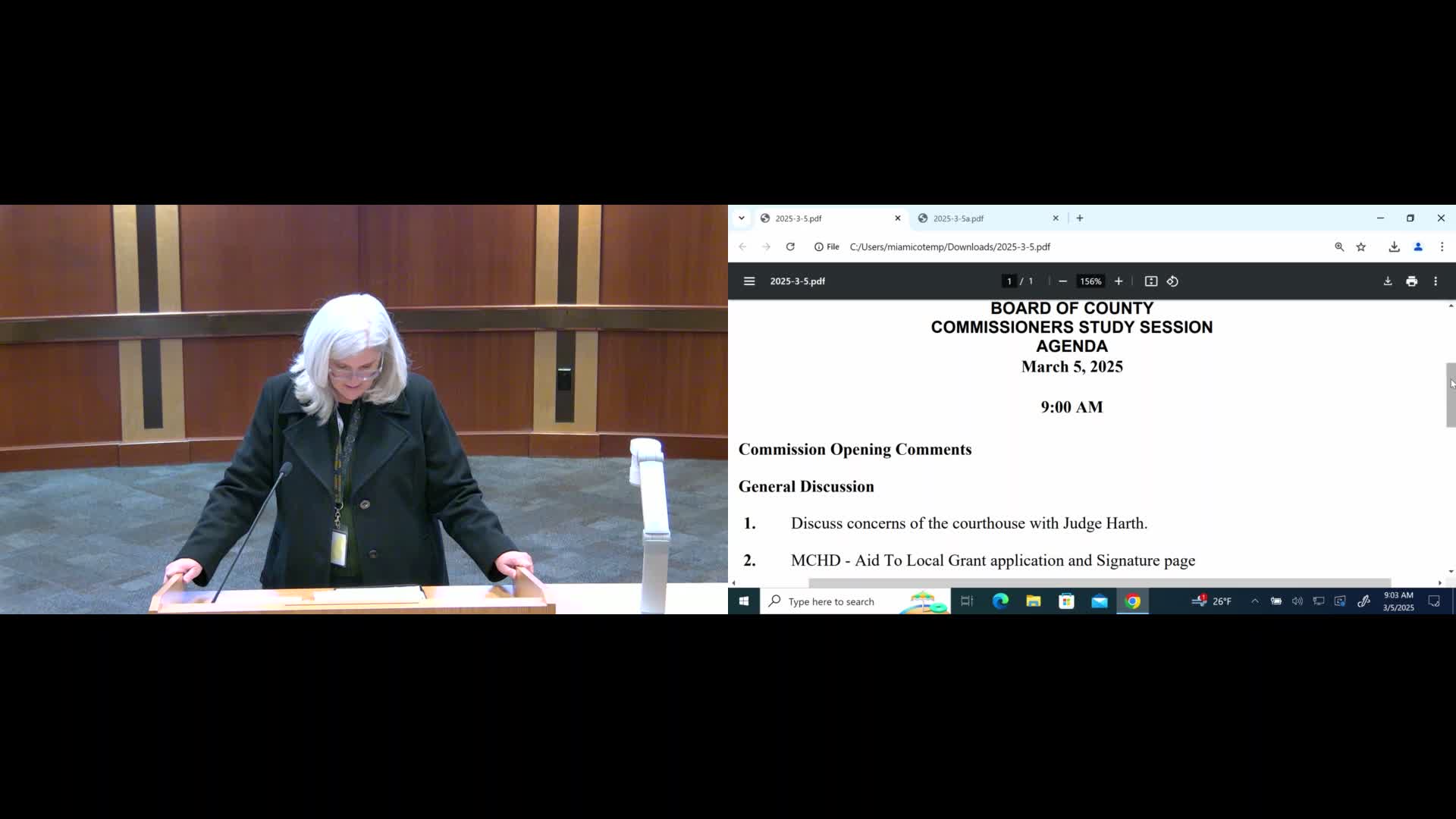
Judge Hart told the Miami County Commission that the 1897 Miami County Courthouse shows recurring water, roof and climate-control failures and asked the commission to engage a firm to study the building’s mechanical, environmental, plumbing and structural systems.
Judge Hart told the Miami County Commission that the 1897 Miami County Courthouse shows recurring water, roof and climate-control failures and asked the commission to engage a firm to study the building’s mechanical, environmental, plumbing and structural systems.
Hart said problems have disrupted court business and public access. “I just do not know what’s wrong with the building,” she said, citing a preliminary-exam hearing where the upstairs courtroom was about 60 degrees and a later jury trial where jurors were fanning themselves. “We ask our community to resolve their disputes in a place that just has problems.”
The judge offered concrete examples: slate tiles and bricks have fallen from the roof; the casing around a judge’s window decayed and fell onto a desk in May; a staff office behind an elevator is so damaged a book was stuck to the floor; key-card access recently locked clerks out of offices; jurors and litigants have been forced to relocate hearings because courtrooms could not be cooled. Hart said the courthouse houses both county and state staff and that the problems affect jurors, victims and litigants.
Why it matters: Hart and other court staff said the issues impede operations, create security and accessibility concerns and risk more-dangerous failures unless the underlying causes are identified. Hart noted that past public discussion about a quarter-cent sales tax raised questions about the courthouse’s needs but did not produce a full systems analysis that would produce current cost estimates.
Commission discussion and next step: Commissioners and staff discussed whether prior studies covered the courthouse. County staff said a prior mechanical, electrical and plumbing (MEP) study addressed a detention facility and pointed to separate environmental testing done periodically, but not a comprehensive courthouse MEP and environmental assessment. After discussion, the commission asked the county administrator, Shane, to study options and return with a plan to engage a qualified firm for a mechanical/environmental/plumbing/structural study. “Alright. Well, I have Shane work on that and get back with the commission,” the commission chair said.
What would follow: Commissioners said an MEP-plus-environmental study would provide empirical data and price estimates to inform decisions about repairs, rehabilitation or larger alternatives (for example, how to address space and security deficiencies). Multiple commissioners emphasized the public-relations need to show facts and numbers if the county seeks public funding or a ballot measure to address courthouse needs.
Hart and other judges added operational details to illustrate urgency. Hart described two recent court dates: a Feb. 17 preliminary exam that was moved because the upstairs courtroom was about 60 degrees, and a Feb. 24 jury trial where the judge said jurors were uncomfortable while hearing testimony from child victims. Other judges and court staff said they routinely bring extra deputies and adjust dockets and scheduling to cope with space and security constraints; they urged the commission to get a systems analysis rather than rely on cosmetic fixes.
Public-safety and access context: speakers noted the building’s age (Hart said the courthouse came online about 1897), recurring water intrusion and interior damage from roof leaks, limited restroom capacity for jurors and court users, and concerns about whether certain exits remain required egress. Commissioners and staff flagged that any study would need advance notice to the court if contractors require temporary closures for inspections.
The commission did not take a formal roll-call vote; commissioners recorded a consensus directing the county administrator to develop a plan and contractor scope and return to the commission with a recommendation and cost estimate for an MEP and environmental study.
Ending: County staff said they will return to a future agenda with options and a recommended approach, including estimated costs and timelines. The commission’s request is limited to studying the courthouse systems and producing recommendations; no contract was approved at the meeting and further action will be required to hire a firm or allocate funding.