Get Full Government Meeting Transcripts, Videos, & Alerts Forever!
Get email alerts on the District Budget topic
No spam. Unsubscribe anytime.
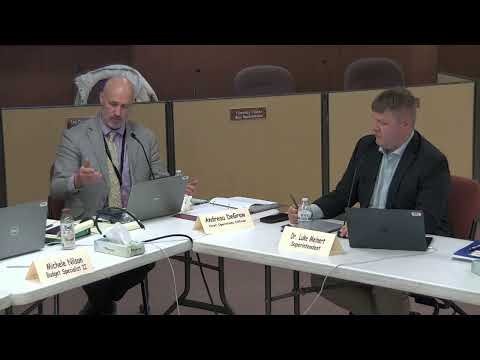
Fairbanks North Star Borough School District debates budgeting for vacancies, class-size targets and transportation subsidy
Summary
At a March work session the Fairbanks North star Borough School District discussed whether to budget for anticipated vacancies, proposed class-size (PTR) changes, transportation subsidy levels, and other budget levers including curriculum funding, laptop replacement and options for programs in North Pole.
The Fairbanks North Star Borough School District considered whether to budget for anticipated vacancies and several linked budget choices at a March 18 work session, with district staff warning the board that budgeting vacancies increases financial risk while some board members proposed a modest, data‑driven contingency to help close the FY26 gap.
The discussion focused on three fiscal decisions: whether to assume savings from vacancies when the district writes its FY26 proposed budget; what class-size (pupil‑teacher ratio, PTR) targets to use for K–12; and how much of a local transportation subsidy the district should assume pending state action. Those items came alongside separate conversations about curriculum and textbook funding, replacement of staff laptops, whether to repurpose buildings for programs such as Star of the North, and a possible charter school application from the Pearl Creek community.
District finance staff member Mr. DeGraw told the board, “My official recommendation is to avoid budgeting for vacancies,” and explained the logic: filling positions late in the year, using substitutes and contracted services for special education, and the district’s recent history of revenues sometimes falling short of expenditures. DeGraw showed that a conservative approach reduces the chance actual expenditures will exceed revenue, but conceded the choice is a “risk proposition” and that the board has authority to adopt a different approach if it wishes.
Several board members pushed back. Board member Miss Doolian said she had reviewed the approach used by other Alaska districts, and argued a modest vacancy assumption could be conservative and productive: “I would rather take a calculated risk now and not decrease the quality of education more than is necessary because we are at the bone,” she said, noting a 1% vacancy assumption would be roughly $1.6 million on the current payroll and benefits base and could reduce the district’s projected deficit.
Other board members voiced concern that any assumption about vacancies becomes a promise the district cannot fulfill if enrollment and revenues fall short. Board member Mrs. Hardy said, “We should not budget to not fill those positions,” arguing that many vacancies are short‑term and that principals need certainty to hire when candidates arrive.
The board reached partial operational consensus on several items to use as the starting point for the next session’s balancing act: a baseline projected enrollment of 11,626 (a 1.5% decline from FY25 actuals, about 79 students), elementary PTR target of 25, middle school PTR near 30.5, and a series of smaller line‑item choices (curriculum funding raised toward historic levels, one‑time laptop replacement deferred, and two proposed correspondence “satellite” sites in Midnight Sun and Two Rivers). The board also asked staff to model a 1% vacancy line (about $1.6 million), a possible 2% enrollment decline scenario, and the financial effect of an 8% charter school administrative fee (estimated at roughly $375,000) and the BSA / charter funding permutations discussed in Juneau.
Transportation funding was a separate, high‑visibility item. District staff described a roughly $3.5 million gap between current state transportation support and projected route costs under current operations. Mr. DeGraw explained the governor’s proposal would add roughly $2.0 million in state support, leaving an estimated local subsidy need of about $1.5 million; the district received a $1.0 million one‑time boost in the current fiscal year. Board members differed on how much to assume for the FY26 budget; some favored zeroing the local subsidy to free general fund dollars for classrooms, while others warned that doing so would almost certainly force midyear reductions to routes or require transfers from the general fund.
Other budget topics discussed: - Curriculum and textbooks: administration told the board the textbook/materials budget had fallen from roughly $900,000 several years ago to $215,000 last year; recent replenishment requests reflect catch‑up needs, particularly for materials that now require bundled digital subscriptions. - Technology: staff said the district’s staff laptops are about two years into a typical four‑year replacement cycle. Deferring the equipment‑replacement purchase again would postpone a roughly $2.0 million replacement obligation but would raise risk of increased device failures and longer‑term security and service problems. - Programs and facilities: the board discussed moving Star of the North into the Midnight Sun facility (a move that several board members supported) and adding two “BEST” correspondence satellite sites (Midnight Sun and Two Rivers) to serve remote families. Administration noted that the Two Rivers option would carry additional utility and facility costs if the district continued to hold that building. - Barnett Magnet and local school staffing: members debated a proposed reduction of 2.5 certified FTE at Barnett Magnet (the change would align Barnett’s staffing more closely with district PTR). Several board members opposed cutting Barnett’s staffing, saying it would undermine a high‑demand program; others said parity with district PTR was reasonable given constrained resources. - Special education at remote sites: multiple board members asked administration to model adding a certified special education teacher at Salchaket (SALCHA) in place of a paraprofessional; staff estimated the incremental cost at roughly $60,000–$70,000.
The board directed administration to return with a revised balancing‑act baseline for the next public session incorporating the items above (elementary 25 PTR, middle school 30.5 PTR, two BEST satellites, curriculum catch‑up estimate, a laptop‑replacement funding note, a 1% vacancy scenario and a 2% enrollment scenario, Star of the North placement, and the SALCHA special‑education teacher option). No formal vote was taken on any item at the work session; the board plans to consider motions and formal action during an upcoming budget meeting.
The discussion underscored tensions the board faces between protecting classroom staffing and managing revenue risk. As administration summarized, the choice to budget vacancies is “a risk proposition” that shifts probabilities for surpluses or deficits; board members who pressed for a modest vacancy assumption argued it could be used strategically to avoid deeper program cuts, while others said any such assumption could become an illusion of available funds and ultimately force midyear corrective actions.
The board scheduled further budget work for the next meeting, instructing staff to prepare scenarios that reflect the consensus starting points and the alternate revenue and enrollment assumptions the board requested.