Get Full Government Meeting Transcripts, Videos, & Alerts Forever!
Get email alerts on the State Land Sales Recreational Cabin Sites topic
No spam. Unsubscribe anytime.
Senate Resources hears SB 105 to let Alaskans nominate and buy remote cabin sites; committee sets bill aside after lengthy public opposition
Summary
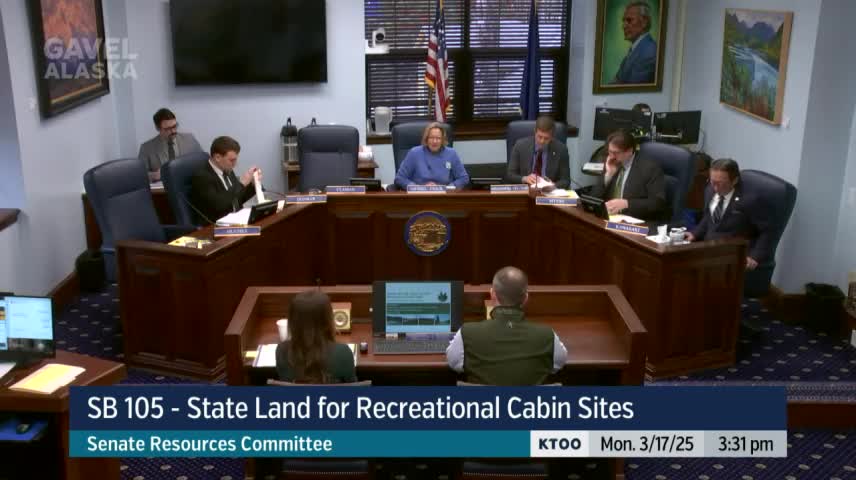
Senate Bill 105, a proposal to expand opportunities for Alaskans to nominate, lease and purchase remote recreational cabin sites on state land, drew hours of questioning and broad public opposition at the Senate Resources Committee hearing March 17; the committee set the bill aside without a vote.
Juneau — Senate Bill 105, a proposal to expand opportunities for Alaskans to obtain recreational cabin sites on state land, drew detailed questions from the Senate Resources Committee and broad public opposition on March 17, 2025. The bill would let individuals nominate up to 10 acres for remote recreational cabin sites, allow a lease of up to 10 years with an option to purchase during the lease, and provide a process to transition certain long‑standing personal use cabin permits into leases or sales. After more than two hours of testimony and committee questioning, Chair Senator Bert Stedman Giesel announced the committee would set the bill aside for further consideration.
The bill’s sponsors and Department of Natural Resources (DNR) officials said the proposal is intended to increase private ownership opportunities for Alaskans and to streamline a land-disposal path that DNR officials described as cumbersome in some cases. "Fundamentally, less than 1% roughly 1% of Alaska is in private hands," Commissioner John Boyle said while introducing the measure. Director Christy Collis said the proposal is meant to help Alaskans obtain and steward small parcels for private recreation and to reduce barriers in the current staking-and-auction processes.
Supporters framed the bill as an incremental way to broaden homeownership and stewardship of remote sites. Director Collis cited Article 8, Section 1 of the Alaska Constitution in describing state policy to encourage settlement and development of resources and said selling discrete parcels for private use can spur local investment. "By placing more land into the hands of Alaskans, we unlock new pathways to hone homeownership, business expansion, and responsible resource development," Collis said.
DNR staff described the existing remote-recreational-staking program and the changes SB 105 would make. Under current practice the department advertises staking areas (historically 86 staking areas covering roughly 66,940 acres advertised across multiple openings), surveys parcels after staking, and disposes of parcels by sealed bid or over-the-counter sale when unsold at auction. Collis said the division has completed 16 advertised staking openings since 2001, resulting in 830 parcels sold totaling about 10,929 acres. The bill would preserve scheduled land offerings but add a nomination path in which an individual could propose a specific 10-acre parcel for DNR approval and public notice; if approved, the applicant could obtain a lease (up to 10 years) while survey and appraisal work is completed and then purchase the parcel at fair market value or enter a purchase contract of up to 30 years.
Two provisions drew sustained committee scrutiny: (1) an exemption in the bill that would remove certain reclassifications from the heightened notice requirements of AS 38.05.945 (the statute that prescribes 30-day online notice, newspaper publication and direct notice to certain local entities), and (2) language allowing transition of personal use cabin program (PUCP) sites into leases or sales even when those sites are within legislatively designated areas such as game refuges and other special management units. Committee members and the Department of Law explained the difference between constitutional public-notice obligations (Article 8, Section 7) and the statutory 38.05.945 notice standard; Assistant Attorney General Christopher Orman told the committee that the constitution requires notice but that the 38.05.945 statute builds a more prescriptive, legislative notice regimen that this bill proposes to narrow for the new program.
Those technical changes prompted broad public opposition during the committee’s one‑minute public‑testimony slots. Testimony came from across the state (McCarthy, Homer, Palmer, Deltana, and other communities) and included longtime users of state land, outdoor-recreation groups and local advisory-board members. Common objections included concerns about habitat fragmentation, increased wildfire risk, diminished public access, reduced local infrastructure capacity (roads, bridges, outhouses, and emergency services), and the potential for speculation or assignment of leases to nonresidents.
"Selling cabin sites on this land would negatively impact [existing local uses]," Pat Garrett of McCarthy told the committee, citing local reliance on state land for firewood and subsistence uses. The Kachemak Bay State Park Citizens Advisory Board chair, Robert Archibald, testified: "Access is a big problem in some of these areas...they're tearing up the countryside." Wayne Hall of Anchorage urged the committee to prohibit dispositions in the bill’s enumerated 14 categories of protected land, calling for a clear textual bar to sales in parks and refuges: "I'd like to see a statement in there that just says any parcels under this program are prohibited in those 14 categories." Several speakers representing Alaska Backcountry Hunters & Anglers and the Alaska Outdoor Council urged the committee to reject SB 105, saying the public domain should remain publicly owned.
DNR officials offered clarifications and some commitments in response to questions. Collis said the department could provide committee members a list of the personal-use cabin permit (PUCP) sites that the bill would make eligible for transition; she agreed to supply the committee with that list. Collis and other DNR staff also said the nomination process would include public notice and the opportunity for administrative appeal after DNR’s initial approval decision; the department described the 10-acre nomination unit and a quarter-mile spacing rule designed to reduce clustering of nominations (except for valid mining claims and existing PUCP sites, which may be closer). Collis said DNR does not currently track the development rate of previously sold remote parcels and offered to provide failure-rate data and over-the-counter inventory figures to the committee.
Committee members pressed DNR and Department of Law on which aspects of the current remote-cabin program require statutory change versus administrative policy changes. Questions included whether DNR could already grant longer leases or structure lease-to-purchase arrangements under existing statutes and whether the 10‑acre nomination limit would apply to subdivision lots. Orman told the committee that leasing law has a common line at 10 years distinguishing short-term and long-term leases and that he would confirm statutory specifics for the committee.
At the hearing’s close, Chair Senator Giesel said the committee would set SB 105 aside. No committee vote on the bill was taken during the March 17 meeting. The chair announced the committee would next convene March 19 and would continue hearings on other matters. DNR officials told the committee they anticipate high interest in the program if enacted: Collis said DNR currently records 119 active PUCP permits, 140 closed permits, and 162 cabins where the permit is inactive or under appeal; she estimated roughly half of the 421 historical PUCP applicants might qualify under the proposed transition path, though exact figures would require parcel‑by‑parcel review.
— Ending summary: SB 105 would add a nomination pathway and lease‑to‑purchase mechanism for recreational cabin sites, expand a conversion path for legacy personal‑use cabin permits (including some sites within legislatively designated areas), and narrow certain statutory public‑notice and written‑finding requirements. Committee members requested additional data from DNR on development/failure rates for previously sold parcels, a list of PUCP sites, and clarifications from the Department of Law about statutory limits on lease terms. Public testimony was strongly tilted toward opposition citing access, habitat, wildfire and notice concerns; the committee set the bill aside without a vote for further consideration.