Get Full Government Meeting Transcripts, Videos, & Alerts Forever!
Get email alerts on the Juvenile Justice topic
No spam. Unsubscribe anytime.
Bonner County justice-services update: fewer arrests but rising acute youth mental-health cases
Summary
J.D. Storm, liaison for the Idaho Department of Juvenile Corrections, told the Bonner County Board of Commissioners on the county—s annual justice-services update that overall youth arrests and court petitions fell in 2024, but detention staff handled a higher share of acute mental-health cases.
J.D. Storm, liaison for the Idaho Department of Juvenile Corrections, told the Bonner County Board of Commissioners on the county—s annual justice-services update that overall youth arrests and court petitions fell in 2024, but detention staff handled a higher share of acute mental-health cases.
"In 2024, there were 83 youth arrests. That's down 38 compared to last year," Storm said, and added that detention admissions for Bonner County youth were 124 in 2024, "down 35 from 2023." He told commissioners that the drop in petitions does not necessarily indicate fewer youth in the system because some low-level incidents are handled as probation violations rather than new charges.
The report and subsequent discussion focused on mental-health needs among youth in custody. Storm and detention staff described repeated episodes in which the facility—s two observation cells were full, forcing staff to place young people on constant observation in general housing: "We had to have put kids out on the floor in the pod so that we could do those checks," the presentation said, and staff reported at one point having five youth on suicide watch.
Why it matters: County officials said local juvenile services are stretched by a lack of community mental-health placements. Storm and others said some youth who require sustained treatment end up committed to the state Department of Juvenile Corrections because local residential mental-health options are unavailable or because youth are discharged from treatment programs and then reoffend.
Key figures from the update: the presentation listed 74 youth petitions in 2024 (down 37 from 2023), charge types of 19 felonies, 134 misdemeanors and one status offense, a probation success rate of 96% and a diversion success rate of 92%. The county—s volunteer Youth Accountability Board handled 24 diversion intakes/releases in 2024, a program staff described as costing Bonner County no local tax dollars because volunteers run panels and program oversight.
Facility capacity and staffing: the detention facility was built with 27 beds but is staffed for a capacity of 16 under current staffing ratios, the update said. Commissioners were told staffing—not physical bed count—limits the facility's usable capacity and that occasional overtime is used to remain within required staff-to-youth ratios.
Demographics and recidivism: intake data showed most youth at intake were ages 14 to 16 (56%), with 11 to 13-year-olds comprising 16%, 17-year-olds about 26% and those 18 or under about 2%. The presentation reported recidivism rates of 9% at six months, 11% at 12 months and 17% at 24 months. Community service hours completed totaled 1,140 and $7,488 in restitution was paid to victims in 2024.
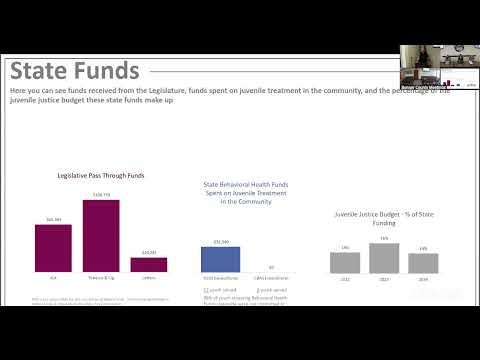
Funding and treatment resources: Storm reviewed state pass-through funds and other accounts used for juvenile services, saying legislative pass-through amounts and tobacco and lottery funds support local juvenile treatment. The county reported spending $32,540 in state behavioral health funds last year to serve 17 youth and noted the county has not had to draw heavily on community-based alternative service (CBAS) funds recently because other local accounts had available balances. Storm told commissioners he would next appear to present a plan for unanticipated revenue now in those accounts.
Board members and staff flagged the mental-health gap as the most concerning operational issue. Chair Buerkle said the board should keep the issue "on our horizon," adding that gender population swings and head counts can affect operations. Commissioners and staff praised the county—s probation and diversion work, and several speakers highlighted the role of families and trusted adults in reducing youth reoffending.
The update closed with staff saying they will return with spending recommendations for surplus funds and continued emphasis on diversion and community-based services where possible.