Get Full Government Meeting Transcripts, Videos, & Alerts Forever!
Get email alerts on the Deferred Maintenance topic
No spam. Unsubscribe anytime.
House Finance Committee hears update on $2.2 billion deferred‑maintenance backlog
Summary
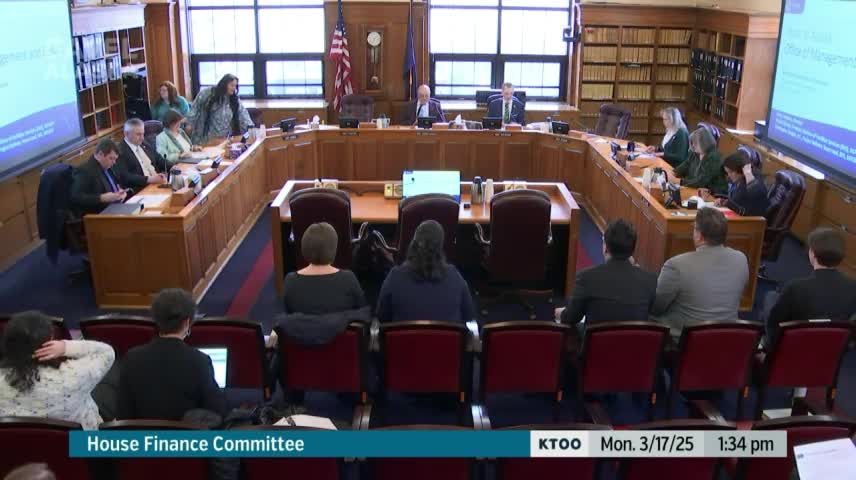
For the record, Co‑Chair Shrogy called the House Finance Committee to order on March 17, 2025, and the committee heard an update from the Office of Management and Budget and the Department of Transportation and Public Facilities on the state’s deferred‑maintenance inventory, prioritization process and funding status.
For the record, Co‑Chair Shrogy called the House Finance Committee to order on March 17, 2025, and the committee heard an update from the Office of Management and Budget and the Department of Transportation and Public Facilities on the state’s deferred‑maintenance inventory, prioritization process and funding status.
The presenters said the state’s facility portfolio includes nearly 2,000 facilities (excluding most school districts) and has an assessed replacement value of roughly $9 billion to $10 billion. Lacey Sanders, director of the Office of Management and Budget, told the panel that the statewide deferred‑maintenance backlog stands at about $724 million for state agencies alone and rises to about $2.2 billion when the University of Alaska’s 402 buildings — which the university inventories separately — are included. Sanders said the university’s backlog totals roughly $1.4 billion, including $1.26 billion categorized as deferred maintenance and about $224 million for renewal and replacement.
Why it matters: deferred maintenance is the sum of postponed repairs or replacements that agencies did not fund through their normal operating budgets. With limited capital available, officials said, the state must prioritize which projects to fund; failure to do so may produce higher replacement costs or safety risks in the future.
The Office of Management and Budget said the current designated funding mechanism for preventative and deferred maintenance is the Alaska Capital Income Fund (Chapter 88, SLA 2018; SB 107). "Annually, the amount of earnings from the fund are deposited into the fund," Sanders said, and those earnings are appropriated in the capital budget to OMB for allocation to prioritized deferred‑maintenance projects. Sanders told the committee the governor’s budget directs roughly $26 million (reported during the hearing as between $26 million and $28 million) to the capital income fund for deferred maintenance in fiscal 2025. She also said OMB holds an unobligated set‑aside (about $6 million this year) for emergent repairs; that set‑aside had been temporarily allocated to the state’s disaster relief fund and is not available until backfilled by a separate appropriation.
On process and prioritization, Daniel Gibson, director of Facility Services at DOT&PF, and Christopher Hodgen, project delivery team lead, described the Facilities Council and the Project Index Value (PIV) method DOT&PF uses to rank projects. Hodgen said the PIV combines a Mission Alignment Index (how essential a facility is to an agency’s mission), a system factor (which building system is affected, such as life/safety versus aesthetics), and a need score (how imminent the failure). "This gives the departments a method to better manage the risk to their programs and guide their investments," Hodgen said. The council, composed of agency representatives, scores projects and forwards a prioritized list to OMB for funding decisions.
Funding gap and recommended targets: Gibson summarized industry guidance that recommended annual investment to keep pace with maintenance ranges from 1 percent to 4 percent of replacement value. "Industry standard basically is anywhere from 1 to 4% of the replacement value of that facility," Gibson said; using the committee’s replacement‑value estimate, that range would translate into roughly $84 million to $337 million per year to sustainably address maintenance needs. Presenters and members noted the current capital income fund appropriation is well below that range, which helps explain the rising backlog.
Questions from committee members centered on several recurring issues: (1) what is and is not included in the displayed totals — the presentation excluded most school‑district buildings and separately inventoried items such as highways and marine assets, and Sanders and Hodgen clarified that Mount Edgecumbe High School and two state museum/library facilities are included in the DEED line but that most school‑district properties are not state owned; (2) the University of Alaska’s backlog is inventoried and funded, in part, through separate appropriations and thus does not always flow through the statewide deferred‑maintenance process; (3) the assessed replacement value of state facilities (Hodgen estimated it at about $9–$10 billion); and (4) whether the state has a comprehensive, statewide execution plan and the practical capacity to deliver projects if large new funding were provided.
Several committee members pressed the presenters for clarity on trends, execution capacity and whether projects are being deferred to the point of becoming uneconomical to repair. Hodgen and Gibson acknowledged that while DOT&PF tracks a short list of replacement needs (for example, some highway maintenance stations and other aging facilities), the state does not currently maintain a single statewide replacement schedule that would eliminate all deferred maintenance within a set time frame. Sanders said OMB has not produced a multi‑year statewide plan to eliminate the backlog and that resource constraints have prevented an all‑in solution. Representative Bynum asked whether the state is trending toward reducing the backlog; presenters said they had not produced a year‑by‑year trend analysis for the committee during this briefing but offered to follow up.
Presenters also described execution risks: limited contractor availability in some communities, market‑price volatility for labor and materials, hazardous‑material mitigation that can increase costs, and the need to ensure DOT&PF or the owning agency has staff capacity to manage and award projects. Committee members asked whether some agencies’ operating budgets already contain maintenance amounts and whether those interagency or operating transactions are being counted consistently; Sanders said the legislature requested clearer operating allocations in the present budget cycle but acknowledged the data are new and not yet standardized across agencies.
No formal action or votes were recorded during this hearing. The committee adjourned after scheduling the University of Alaska to present its deferred‑maintenance and capital requests in a March 18 hearing.
Ending: The committee asked OMB and DOT&PF to provide follow‑up information, including (1) the assessed replacement value documentation, (2) how many facilities have at least one deferred‑maintenance project on record, and (3) a clearer year‑by‑year trend of the backlog. The University of Alaska was scheduled to appear before the committee the next day to explain its inventory and funding requests.