Get Full Government Meeting Transcripts, Videos, & Alerts Forever!
Get email alerts on the Public Safety Care Department topic
No spam. Unsubscribe anytime.
Seattle committee hears CARE update: officials say 24 responders 'not nearly adequate,' urge sole-dispatch authority
Summary
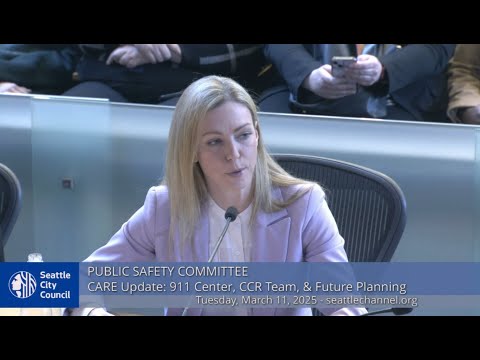
Seattle — The Seattle City Council Public Safety Committee on March 11 heard a wide‑ranging update on the city’s CARE Department, Seattle 911 and the city’s community crisis response effort.
Seattle — The Seattle City Council Public Safety Committee on March 11 heard a wide‑ranging update on the city’s CARE Department, Seattle 911 and the city’s community crisis response effort. Chief Amy Barton, who leads the CARE Department, said the program has grown quickly but remains understaffed and constrained by dispatch rules and coordination gaps that limit its ability to keep people out of the criminal justice system.
"The current headcount of 24 responders is not nearly adequate to meet the need," Barton said, adding that CARE aims for 24‑hour, seven‑day coverage and faster connections to treatment and crisis beds. Barton said she needs the authority to send CARE responders without automatic police accompaniment in many calls and pressed for clearer lines among dispatch, police and health partners.
Why it matters: CARE is the city’s civilian alternative for many behavioral‑health and nonviolent crisis calls routed through 911. Committee members and the department described a system in which multiple outreach teams, separate records systems, and labor agreements limit the city’s ability to send the most appropriate responder quickly. Council members said those delays translate into recurring emergency calls, repeated overdoses and people left in visible crisis on sidewalks.
Barton told the committee that CARE responders have attended more than 1,700 calls to date and that, in the calls CARE handles, responders give rides and provide on‑scene care about 30 to 40 percent of the time. She said average dispatch times remain long: the department is still sometimes dispatched in 11 minutes for priority 1 or 3 calls and cited an ideal target of seven minutes for urgent responses. Barton also highlighted budget differences, noting the police budget at roughly $448 million, the Human Services Department at roughly $385 million, fire at about $327 million and CARE at about $33 million.
Committee members pressed for specifics and for faster use of available treatment resources. Councilmember Moore said callers should not have to request a CARE dispatch and that 911 should triage and dispatch CARE when appropriate. "I need to be able to dispatch CARE without police," Moore said, arguing sole dispatch authority is central to the program’s effectiveness.
Councilmember Saka summarized a common critique: "We have an abundance of services and a dearth of results," and urged the committee and the executive branch to align investments and contracts so outreach work becomes more effective on the street.
Several council members raised barriers they said slow expansion, including a memorandum of understanding with the police department and collective bargaining constraints that limit when officers will turn calls over to CARE. Barton said some sergeants already hand high‑utilizer calls to CARE over police channels, but inconsistent practice and labor limits create friction.
On referrals to crisis beds and treatment, Barton said the city currently lacks reliable, on‑demand treatment capacity and cited examples where people could not be placed promptly. She urged faster connections to detox and to new crisis care sites due to open soon, including references to an "Orca Center" and STAR, which she said should create a swifter through line from field contact to clinical intake.
Public comment reflected neighborhood frustration and private outreach efforts. Alonzo Smalls, an in‑person speaker, told the committee, "Safety should be our number one priority, period." Andrea Suarez, representing We Heart Seattle, described private outreach and said her organization has helped people access detox and housing and offered to subcontract with the city on outreach efforts. A remote commenter, David Haines, criticized city leadership and CARE’s role in 911 triage.
The committee asked the CARE leadership for measurable outcomes and for a clearer dashboard of activity and results. Barton said a public dashboard showing dispatch and outcome data will be published in days and said the Seattle University evaluation will provide an independent look at performance. She also noted national context: 89 alternative response programs exist around the country, and state legislation (House Bill 1816) under consideration would allow large jurisdictions to formally establish alternative response units independent of law enforcement.
No formal policy changes were made at the meeting. Committee chair Robert Kettle said the committee will continue oversight and schedule follow‑up sessions to address coordination, dispatch protocols and workforce expansion.
What officials said next: Barton recommended scaling the CARE responder pool to a number that would allow near‑round‑the‑clock coverage and urged that the council and mayor coordinate to resolve bargaining and dispatch protocols that now require police on some CARE calls. Council members said they will pursue both legislative and oversight options to improve referrals to treatment, data sharing and coordinated response among CARE, Health One/Health 99, community service officers and outreach providers.
Context and next steps: The CARE Department was established by ordinance in late 2023 (Ordinance 126954). Committee members repeatedly urged quicker, measurable progress in North Precinct and downtown neighborhoods where visible crises persist. The committee requested regular updates and a forthcoming dashboard to clarify how often CARE dispatches, the outcomes of those dispatches, and how frequently CARE achieves warm handoffs into treatment or shelter.