Get Full Government Meeting Transcripts, Videos, & Alerts Forever!
Get email alerts on the Sustainability topic
No spam. Unsubscribe anytime.
Council adopts Sustainability Commission work plan; commission to lead most initiatives
Summary
The Bloomington City Council approved the Sustainability Commission’s Feb 2025–Mar 2026 work plan, which emphasizes energy upgrades, outreach, alternative transportation feedback and policy review; council discussion emphasized collaboration and limited city staff support.
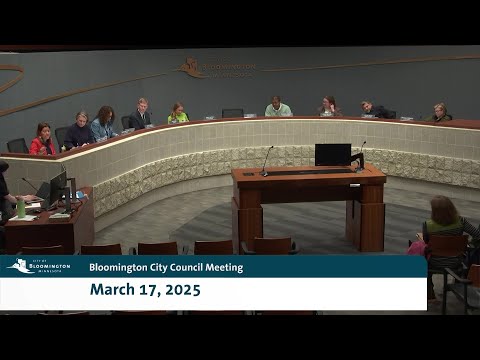
The Bloomington City Council on March 17 unanimously adopted the Sustainability Commission’s Feb. 2025–March 2026 work plan, approving a package the commission says will be largely carried out by volunteers with modest staff support.
Emma Strauss, a city staff presenter, told the council the commission has 11 members (including two youth seats and one council liaison) and that the plan focuses on improving home energy performance, alternative‑transportation outreach, education to change behavior, and a policy review of the commission’s charter and role. Chair Angie Bogash described commission priorities as “work with staff to enhance alternative transportation, identify areas to incentivize more sustainable behavior, [and] education and outreach for behavior change.”
Strauss said the commission’s model for the coming year is approximately “80% of the commission carrying out the work with 20% staff support.” Commissioners listed accomplishments from 2024 including community energy workshops, door‑knocking to raise participation in a home energy program, volunteer events (garlic mustard pull and buckthorn removal) and outreach at library energy fairs.
Council members praised the commission’s activity and asked questions about staffing and funding. Council member Rivas asked whether funds were already set aside to support ambitious transportation elements; Strauss replied the plan emphasizes participation in existing studies (for example, the American Boulevard Transit Study and Safe Routes to School outreach) rather than creating a new transportation program, and that the commission has a small annual marketing budget for outreach. Council member D’Alessandro and others thanked commissioners for the plan and asked how liaison opportunities and collaboration with other commissions would be integrated; Strauss said staff‑commission collaboration is stronger this year and that the commission has already convened a joint meeting with the Parks Commission on the Community Health and Wellness Center.
The council adopted the work plan by a 6‑0 vote. Mayor and council members asked staff to share council appreciation with the commission and the volunteer commissioners.