Get Full Government Meeting Transcripts, Videos, & Alerts Forever!
Get email alerts on the Waterfront Docks topic
No spam. Unsubscribe anytime.
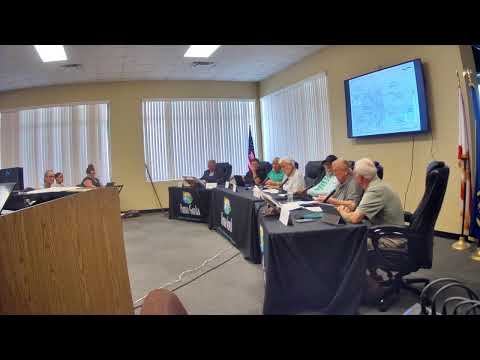
Punta Gorda City staff discuss boat-lift permit, vessel-size limits and navigation concerns
Summary
City staff and meeting participants reviewed a special-permit request for a private boat lift and dock, discussing vessel-size limits, the vessel-limitation line, dredging and neighbor access; staff said the proposed installation should not impede navigation and noted special permits are time-limited.
Punta Gorda City staff and meeting participants discussed a special-permit application for a private boat lift and dock, focusing on constraints tied to vessel length, the local vessel-limitation line and dredging clearance; no formal vote or decision was recorded.
City staff explained that boat length dictates how far a lift must be set back from the seawall. “2 thirds of the of the length of the boat is gonna be forward of the center line of the lift itself. So we have to keep the lift far enough back so that the boat, stays off the the seawall,” an unidentified staff member said, adding that riprap and blow ties would also affect placement.
The staff member told the meeting that, when the plan was scaled, a 24- to 25-foot vessel was the largest likely to fit. “24, maybe 25 feet. I think we when we scaled it out, we might be able to get the 25 foot boat in there,” the staff member said, and noted depth and dredging clearance are additional limiting factors.
Participants raised concerns about neighboring properties and mirror-image dock installations. The staff member responded that the adjacent south property “has plenty of room to get in and out” and that another neighbor’s conditions “is what it is for him,” indicating access would not change for those properties in this case. The staff member also said the proposed lift would not encroach on neighbors when placed according to the engineering plans.
On navigation, the staff member said the proposed installation would not interfere with navigation or channel traffic at the location under review: “it’s also not there’s no not gonna be any inference with navigation or traffic where it is.” The discussion returned to the purpose of the vessel-limitation line: staff described it as a measure “to keep vessels inside of a specific area” and questioned whether a separate size-based standard was necessary when the limitation line already exists to prevent navigation conflicts.
City documentation and prior permit history were cited. The staff member said the property owner and contractor “received a letter from the city with the results of this and the conditions” and confirmed that a previously issued special permit was valid only for two years: “But it’s only only good for 2 years, so it didn't really apply anyways.”
Speakers suggested the city may need clearer guidance on whether and how vessel size should factor into permit decisions. One meeting participant noted that while limiting vessel size can be appropriate where navigation would be impeded, “I don't believe that we have any criteria right now that says that we should do that or even that we could do that.” The staff member agreed that future guidance could be considered, but said size was not currently a formal criterion in evaluating special permits.
No formal motion or vote was recorded in the transcript excerpt. Staff described the permit conditions and the practical limits imposed by seawall clearance, riprap, depth and the vessel-limitation line; participants asked clarifying questions and urged consideration of whether local standards should explicitly address vessel size in future reviews.
The discussion closed with staff and participants noting the balance between facilitating harbor use and avoiding undue limitations; staff said the vessel-limitation line exists to prevent navigation interference and emphasized that, for this site, navigation was not expected to be impacted.