Get Full Government Meeting Transcripts, Videos, & Alerts Forever!
Get email alerts on the Zoning Data Centers topic
No spam. Unsubscribe anytime.
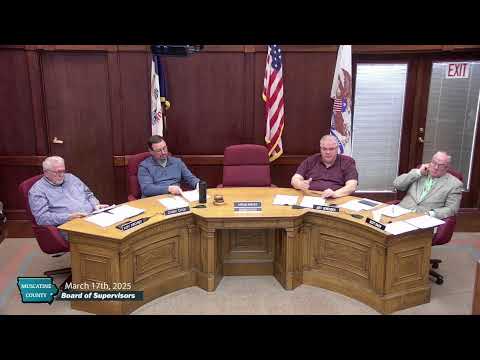
Muscatine supervisors reopen hearing on data centers; zoning commission recommends industrial districts and special-permit review
Summary
Board discussed definition and placement of data centers and cryptocurrency-mining buildings; zoning commission recommended special-permitted use in I-1 and I-2 districts; supervisors raised power, water and safety concerns and directed staff to schedule ordinance first reading.
The Muscatine County Board of Supervisors reopened and completed a public hearing March 17 on proposed zoning standards for data centers and cryptocurrency-mining installations, reviewing a new definition and recommended district placement.
County Development staff told the board the zoning commission recommends treating “cryptocurrency mining or production installations and data centers” as a physical facility that houses computing and networking equipment and supporting equipment such as batteries, backup generators and cooling systems. The commission recommended treating these facilities as special-permitted uses in both I-1 (light industrial) and I-2 (heavy industrial) districts rather than allowing them in agricultural or residential districts.
Supervisors and staff discussed hazards and community impacts raised by other counties: high electrical demand, potential large-scale battery storage (which raises firefighting and safety concerns), noise and heat generation, potential for difficult-to-combat fires and heavy water use for cooling in water-cooled installations. County staff said some data centers are air-cooled while others use water cooling; water use would trigger Iowa Department of Natural Resources permits if large daily withdrawals are required.
Board members asked how utilities are engaged; staff said utility agreements typically occur before land-use applications, similar to large factories, but urged that the county will review water, septic and electrical plans during special-use permitting.
The county reopened the public hearing for this agenda item and then closed it after hearing public concerns, including a speaker who urged the board to monitor modular nuclear or other emerging power sources and emergency-response costs that could attach to some facilities. The board instructed staff to prepare ordinance amendments for first reading in the coming weeks so the county’s rules will place data centers in industrial districts and allow case-by-case conditions during special-use review.
Ending: Supervisors voted to close the hearing by roll-call vote (all aye) and scheduled ordinance amendments to be presented for first reading; staff will continue to refine proposed definitions and permitting requirements.