Get Full Government Meeting Transcripts, Videos, & Alerts Forever!
Get email alerts on the Zoning Private Burial topic
No spam. Unsubscribe anytime.
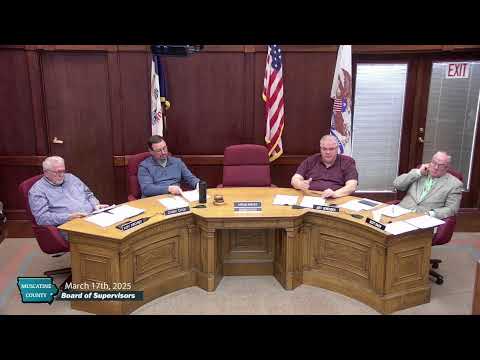
Muscatine County holds public hearing on private burial-site rules; no ordinance adopted
Summary
Supervisors heard zoning commission recommendations to establish private burial-site definitions, setbacks and permitting rules; board closed the hearing and will finalize ordinance language with staff before first reading.
Muscatine County supervisors held a public hearing March 17 on proposed zoning regulations for private burial sites after a landowner inquiry prompted staff review. The hearing covered definitions, setback requirements and a special-use permitting process but did not produce a final ordinance vote; staff will return with revised language for first reading.
The zoning commission recommended defining “private burial sites” (family-only burials without sale of plots), making them a special-permitted use in A-1 (agricultural) and R-1 (residential) districts, and requiring county review via a special-use permit from the Board of Adjustment. Recommended minimum standards included a 25-foot separation from waterways, a 10-foot setback from property lines and a prohibition on burials in floodplain areas. The commission also proposed that approved sites be recorded with a site plan so the county retains a permanent record.
County Development staff told the board they will check proposed language against the county’s existing Pioneer Cemetery ordinance to avoid conflicts and will work with zoning administrator Jim (last name not specified in the transcript) on final wording. Staff also reminded supervisors that Iowa law allows burials on private property but does not preclude local land-use regulations; state statutes governing handling, transport and interment of human remains would still apply.
Supervisors expressed concern about longer-term consequences if property containing private burials later changes ownership, and whether such sites could create future county responsibilities comparable to pioneer cemetery cases the county had discovered previously. Supervisors noted that making private burial sites a special-use permit would allow the county to evaluate applications case by case and create public records to reduce surprise discoveries during property transfers.
After public comment (no members of the public spoke), the board voted to close the public hearing. The board directed staff to finalize ordinance language in consultation with the zoning administrator and return the amendment for a formal first reading in the coming weeks.
Ending: Supervisors closed the hearing by roll call vote (all aye) and instructed staff to reconcile the draft private-burial provisions with the Pioneer Cemetery ordinance before placing the ordinance on the agenda for first reading.