Get Full Government Meeting Transcripts, Videos, & Alerts Forever!
Get email alerts on the Jail Reentry Waiver topic
No spam. Unsubscribe anytime.
Spokane County reports delays, billing and pharmacy issues with 11:15 jail reentry waiver
Summary
Spokane County staff reported operational and billing gaps in the federal/state 11:15 partial reentry waiver implementation and recommended moving the county from cohort 1 to cohort 2 to allow more time to resolve provider contracting, billing and medication‑dispensing issues.
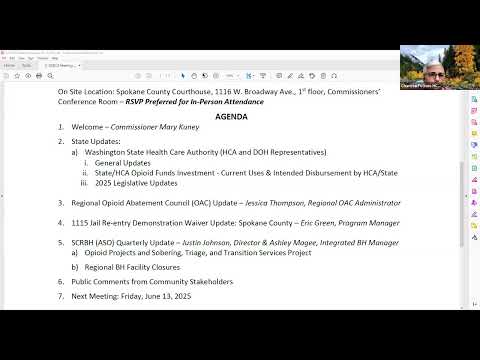
Spokane County staff told the regional meeting that implementation of the 11:15 partial reentry (jail‑to‑community) waiver has encountered multiple operational and billing hurdles and that county leaders expect a delayed rollout for the county jail.
Project manager Eric Green briefed attendees on the county’s implementation timeline, provider contracting and outstanding technical issues. Spokane County was an early cohort (cohort 1) for the waiver, Green said, but he described unclear state requirements early in the process, rolling deadlines, and slow release of billing guidance and covered services. He said Spokane’s jail medical provider initially declined to include many behavioral health commitments in its proposal; contract negotiations later produced a single vendor and the county moved into implementation in February while the provider develops an amended plan.
Why it matters: the waiver is intended to expand Medicaid‑funded clinical and reentry services—such as prerelease enrollment in Medicaid, MOUD continuity, and prerelease medications in hand—for people leaving local jails. Implementation problems could delay services that county officials consider critical to reducing overdose and recidivism among people exiting custody.
Specific implementation challenges described
- Policy and operations guidance was incomplete: Green said only an initial section of the HHS/ACA policy and operations guide had been released; other sections were still pending. - Billing mechanics and eligibility tooling were late: billing codes were not released until late February; a state third‑party administrator (TPA) clearinghouse expected to help with billing was reported to be in contract negotiation and not anticipated to be fully stood up until November. - Pharmacy point‑of‑sale issue: the waiver’s billing rules treat medications as point‑of‑sale purchases, but jail pharmacy operations typically purchase and dispense medication in bulk under controlled distribution, complicating how prerelease medications could be billed and provided “in hand.” - Enrollment and release timing: many people booked into local jails lack immediate documentation (income, identification) and release dates are often unknown, complicating the 90‑day prerelease enrollment window and logistics for short stays. - Sustainability and cost concerns: preliminary county calculations, using conservative assumptions and fee‑for‑service payment methods, projected poor sustainability; the county reported a recent roughly $5,000,000 increase in the medical provider contract even before incorporating full waiver services.
Juvenile facility: different trajectory
Green said the county’s juvenile detention program met its Milestone 2 requirements and has the local provider infrastructure to proceed; the juvenile facility’s principal remaining barrier is lack of an electronic health record (EHR) until the state’s AC Max system is available.
Local and state reaction
Jason (state HCA) and other state participants encouraged Spokane’s move to cohort 2 and urged caution about a July 1 cohort start. Jason said July 1 was an aggressive timeline to begin with and that shifting to a later cohort can reduce risk to counties and to the state while the TPA, billing rules and policy guidance are finalized.
Green said the county is continuing implementation planning with its medical provider and will request an official cohort change if needed. No formal vote was taken at the meeting; county staff said they would proceed with more detailed discussions with the state and provider to finalize a new target go‑live date.
Ending
Spokane County officials said they remain committed to implementing reentry services but asked for more definitive guidance and earlier availability of billing and pharmacy solutions before a full jail‑level rollout.