Get Full Government Meeting Transcripts, Videos, & Alerts Forever!
Get email alerts on the Opioid Settlements topic
No spam. Unsubscribe anytime.
State details opioid-settlement spending; Spokane region among recipients
Summary
Health Care Authority officials briefed Spokane County leaders on opioid‑settlement funds, the state distribution framework and programs using those dollars in Spokane, including perinatal treatment, naloxone distribution and jail-based medication access.
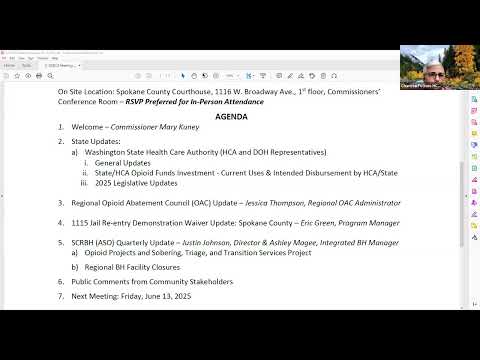
At a Spokane County regional meeting, officials from the Washington State Health Care Authority on March (date not specified) outlined how opioid‑settlement dollars are being distributed and used in Spokane County and the six‑county region.
The Health Care Authority (HCA) presentation described a multi‑year flow of settlements and bankruptcy payments to state and local governments, explained the state’s role in recommending uses to the governor and legislature, and listed current Spokane programs funded in part by settlement money.
The overview noted that tribes receive 20% of settlement deposits into a separate tribal account created by a recent session bill (referred to in the briefing as “bill 6099”). HCA staff said local governments receive direct payments and many regions have formed opioid abatement councils to decide local spending priorities. “There’s a lot of interest in how the opioid‑settlement dollars are being used,” HCA’s state opioid administrator, Chris Sherrer, told meeting participants.
Why it matters: opioid‑settlement funds are a continuing, multi‑year revenue stream that local officials said they are using to expand treatment, harm‑reduction and reentry services. Spokane County and its regional partners described a mix of local projects and statewide programs that affect access to medications for opioid use disorder (MOUD), naloxone distribution and short‑term housing supports.
Key Spokane uses and statewide programs described
- Maddie’s Place: a perinatal substance‑use disorder treatment pilot in Spokane funded at a little more than $5,000,000, according to HCA’s slide deck. - Short‑term housing vouchers: four local organizations in Spokane are distributing vouchers supported by HCA funds. - Clubhouse/recovery‑support: two Spokane organizations are receiving operational support for peer‑run recovery services under a proviso funded through HCA. - Mobile methadone: HCA noted support through Acadia Healthcare for establishment of a mobile methadone unit serving the community. - Recovery residence grants: operational grants for recovery housing are active in Spokane. - Naloxone distribution: HCA said it supports naloxone supply to several Spokane area organizations and a statewide mail‑order naloxone system that can deliver to Spokane addresses. - MOUD in jails: HCA reported that roughly 23 jails statewide have signed up for a Medicaid‑funded MOUD program supported through settlement dollars; HCA asked local leaders to consider how Spokane’s jails participate. - Long‑acting injectable buprenorphine: HCA described a program allowing qualifying small clinics to request supplies of long‑acting injectable buprenorphine if they meet storage and regulatory requirements.
HCA said some settlement funds will come as long, scheduled payments, while others depend on ongoing litigation and bankruptcy proceedings; the agency is continuing to receive and program money over multiple years. Chris Sherrer said state executive sponsors and the legislature share decision authority because the legislature controls appropriations.
Local accountability and reporting
HCA staff said the agency is working to make information publicly available and to report to the legislature and governor’s office on how settlement funds are spent. HCA noted it publishes a state opioid and overdose response plan and convenes work groups to advise on priorities and measurement. Commissioner Rosenkrantz asked for outcome metrics beyond dollars spent; HCA staff said the agency tracks contracts and overdose events and that more work is needed to incorporate patient‑reported quality‑of‑life measures and recidivism analyses tied specifically to abatement spending.
Regional abatement council
Jessica Thompson, the Spokane Regional BHASO supervisor and regional Opioid Abatement Council administrator, briefed the group on the regional council’s work. The Spokane regional council includes Adams, Ferry, Lincoln, Pend Oreille, Stevens and Spokane counties and the cities of Cheney, Liberty Lake, Spokane and Spokane Valley. Thompson said the council meets every other month and focuses on naloxone replenishment, school‑based prevention curriculum, canine interdiction initiatives, high‑utilizer programs and co‑response teams. “Things are going really well,” she said, and the council is compiling 2024 annual expenditure reports for public posting.
Next steps and resources
HCA told the group it is finalizing additional budget analyses and will share the slides and hyperlinks used in the presentation; Chris Sherrer said he would send the slide deck to the local contact after the meeting. HCA also invited attendees to a state learning community meeting on long‑acting injectable buprenorphine and other topics (meeting registration link was posted in the meeting chat).
Ending
County staff and HCA officials said they will continue to track settlement receipts, report spending publicly, and refine outcome measures. Local officials asked HCA to provide more comparative and outcome data—for example recidivism, reduced overdoses and measures of quality of life—to help counties evaluate which spending choices are changing outcomes.