Get Full Government Meeting Transcripts, Videos, & Alerts Forever!
Get email alerts on the Consumer Protection Defective Tenancy topic
No spam. Unsubscribe anytime.
Committee advances bill to remove defective-tenancy exemption from consumer-protection law
Summary
The Public Safety Committee on March 17 advanced Bill 6-25 to remove the county consumer-protection exemption for defective tenancy, allowing expanded enforcement tools against chronically noncompliant landlords.
The Public Safety Committee on March 17 advanced Bill 6-25, which removes a long-standing defective‑tenancy exemption from the county’s consumer-protection chapter and clarifies enforcement avenues including access to circuit court for more serious or aggregated claims.
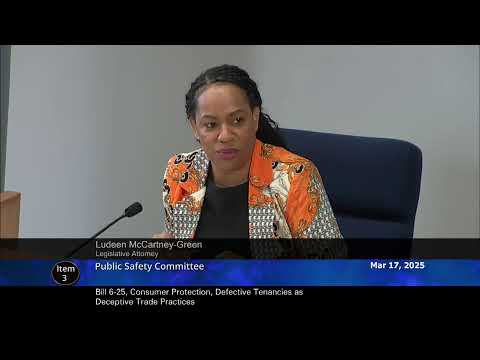
Councilmember Mink, a bill sponsor, said the change is aimed at holding a small subset of "very egregious law breaking landlords" accountable for conduct that already violates county codes and public-safety standards. "Most landlords are not doing this," she said, "but there are some who continue year after year after year." Staff attorney McCartney Green explained the bill’s technical changes: it expands the definition of "person" to include landlords, explicitly treats rental housing as a consumer good or service under chapter 29 and removes the statutory exemption for defective tenancy dating to 1973. She also said the bill would allow county attorneys to file circuit‑court actions under chapter 11 and chapter 29, noting circuit court’s higher money threshold and broader discovery tools.
Scott Bruton, Director of the Department of Housing and Community Affairs (DHCA), and Department representatives emphasized the intent is not to duplicate existing code‑inspection work but to create a collaborative enforcement pathway. DHCA described its existing housing code inspection capacity and noted practical challenges with district court fines, including long delays and reduced penalties when owners remediate shortly before hearings. DHCA said it and the Office of Consumer Protection (OCP) are discussing standard operating procedures so OCP can triage complaints and refer investigations without duplicating DHCA’s enforcement staff.
Staff provided a late fiscal-impact statement showing estimated increased expenditures for FY26 of approximately $248,000 and $388,000 for FY27 to support investigative staffing in OCP; revenues were listed as unknown and dependent on enforcement outcomes. The committee asked for an amended fiscal-impact statement before full council and requested that OCP and DHCA develop an MOU and operational procedures to minimize duplication. The committee moved and seconded approval and recorded the measure as advancing on a 3-0 voice vote.