Get Full Government Meeting Transcripts, Videos, & Alerts Forever!
Get email alerts on the Water Infrastructure topic
No spam. Unsubscribe anytime.
WSSC outlines FY26 capital priorities; council asks for jurisdictional revenue breakdown
Summary
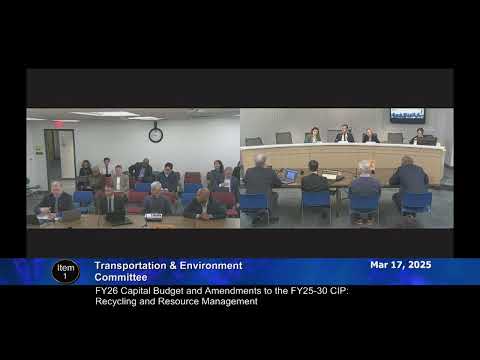
WSSC staff reviewed FY26 capital priorities before the Montgomery County Transportation and Environment Committee on March 17 and agreed to provide a jurisdictional revenue breakdown and updates on smart-meter planning and federal-grant stability.
Representatives of the Washington Suburban Sanitary Commission (WSSC) briefed the Transportation and Environment Committee on March 17 about FY26 capital priorities, and committee members asked for more detailed cross-jurisdiction financial information and federal-grant impact assessments.
WSSC staff described multiple CIP categories: water distribution (mains and hydrants), wastewater collection (small and large sewers), wastewater pump-station upgrades, water treatment and storage (including elevated storage-tank rehabilitation), upgrades at water-resource recovery facilities (Parkway, Piscataway, Western Branch), and interjurisdictional investments at Blue Plains. Staff also highlighted innovation/priority programs—lead abatement initiatives, PFAS/forever-chemical work, smart-meter planning, and a bioenergy program at Piscataway.
The presentation included project-scale budget references for FY26 cycles: small sewer replacements (about $51.5 million), large sewer mains (about $42 million), elevated storage/filtration plant upgrades (about $23 million for tank rehabilitation and related filtration work), and water-resource recovery facility projects (about $31 million). WSSC staff said those investments are aimed at replacing aging infrastructure where the system has seen high break and basement-backup densities and to support growth across the two-county service area.
A WSSC representative described community impacts: “the impact to the community is replacing that old infrastructure, and promoting growth,” and noted rehabilitation and energy-efficiency work in plants and tanks is intended to reduce operating costs, chemical use and energy consumption over time.
Councilmembers pressed WSSC about how revenue collected is allocated between Montgomery County and Prince George’s County. WSSC staff said the system is operated as a unified water and sewer district and that most fees are pooled into a common system; they committed to provide a county-level breakdown on revenue collection and disbursements to inform the Council’s ongoing rate discussions. Committee members also asked WSSC to flag whether recent federal budget uncertainty could affect capital planning; WSSC staff said current federal grants on the books remain intact but that the agency is monitoring developments and would report any change in available grant funding.
The committee expressed general support for WSSC’s CIP posture and asked for follow-up deliverables: a jurisdictional revenue/disbursement breakdown, an update on the smart-meter planning timeline and potential bill impacts, and notification if federal grant reductions would affect Blue Plains or other shared services.