Get Full Government Meeting Transcripts, Videos, & Alerts Forever!
Get email alerts on the Youth Recreation Center topic
No spam. Unsubscribe anytime.
Pontiac moves forward on $37 million youth recreation center design, authorizes bids and construction manager review
Summary
City council voted to fund further design work, amend the architect contract and hire a construction manager-at-risk to develop a guaranteed maximum price while hearing a financial plan that relies on cash balance, ARPA and up to $15 million in bonds.
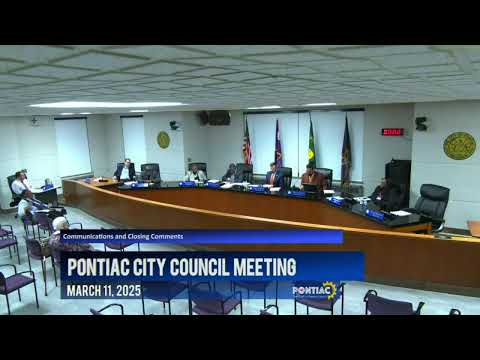
Pontiac City Council on March 11 approved contract changes and a construction-manager step that advance a proposed $37 million youth recreation center toward a final price.
The council’s action amended the city’s architectural contract for the project and authorized the mayor or deputy mayor to execute an AIA A133-2019 agreement with Clark White (joint venture) to provide construction-manager-at-risk (CMAR) services, allowing the city to move from design to hard bids and a guaranteed maximum price.
Deputy Mayor Stevens told the council the project was designed to a $37 million target after months of community outreach. “We started with a base number of $25 million,” Stevens said in the presentation. “The center that we designed, not including the pool, was a $37 million building.”
Nut graf: The council voted to keep the project on schedule while requiring the next step — a CMAR-led bid process — to produce a firm construction cost. That process will let the city decide whether to proceed at the guaranteed maximum price or scale back, supporters said.
Council members pressed for fiscal details during a lengthy discussion. The administration presented a proposed “capital stack” that would pay for construction with a mix of general-fund cash, federal ARPA dollars and tax-exempt borrowing: roughly $18.2 million from the general fund, $6.8 million in ARPA earmarked for youth recreation, and $15 million in bonds. The city's annual debt-service estimate for a $15 million bond was about $1.1 million per year at current interest-rate assumptions, the city’s financial advisors told council.
Deputy Mayor Stevens said the city currently collects roughly $1.3 million a year from a voter-approved recreation millage and has intentionally underspent that fund to save for operations. The administration estimated preliminary annual operating costs including utilities at about $200,000 and a baseline cleaning estimate near $30,000; council members noted these numbers could rise and asked for more detailed operating projections.
Councilman Goodman, who moved the architect contract amendment, said he had canvassed residents and heard widespread support for a new center. “People want this to be done,” Goodman said. Councilwoman James, who moved to amend the architect contract earlier in the process, underscored the risk of defaulting on previously made council decisions: “We have to follow through with the decisions that have been made.”
The two final procedural votes passed on unanimous recorded tallies: a resolution to amend the architect contract (moved by Councilman Goodman, seconded by Councilwoman James) passed 6-0, and the resolution authorizing the mayor or deputy mayor to execute the AIA A133-2019 agreement for Clark White (moved by Councilwoman Jones, seconded by Councilwoman James) also passed 6-0. Both measures allow the city to proceed with the preconstruction and bidding work but do not obligate the city to the final construction cost until the guaranteed maximum price (GMP) is submitted for council approval.
Supporters said borrowing now while tax-exempt municipal bonds remain available gives the city a lower-cost financing option; staff said they intend to seek bond authorization before any federal changes eliminate tax-exempt municipal debt advantages. The city’s financial memo also modeled a pessimistic scenario in which revenues over time slow; even under a conservative projection the city forecasted years before expenses would exceed revenues, assuming no major unanticipated financial shocks.
Opponents and skeptical members urged caution. Several council members asked the administration to continue pursuing philanthropic contributions and to return with a redlined ordinance and more precise operating estimates. Council members also asked for regular updates on how potential county employment growth and new development might affect the city’s revenue stream and the project’s affordability.
Ending: The city’s next procedural step is the CMAR’s preconstruction work and the production of final construction documents and bid solicitations; staff said the GMP could be presented in early August. Council scheduled follow-up oversight in upcoming meetings as the CMAR compiles subcontractor bids and final cost data.