Get Full Government Meeting Transcripts, Videos, & Alerts Forever!
Get email alerts on the Education topic
No spam. Unsubscribe anytime.
Catoosa County superintendent highlights rising health-care costs, facility projects and student achievement at teacher assembly
Summary
Superintendent Chance Nix addressed teachers at a district appreciation assembly, outlining student achievement gains, ongoing facility projects funded by E‑SPLOST, a district water‑testing effort and the budget pressure from sharply higher employee health premiums.
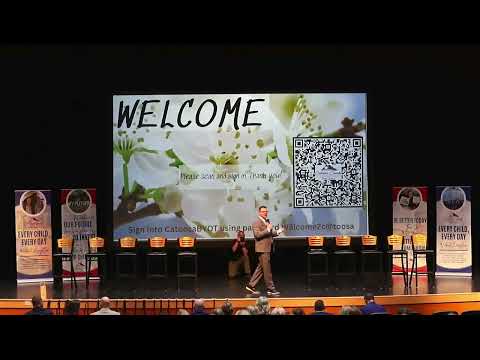
Superintendent Chance Nix addressed several hundred Catoosa County Public Schools employees at a teacher appreciation assembly, saying the district would protect teachers amid state budget uncertainty and describing how rising employee health‑insurance costs, facility work funded by E‑SPLOST and short‑term borrowing affect the district’s finances.
Nix opened by praising classroom staff as “the closest to the kids,” and repeatedly used the district motto, “Every child, every day, without exception,” to frame updates on student achievement, facilities and operations.
NUT GRAF: The meeting combined celebratory recognitions — district graduation and school award results, a new LEAP Academy and CCRPI honors — with practical updates about operations: a nearly completed lead‑testing program for water fixtures, changes to middle school planning time, a short‑term tax anticipation borrowing in fall 2024, and a doubling of state‑mandated employee health‑insurance rates that district leaders say is creating immediate budget pressure.
District achievements and programs: Nix and staff listed multiple recent accomplishments. For 2024 the district’s four‑year graduation rate was reported as 90.81%, above the cited state average of 85.4%. Four secondary schools were named math leader schools by the Georgia Department of Education, three high schools gained AP honor status with a reported 25% or greater increase in AP participation, and Wood Station Elementary earned Title I Reward School recognition. The district also reported expanded dual‑enrollment participation (more than 400 high school students earning college credit through partnerships with Georgia Northwestern Technical College and Dalton State College) and the launch of the LEAP Academy, a language and credit recovery program for newcomers and developing English learners.
Facility projects and E‑SPLOST: Superintendent Nix and other speakers described completed and planned facility work funded in part by E‑SPLOST (the Education Special Purpose Local Option Sales Tax). Phase 1 of the Boynton Elementary expansion — about 20,000 square feet with 16 new classrooms, a playground, an expanded car rider loop, a 50‑space parking lot and a retention pond — was reported as complete and open. Planning for a Phase 2 addition was described that would add roughly another 20,000 square feet, a new media center, refurbished gym and cafeteria, a bus loop and more classrooms. Staff listed other recent projects across the district (roof and maintenance work, signage updates, new athletics facilities and planned audio improvements for a high school theater).
Operations and safety updates: District staff said they had tested fixtures used for student consumption as part of a voluntary Clean Waters of Georgia program and had mitigated any sites that returned elevated results; one kitchen sink at Wellington Elementary remained undergoing a second round of mitigation and retesting at the time of the assembly. The district also said nurses recorded more than 42,000 visits to school nurse offices during the first semester, and that transportation serves roughly 6,000 students daily with a fleet of about 150 buses and roughly 70% staffing.
Planning time and schedules: The district explained a change that added an early‑release planning window for middle schools so middle‑school non‑instructional planning minutes would be closer to the elementary and high‑school bands. Staff presented the change as data‑driven: middle school weekly non‑instructional minutes were increased to bring that grade band in line with others.
Budget pressures and borrowing: Austin Carter, the district’s director of finance, summarized the immediate fiscal challenge: state‑mandated employee health‑insurance premiums that the district must withhold and remit have risen substantially. Carter said the state premium amount cited in earlier years was about $945 per month per covered employee and would increase to $1,885 per month starting in July (as described at the assembly), creating a multi‑million‑dollar annual increase the district must cover. District leaders said the classified workforce (paid largely from local funds and grants) will especially feel the local budget pressure. To manage cash‑flow timing, staff explained the district used an $8 million tax‑anticipation note in fall 2024 — a short‑term loan commonly used by Georgia school districts to bridge the gap between operating expenses and the timing of local tax receipts.
Transparency and audits: The district reminded staff that it undergoes regular financial review by the Georgia Department of Education, independent audits and the Georgia Department of Audits and Accounts; it also publishes audited reports and monthly financials on the district website and provides stakeholder briefings through a “lighthouse” program.
What leaders asked of staff: Nix and the leadership team repeatedly asked teachers to continue using their voices in the legislative session and assured staff the district leadership would “worry” about budget and policy pressures so teachers could focus on instruction. The assembly closed with recognition of directors and school board members and additional encouragement for teacher well‑being and retention.
ENDING: District leaders said they will continue to share details with staff and the public as pending items (the Wellington Elementary retest, E‑SPLOST public outreach and forthcoming strategic‑plan and E‑SPLOST surveys) advance. No formal board votes took place during the assembly; updates and staff answers reflected the superintendent’s and directors’ reports to employees.